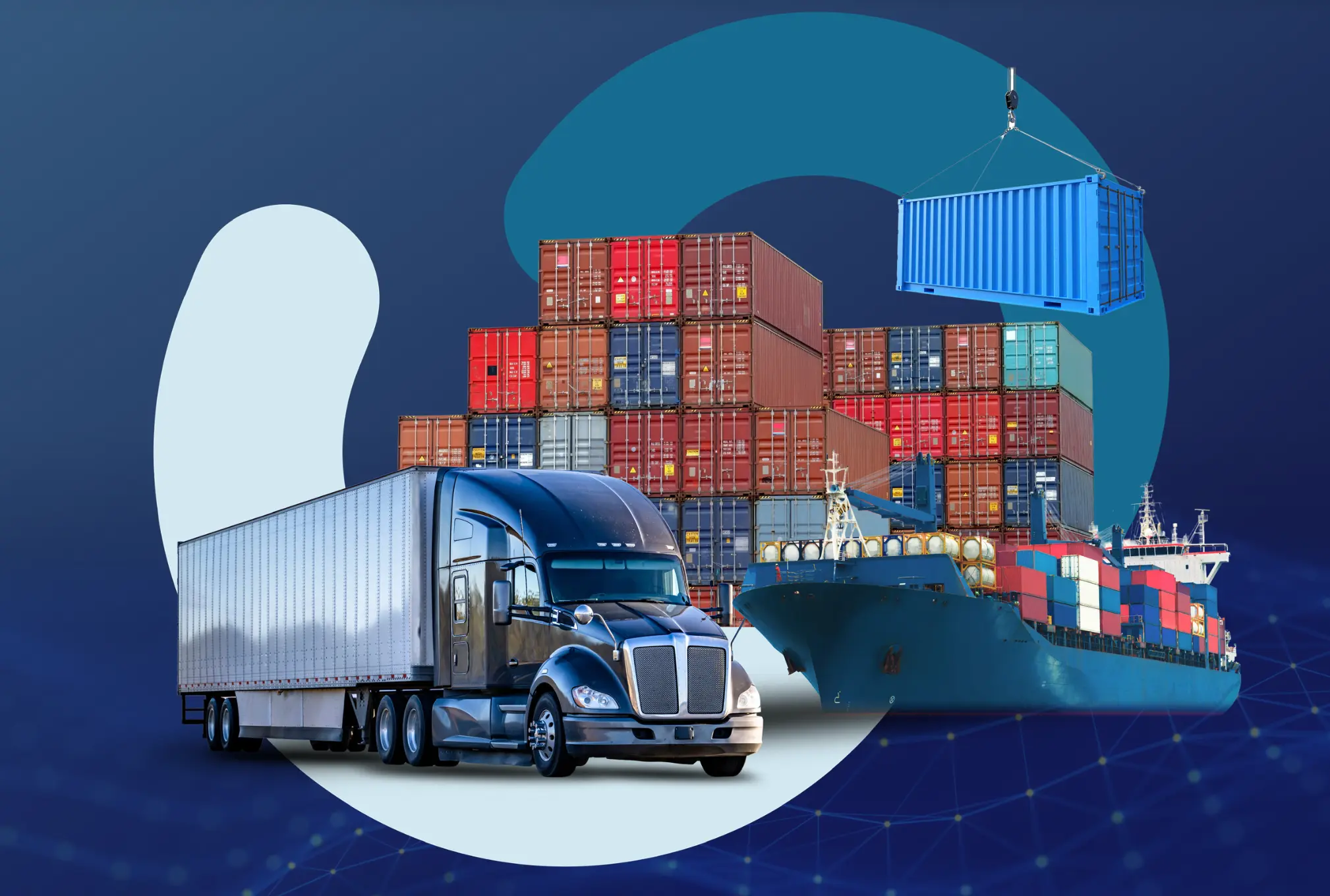
Market Compression describes a period in which multiple structural forces—including capacity, technology, consolidation, labor, regulation, capital investment, and customer expectations—change simultaneously, compressing competitive positions toward a new equilibrium. Unlike ordinary freight cycles, Market Compression permanently reshapes how organizations compete.
Executive Summary
When PartnerLinQ first introduced the concept of Market Compression in transportation markets during late 2023, the industry was reacting to an unprecedented series of disruptions. Yellow Corporation had exited the market, truckload rates were falling, carriers were restructuring, and both shippers and logistics providers were attempting to understand whether they were witnessing a temporary freight recession or something more structural. Three years later, enough time has passed to answer that question.
What Happened to Transportation Between 2023 and 2026?
Between 2023 and 2026, transportation markets shifted from disruption to realignment. Yellow's bankruptcy redistributed freight across the LTL industry while market leaders in transportation invested in network optimization, automation, digital infrastructure, and integrated logistics. The industry's competitive focus moved beyond capacity and toward operational execution, visibility, and coordinated business networks.
an entire industry, sometimes permanently.
What Is Transportation Market Compression?
Complex market dynamics are often easier to understand through simple physical systems. Market Compression behaves much like what happens when a child meets Jell-O for the first time. The child interacts with the Jell-O and gives it a good squeeze, at which point Jell-O escapes the child’s grasp.
The squeeze of Market Compression causes competitive positions across an industry to shift position, often unpredictably, often permanently. Market Compression reshape how transportation companies compete within the market. The new equilibrium, unlike a market correction or ordinary freight cycle is an entirely new competitive environment, a shift, where previously competitive positions undergo a dramatic change impacting an entire industry, sometimes permanently.
The Market Compression Framework
Capacity
Technology
Labor
Capital
Regulation
Customer Demand
Consolidation
Competition
↓
Competitive Compression
↓
Industry Realignment
↓
Execution Capability
↓
Competitive Advantage
The Jell-O effect
While the interaction between a child and Jell-O may be predictable, the outcome rarely is. As the child squeezes tighter, the Jell-O eventually escapes the forces attempting to contain it, squirting free in an entirely unexpected direction. The moment the applied force exceeds the friction holding it in place, the system reaches its own form of "escape velocity."
Market Compression follows a similar pattern. Under periods of Market Compression structural forces build across an industry mounting competitive pressures that eventually overwhelm the forces that once kept markets stable. When that threshold is crossed, markets eventually reach a tipping point where competitive positions begin shifting rapidly and often unpredictably. The direction of change is rarely linear, but the consequences are lasting.
It did however influence how they would evolve.
From Yellow's Collapse to Industry Realignment
Yellow's bankruptcy did not compress the market because one carrier disappeared. The bankruptcy event signaled a redistribution of the competitive advantage Yellow had amassed over decades. The transportation industry did not replace Yellow it reorganized around its absence. The result was far more significant than a redistribution of freight volume.
Transportation networks are not a static collections of trucks and terminals. They are living ecosystems built upon years of operational knowledge, customer trust, geography, density, and partner relationships. Removing a carrier the size of Yellow did not leave an empty space waiting to be filled. It forced thousands of independent decisions by shippers, carriers, brokers, third-party logistics providers, and technology partners. Each responding to new opportunities and new risks.
Carriers expanded terminal footprints or selectively pursued profitable freight rather than volumes. Regional carriers entered markets and relationships previously dominated by national providers. Large shippers diversified carrier portfolios to reduce their dependence on any single transportation partner. Shippers that had once relied on long-standing routing guides suddenly found themselves reevaluating carrier strategies, network, and their own resilience.
Network density is rarely built overnight. Yellow's assets allowed portions of the market to compress years of organic growth into a matter of months. Terminals located in strategic freight corridors became highly sought-after infrastructure, allowing acquiring carriers to accelerate expansion that might otherwise have required years of development and investment. In transportation.
Drivers, dock workers, and operations personnel were dispersed throughout the industry, bringing institutional knowledge and local market expertise into competing organizations. A national workforce once Yellow's workforce and strategic advantage, strengthened former Yellow's competitors almost as much as its freight volumes did.
Many expected Yellow's exit to create a prolonged capacity shortage and sustained rate inflation within the LTL market. Instead, the market found a new equilibrium. Capacity was redistributed rather than permanently eliminated, while carriers became increasingly disciplined about the freight they accepted and the returns they expected. The conversation shifted away from maximizing shipment counts toward optimizing network quality, yield, and operating performance.
Industry Realignment Timeline
Yellow Bankruptcy
↓
Freight Redistribution
↓
Terminal Acquisitions
↓
Carrier Diversification
↓
Technology Investment
↓
2026
New Competitive Equilibrium
How Did Yellow Change the Transportation Industry?
Yellow's bankruptcy permanently redistributed freight, terminals, drivers, customer relationships, and pricing influence throughout the North American LTL market. Rather than replacing Yellow, the transportation industry reorganized around its absence, accelerating carrier expansion, network optimization, and long-term strategic realignment.
The Industry Finds a New Equilibrium
Transportation markets responded through thousands of independent decisions made by carriers, brokers, logistics providers, and shippers. Freight moved. Drivers moved. Terminals changed hands. Freight volumes migrated across established networks, terminal capacity changed hands, customers diversified carrier relationships, and organizations selectively pursued business aligned with their operating models rather than attempting to recreate Yellow's scale.
Entire freight networks adjusted with remarkable speed. Embedded business relationships that had remained stable for decades suddenly shifted as shippers diversified carrier portfolios, terminals changed ownership, and freight moved through newly configured networks. Rather than descending into prolonged disruption, the industry adapted, establishing a new competitive equilibrium built on operational discipline, capability, and resilience.
The LTL market recovered by redistributing existing capacity rather than replacing it. Competing carriers absorbed freight, acquired terminals, hired experienced personnel, optimized existing networks, and focused on higher-quality freight. The result was a more disciplined and operationally efficient market avoiding prolonged capacity shortages.
Why does simplification matter? Simplification is one of the defining characteristics of Market Compression and FedEx is a prime example of a response to Market. Rather than expanding capacity in response to changing market conditions, some companies have spent the past several years simplifying some of the world's most complex transportation networks.
FedEx: Simplifying the Enterprise
Historically, FedEx Express and FedEx Ground operated as highly successful but largely independent networks. Separate pickup operations, overlapping routes, independent facilities, and distinct operating models reflected decades of organizational growth. As freight markets evolved, maintaining parallel networks increasingly introduced operational complexity that offered diminishing strategic value.
Rather than asking customers to adapt to multiple operating companies as it had for decades, FedEx is redesigning its operations to present a more integrated transportation experience built around a common digital and operational foundation.
While transformation is still underway, FedEx’s Network 2.0 addresses complexity by consolidating pickup and delivery activities, optimizing routes, reducing handoffs between facilities, and standardizing technology across the enterprise.
The updated FedEx operating model and network offers an important insight into how transportation leaders are redefining competitive advantage. Viewed through the lens of Market Compression, FedEx illustrates a broader industry transition. Competitive differentiation is shifting away from managing multiple independent operating organizations toward orchestrating a single, coordinated execution environment.
UPS: Refining the Network
UPS's response to Market Compression reflects a different, but equally significant, strategic evolution. Over the past several years, UPS invested in network optimization, automation, healthcare logistics, digital technologies, and customer segmentation. Investments that reflect a deliberate strategy to improve operational performance.
Rather than restructuring the operating model, the company focused on refining how it creates value. The objective has been less about expanding transportation capacity and more about improving the quality, resilience, and profitability of execution. Unlike previous periods where success was measured in volumes, UPS emphasized the quality of freight flowing through its network
What was the result? An environment, where profitability increases by moving the right freight through the network rather than moving more freight. A shift that illustrates another important characteristic of Market Compression - As transportation markets mature, competitive advantage increasingly depends upon operational discipline rather than network expansion alone.
Viewed alongside broader industry developments, UPS demonstrates that transportation leadership can be re- defined by the ability to optimize operations, improve execution quality, and adapt - as customer requirements and market conditions evolve.
Why Are Transportation Companies Simplifying Their Networks?
Transportation providers increasingly simplify networks because operational complexity slows execution, increases costs, fragments information, and reduces organizational agility. Integrated operations enable better visibility, faster decisions, improved customer experiences, and more consistent execution across increasingly interconnected supply chains.
Ryder: Something of a Quiet Transformation
Ryder is evidence that Market Compression isn't only compressing transportation companies, it's compressing business models. Transportation is gradually becoming less about assets and more about how effectively information moves between partners.
Modern logistics providers increasingly compete on their ability to orchestrate complex, multi-enterprise operations rather than simply move freight. As transportation networks become more digitally connected, competitive advantage is shifting toward organizations capable of integrating customers, carriers, warehouses, suppliers, and enterprise applications into a coordinated execution environment.
Ryder's transformation reflects a broader shift occurring across the transportation industry. Long recognized for leasing and dedicated transportation, Ryder has steadily expanded through acquisitions such as Cardinal and Baton into warehouse operations, e-commerce fulfillment, supply chain engineering, automation, and digital logistics.
The company's investment strategy suggests that transportation providers increasingly compete by orchestrating complex supply chain operations rather than simply moving freight. While physical assets remain essential, they are no longer sufficient to differentiate the service model.
Transportation companies are increasingly becoming technology-enabled logistics providers and the Ryder transition reflects one of the more important observations emerging from three years of Market Compression.
Werner: A Transformation Primer
Historically recognized as one of North America's premier truckload carriers, Werner has spent the past several years expanding beyond transportation capacity. Dedicated services, brokerage, final-mile delivery, cross-border operations, transportation management, and digital visibility have become increasingly integrated into the operating model. The objective is no longer simply to move freight efficiently; it is to provide customers with a better, more connected, and resilient execution environment.
A reflection of a broader industry reality, as transportation markets mature, customers increasingly evaluate providers based not only on fleet size or network reach, but also on their ability to exchange information, to collaborate across systemic boundaries, and respond quickly when conditions change.
Transportation providers are increasingly discovering that trucks create movement, but information creates coordination. Every shipment depends on orders, appointments, inventory positions, warehouse activity, transportation planning, customer commitments, financial transactions, and continuous communication among multiple organizations.
U.S. Transportation Market at a Glance (2026)
| Metric | Estimate | Why It Matters |
| Annual U.S. Freight Spend (Trucking) | ~$906 Billion | Trucking remains the dominant freight mode and represents one of the largest sectors of the U.S. economy. (American Trucking Association) |
| Authorized Interstate Motor Carriers | ~580,000 | Illustrates the highly fragmented nature of the North American transportation market. (American Trucking Association) |
| North American LTL Market | ~$70–80 Billion annually | LTL remains one of the most strategically important freight segments following Yellow's market exit. (Reuters) |
| Annual U.S. Parcel Volume | ~23–24 Billion parcels | Parcel volumes continue growing as e-commerce reshapes fulfillment and transportation networks. (Mordor Intelligence) |
| U.S. Retail Sales from E-Commerce | ~16–17% | Digital commerce continues driving investment in transportation, fulfillment, automation, and last-mile logistics. |
| Professional Truck Drivers (CDL Drivers) | ~3.5 Million | Driver availability remains one of the industry's defining structural constraints. (American Trucking Association) |
A New Equilibrium: Recounted
The redistribution extended well beyond the largest LTL carriers. Instead of changing their identities. Truckload providers such as Bison Transport, Mesilla Valley Transportation (MVT), Paper Transport, Ruan, Speedy Transport, and Vista Trans refined their operating models. Collectively, these organizations demonstrated that Market Compression did not reward scale alone. Seeking disciplined growth rather than pursuing broad expansion. While these companies were affected by changing freight flows and customer sourcing decisions, they responded by strengthening their own competitive advantages. Market Compression rewarded specialization, operational discipline, and the ability to create value beyond transportation capacity.
A similar pattern emerged in the logistics sector where third-party providers including Andrews Logistics, Bulkmatic Transport, Logistics Plus, Magnum Logistics, Redstone Logistics, and Syfan Logistics with shifts in their own carrier networks, recognized new opportunities to engage in increasingly complex transportation ecosystems.
Equilibrium: Rebalance Rewarded
Market Compression rewarded organizations that understood where they created value—where they would be able to capitalize. Resisting temptation and rather than simply replacing capacity, these forward-thinking operators expanded the value they delivered through partner enablement and diversification, digital visibility, and enhanced coordination.
The result – they gained a competitive advantage, one that increasingly belongs to organizations capable of connecting fragmented transportation networks into coordinated execution. The industry reorganized, the freight moved—but the information, the visibility, and the execution became the capabilities that differentiated the winners from the pack.
Why Is Technology Becoming Transportation's Competitive Advantage?
Transportation companies increasingly compete through information, beyond transportation assets. Visibility, integration, automation, artificial intelligence, and coordinated business execution enable organizations to respond faster, collaborate more effectively, and improve operational resilience across complex business networks.
| Yesterday (2023) | Today (2026) |
|---|---|
| Transportation | Business Networks |
| Assets | Information |
| Fleet | Visibility |
| Capacity | Execution |
| Routes | Coordination |
| Scale | Intelligence |
Technology becomes Transportation’s Ally
Whether expanding logistics services, simplifying enterprise operations, optimizing delivery networks, or strengthening customer relationships, technology became the common enabler behind nearly every significant strategic decision. Now nearly three years after the industry's restructuring, one observation has become difficult to ignore. Transportation companies did not respond to Market Compression by pursuing identical business strategies, yet they consistently invested in remarkably similar capabilities.
A notable shift in the industry's competitive priorities.
Historically, transportation technology focused in on improving individual business function. Transportation Management Systems (TMS) optimized routing. Warehouse Management Systems (WMS) improved fulfillment. Enterprise Resource Planning (ERP) systems managed financial and operational processes. Electronic Data Interchange (EDI) accelerated document exchange. Each technology solved an important problem largely within the boundaries of a single organization or business function.
Freight moves through increasingly interconnected business ecosystems where shippers, carriers, brokers, warehouses, manufacturers, retailers, suppliers, customs agencies, ports, and logistics providers must continuously exchange information and coordinate decisions.
Competitive advantage depends on how effectively organizations work together and not on how efficiently individual systems operate. Technology therefore, beyond operational support, becomes the connective infrastructure that enables coordinated execution across multiple systems.
Does Integration reduce friction?
Integration across multiple systems reduces friction between business partners. Business networks extend capabilities beyond organizational boundaries. Automation accelerates routine decision-making. Artificial intelligence assists by identifying patterns, recommending actions, and improving operational responsiveness. Visibility across multiple systems allows organizations to anticipate disruption rather than react to it.
Does Technology enable simplification?
Yes, when viewed through the lens of Market Compression, the evolution of the technology market between 2023 and 2026 should not be surprising. The FedEx, UPS, and Werner case studies similarly demonstrate that technology is no longer viewed as a supporting function.
Periods of structural change reward organizations capable of adapting more quickly than their competitors. Technology has become the mechanism through which transportation companies simplify complexity, strengthen collaboration, improve visibility, and execute with greater confidence across increasingly interconnected supply chains.
Today, it is redistributing execution capability.
How Transportation Leaders Responded to Market Compression
Looking across the industry's response over the past three years, one conclusion becomes increasingly difficult to ignore. Competitive advantage is shifting beyond transportation capacity and network size toward an organization's ability to synchronize business information, coordinate execution across multiple enterprises, and respond intelligently as market conditions change.
While Transportation providers continue investing in fleets, terminals, and warehouses, they are investing just as aggressively in the digital infrastructure required to connect those assets into cohesive operating networks.
What Transportation Executives Should Watch for Next
Transportation Market Compression has entered a second phase where the first phase was about optimization, capitalization, and survival, this new phase is likely to be more about operational selections. Winning organizations will be capable of executing faster, collaborating more effectively, and adapting continuously through intelligent partner connectivity and operational visibility.
The Next Compression
The next phase of Market Compression is unlikely to be driven primarily by capacity. Instead, it is likely to be driven by execution capability. Shipper and carrier organizations that can synchronize partners, automate decision-making, improve visibility, and orchestrate multi-enterprise operations will increasingly separate themselves from organizations that largely continue competing on assets or rates.
Conclusion
When PartnerLinQ introduced the concept of Market Compression in 2023, the focus was on understanding how rapid structural change would reshape transportation markets. Three years later, the evidence suggests Market Compression has become more than a period of disruption. It has become a lens through which transportation's ongoing transformation can be understood. The industry's leaders have responded differently, but they have moved in remarkably similar directions—toward greater connectivity, greater visibility, and more intelligent execution across increasingly complex business networks.
It redefined what transportation companies must become to remain competitive.
People Also Ask
What Role Does EDI Play in Modern Transportation?
Electronic Data Interchange (EDI) remains one of transportation's foundational technologies, enabling standardized exchange of shipment information, invoices, status updates, appointments, inventory, and freight documents between carriers, shippers, warehouses, suppliers, and customers. Increasingly, EDI operates alongside APIs and cloud integration platforms within connected transportation ecosystems.
What Is a Transportation Business Network?
A transportation business network connects shippers, carriers, suppliers, warehouses, logistics providers, and enterprise applications into a shared digital ecosystem where information, transactions, and business processes are coordinated across multiple organizations in real time.
How Did Transportation Business Models Change?
Transportation companies increasingly evolved from asset-focused carriers into technology-enabled logistics providers. Competitive differentiation now depends on integrating transportation, warehousing, fulfillment, visibility, automation, and partner connectivity into coordinated business execution rather than operating each capability independently.
How Are Business Networks Changing Transportation?
Transportation business networks connect shippers, carriers, suppliers, warehouses, customers, and enterprise systems into shared operational ecosystems. These networks improve visibility, accelerate decision-making, reduce friction, and enable coordinated execution across multiple organizations.
| Stage | Business Process | X12 | EDIFACT | Description |
| 1 | Shipment Authorization | 940 862 | DESADV(context) DELJIT | Shipment Authorization triggers tender and accrual process |
| 2 | Truck Load Tender | 204 | IFTMIN | Shipment tender sent to motor carrier |
| 3 | Internal Procurement Authorization | 812 | CREADV(context) | Internal requisition and triggers Freight Accrual |
| 4 | Carrier Tender Response | 990 | IFTMAN | Carrier accepts or rejects load |
| 5 | Freight Accrual Authorization/Adjustment | 812 | CREADV(context) | Freight Accrual/Reversal |
| 6 | Shipment Status | 214 | IFTSTA | Shipment status updates provided |
| 7 | Freight Invoice | 210 | INVOIC (context) | Carrier sends freight invoice |
| 8 | Credit/Debit Adjustment (Reverse Freight Accrual) | 812 | CREADV(context) | Payment authorization reverses Freight Accrual |
| 9 | Payment / Remittance | 820 | REMADV | Payment issued |
How Is AI Changing Transportation?
Artificial intelligence is helping transportation companies improve planning, identify operational patterns, automate routine decisions, optimize routing, anticipate disruptions, and improve visibility across increasingly complex transportation networks. AI enhances execution by supporting faster and more informed operational decisions.
What is the key to AI in Transportation?
The key to Artificial intelligence helping transportation companies improve planning, identify operational patterns, automate routine decisions, optimize routing, anticipate disruptions, and improve visibility across increasingly complex transportation networks lies within canonical data models and semantic data modelling, large language models in their own right.
Examples:
- What is transportation market compression?
- Why did Yellow Freight fail?
- How did Yellow affect the LTL market?
- Why are transportation rates still under pressure?
- Why are shippers diversifying carriers?
- Why is transportation visibility important?
- How is AI changing transportation?
What Is Coordinated Business Execution?
Coordinated business execution is the ability to synchronize business information, trading partners, enterprise applications, workflows, and operational decisions across multiple organizations. Rather than optimizing individual systems, coordinated execution aligns the entire business network around a shared operational outcome.
Explore Our Integration Solutions

PartnerLinQ Integration Solutions
Connect Everything. Integrate Intelligently.
Future-Proof Your Business with Composable, AI Powered Connectivity.