
What is the EDI 990 Response to a Load Tender?
The  EDI 990, also known as the Response to a Load Tender, is a standardized Electronic Data Interchange (EDI) transaction set used by carriers to respond to a Motor Carrier Load Tender (EDI 204). The response to a Load Tender (990) from a carrier allows carriers to communicate their acceptance, conditional acceptance, or rejection of a shipment offer. This timely exchange ensures efficient shipment planning, enabling shippers to secure transport capacity and carriers to confirm load commitments. The EDI 990 Response to a Load Tender must be received by the “Must Respond Date” and “Must Respond Time” indicated in the Motor Carrier Load Tender (204). An accepted load means that the carrier will handle the freight. A rejected load means that the carrier has declined the load. If a load is rejected or If the response to a Load Tender (990) is not received by the “Must Respond Date” and “Must Respond Time” the load is typically reassigned (tendered) by the shipper to another carrier.
How do trading partners use the EDI 990?
Trading partners use the EDI 990 primarily to streamline the shipment tendering process. Carriers respond to the EDI 204 by sending an EDI 990 within the 'Must Respond Date' and 'Must Respond Time' windows. Failure to respond within the timeframe often results in reassignment of the load to another carrier. The 204/990 process ensures accountability and communication clarity between shippers and carriers.
How does PartnerLinQ use the EDI 990?
PartnerLinQ uses the Response to a Load Tender (990) to enable carriers to accept, conditionally accept, or decline a load tender, exchanging the Response to a Load Tender (990) in response to the Motor Carrier Load Tender (204), a process which allows for better shipment pick up planning.
The response to a Load Tender (990) from a carrier indicates whether the load was accepted or rejected. The response must be received by the “Must Respond Date” and “Must Respond Time” indicated in the Motor Carrier Load Tender (204). An accepted load means that the carrier will handle the freight. A rejected load means that the carrier has declined the load. If a load is rejected or If the response to a Load Tender (990) is not received by the “Must Respond Date” and “Must Respond Time” it is typically reassigned by the shipper or consignee and tendered to another carrier.
What responses to the 990 Response to Load Tender are expected/sent?
The EDI 990 Response to a Load Tender is a response document so the only response expected might be a 997 Functional Acknowledgement. PartnerLinQ reconciles the Response to a Load Tender (990) for each EDI 204 Motor Carrier Load Tender (204) and shippers typically require a Response to a Load Tender (990) for each Load Tender (204) business message sent. The Response to a Load Tender (990) should indicate if the tender is accepted or rejected. The Response to a Load Tender (990) typically must be received in these circumstances by the "Must Respond by Date", which may be contractually stipulated as a specific time window. When the tender response is not received by Must Respond by Date and or time window, the load may be subject to cancellation or reassignment to another carrier.
What does the EDI 990 Load Tender Response support?
The EDI 990 Response to a Load Tender supports automated communication between carriers and shippers or brokers in the transportation industry, primarily as a reply to an EDI 204 Load Tender. It enables carriers to indicate their ability to handle a shipment offer, streamlining logistics processes by reducing manual follow-ups. It also supports efficiency by automating responses, and streamlining communication, the 990 reduces manual phone calls or emails, and speeds up load assignments, all essential elements for just-in-time shipping.
What happens when there’s a Failure to Respond ?
When the time to respond, as determined by the sender, has elapsed and there has been no response from the carrier the sender may, at their discretion, cancel the load sent to the carrier by sending a cancellation notification in Load Tender (204) indicated by the B2A01 Transaction Set Purpose where the B2A Transaction Set Purpose = 01 Cancellation
Do shippers incorporate Business Alerting with the 990?
Shippers typically require a Response to a Load Tender (990) for each Load Tender (204) sent, timing is critical for shipment and the relationship between the 204 and 990 should be considered a timed event; in other words, the Response to a Load Tender (990) must be received by the ‘Must Respond by Date’ found following G6201 in the Load Tender (204) business message where the G6201 = 64 ‘Must Respond By’. A ‘Must Respond by’ date/time may be included in the G62, or it may be contractually stipulated. When the tender response is not received by the Must Respond by Date and or time window, the load may be subject to cancellation or reassignment to another carrier.
Do carriers incorporate Business Alerting with the Response to a Load Tender (990)?
Regarding alert configuration for carriers, alerting should be automated by the responding system, alerting need not be part of the TMS and in many cases is configured in the middleware or in platforms like PartnerLinQ, in either case, alerting should be configured by the response system…
- To reconcile Response to a Load Tender (990) transactions to each EDI 204 Motor Carrier Load Tender (204) received.
- To alert carrier business teams prior to the expiration of any Motor Carrier Load Tender (204) relative to its unique ‘Must Respond by’ date and or time window, SOP for the client or customer, or by other agreement.
- To alert carrier business teams of a Load cancellations as a result of ‘non-response’ condition should also be alerted When sent, a cancellation qualifier in a Motor Carrier Load Tender (204) indicates (1) The 'Must Respond by Time' has elapsed with no response from the carrier or (2) a Traffic Analyst has cancelled or reassigned the load to another carrier.
- To ‘measure and display’ statistical information relative to (A) Successful Load Tenders (990) sent for each EDI 204 Motor Carrier Load Tender (204) received. (B), Cancellations & Rejections – Cancellations of EDI 204 Motor Carrier Load Tenders and Rejections by way of Response to a Load Tender (990) transactions sent, and (C) Expiration of Motor Carrier Load Tender (204) where Response to a Load Tender (990) transactions were sent late or not sent at all.
Are Functional Acknowledgments expected to be used with the 990 Load Tender response?
Functional Acknowledgment (997) are an industry ‘best practice’ that should be sent back to PartnerLinQ on receipt of the Motor Carrier Load Tender (204) business message, the Functional Acknowledgment (997) response should be within 24 hours.
Functional Acknowledgment (997) are an industry ‘best practice’ and are automatically generated by PartnerLinQ for transmission back to the sending party whenever PartnerLinQ receives any transaction.
The Functional Acknowledgment (997) is used to indicate the results of a syntactical analysis of functional groups and their business messages by PartnerLinQ and confirms the delivery of information and document any formatting errors or loss of data. Business messages with errors may be accepted with errors or rejected. Rejected messages must be corrected and re-transmitted by the sending party.
Are MDNs used with the 990 Load Tender response?
The adoption of MDNs in secure business-to-business data exchange provides a number of key benefits:
- Savings and Efficiency: Organizations save time and reduce errors by avoiding disputes around whether documents were successfully delivered.
- Proof of Delivery and Integrity: The inclusion of hash totals ensures messages cannot be tampered with without detection.
- Cooperation and Compliance: MDNs support industry standards, helping enterprises meet regulatory and partner-driven requirements
- Enhanced Trust: By providing clear, auditable confirmation of message delivery, MDNs strengthen trading partner relationships.
What are the Key Features of the EDI 990 Response to a Load Tender?
- Enables real-time communication between shippers and carriers.
- Supports acceptance, conditional acceptance, or rejection of shipment tenders.
- Contains shipment identification numbers and Standard Carrier Alpha Codes (SCAC).
- Provides optional reference information and equipment details.
- Reduces manual data entry errors by standardizing tender details.
- Speeds up tracking and decision-making for carriers and shippers
- Facilitates business alerting to notify parties of missed response deadlines
What is the Purpose of the EDI 990 Response to Load Tender?
The primary purpose of the EDI 990 is to confirm whether a shipment offer has been accepted, conditionally accepted, or rejected. It provides clarity in the transportation process, helps shippers manage capacity allocation, and ensures loads are assigned efficiently. Additionally, it supports compliance with contractual response windows.
What Information is Included in the EDI 990 Load Tender Response ?
While the exact elements can vary by implementation (e.g., ANSI X12 v4010 Vs. v5010), the core information is carried in control and business segments. The EDI 990 includes structured data to communicate a carrier's reply to an EDI 204 Load Tender, primarily conveying acceptance or rejection and with it, supporting details like references, dates, party information, exceptions and notes.
What are the Essential Components of the EDI 990 Response to Load Tender?
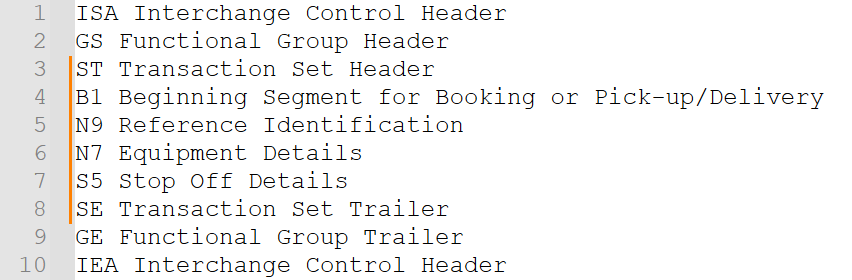
| Component | Description | Typical Segment(s) |
|---|---|---|
| Message Header & Control | Identifies the transaction and establishes control information. | ST |
| Shipment Identification | Provides shipment-level identifiers such as PO numbers, account codes, or customer order IDs. | B1, N9 |
| Equipment Identification | Provides equipment and trailer/container details linked to the shipment. | N7 |
| Stop Off Details | Defines stop sequences and reasons. | S5 |
| Transaction Trailer | Indicates the end of the transaction and validates segment count. | SE |
- ST (Transaction Set Header): Identifies the start of the transaction.
- B1 (Beginning Segment for Booking): Contains carrier response and shipment identifiers.
- N9 (Reference Identification): Provides reference data such as PO numbers, account codes, or customer order IDs.
- N7 (Equipment Details): Describes equipment type, number, and characteristics.
- S5 (Stop Off Details): Defines stop sequences and reasons.
- SE (Transaction Set Trailer): Indicates the end of the transaction
What are the Common Segments Included in the EDI 990?
| Segment / Segment Name | Purpose / Usage |
|---|---|
| ST02 Transaction Set Control Number | Identifying control number that must be unique within the transaction. |
| B101 Standard Carrier Alpha Code | The Standard Carrier Alpha Code (SCAC) used to identify transportation companies, developed by the National Motor Freight Traffic Association. |
| B102 Shipment Identification Number | Shipment Identification Number assigned to the shipment by the shipper or consignee. |
| B104 Reservation Action Code | Reservation Action Code indicating acceptance or rejection. |
| N901–N902 Reference Identification | Reference identifiers such as Bill of Lading, PO Number, or Customer Reference. |
| N711 Equipment Description Code | Code identifying the type of equipment used for the shipment (trailer type). |
| S501–S502 Stop Sequence and Reason Codes | Identifying number for the specific stop and the sequence in which the stop is to be performed. |
| SE02 | Transaction Set Control Number that must match the control number in the ST segment (ST02). |
- B101: SCAC identifying the responding carrier.
- B102: Shipment Identification Number.
- B104: Reservation Action Code (Acceptance or Rejection).
- N901–N902: Reference identifiers such as Bill of Lading, PO Number, or Customer Reference.
- N711: Equipment Description Code (e.g., trailer type).
- S501–S502: Stop sequence and stop reason codes
What Status Codes are used with the EDI 990 Load Tender Response?
Status codes used in the EDI 990 are found in the B1 Beginning Segment. Codes found in the B1 indicate the carrier's intended action with regard to the load tender (offer), the most commonly used "A" (Accepted), "B" (Conditional Acceptance), "D" (Reservation Cancelled/Declined), and "E" (Reservation Declined).
What Reason Codes are used with the EDI 990?
Reason codes are captured in the B106 (v5010 and above) when an action is declined, covering things like no equipment available or capacity constraints. The B106 element is conditional or required or when the Reservation Action Code (B104) indicates a decline response (e.g., "D" (Reservation Cancelled/Declined), and "E" (Reservation Declined).), providing the specific rationale for rejection, codes that help shippers understand and re-tender more efficiently.
What Use Cases does the EDI 990 Response to Load Tender support? 
- Carrier acceptance of a shipment tender within contractual deadlines.
- Rejection of a shipment when capacity is unavailable.
- Conditional acceptance when special equipment or constraints are required.
- Business alerts when no response is received by the 'Must Respond' deadline
What are the Benefits of the EDI 990?
- Improves efficiency in freight assignment.
- Provides real-time visibility into shipment commitments.
- Reduces manual communication errors.
- Enables automation within TMS and ERP systems
How efficient is the EDI 990 Response to Load Tender?
The EDI 990 Response to a Load Tender enhances efficiency in the transportation and logistics sector by automating responses to load tenders, reducing manual intervention, and accelerating bookings. Key efficiency benefits include:
- Time Savings: Response processing in minutes for faster load assignments, minimizing delays in supply chain operations.
- Automation and Error Reduction: Virtually eliminating manual data entry, re-keying, and discrepancies, streamlining communications between parties.
- Cost Reduction: Lowering administrative overhead by automating workflows, improving overall operational throughput and carrier relationships.
How Compliant is the EDI 990 Response to a Load Tender?
The EDI 990 is highly compliant as a standardized ANSI X12 transaction set, designed for interoperability across trading partners in the U.S. transportation industry. It adheres to established guidelines such as versions 4010, 4030, 5010, and 5020, ensuring consistent format and data contents for responses to load tenders.
What is the Format of the EDI 990 Response to a Load Tender?
The EDI 990 structured format ensures precise transmission of details like reference numbers and status codes, enhances overall data integrity in logistics workflows. The EDI 990 follows the ANSI X12 standard, providing a structured, text-based format for carriers to respond to load tenders, leveraging a simple linear structure without complex loops, enclosed in a transaction set header (ST) and trailer (SE).
How Accurate is the EDI 990 Response to a Load Tender?
Accuracy depends on quality (e.g., correct shipment IDs) and there is potential for issues if quality is lacking or systems are misconfigured. When optimized, the 990 supports rapid, error-free confirmations, contributing to reliable supply chain visibility. The 990 generally promotes accuracy by standardizing the exchange between parties, minimizing manual entry errors and common pitfalls in traditional load tendering.
What are the Limitations of the EDI 990 Response to a Load Tender?
- Scope Restriction: Exclusively designed for full truckload (FTL) shipments; does not support less-than-truckload (LTL) or other modes like rail/air without extension.
- Response Options: Limited to predefined actions (e.g., accept, reject, conditional accept), lacking flexibility for complex negotiations, counteroffers, or detailed bidding.
- Dependency on EDI Infrastructure: Requires all parties to have compatible EDI systems; non-EDI partners face barriers, and implementation can be costly for small carriers.
- Timeline Rigidity: Mandates quick responses (e.g., within 2 hours), which may pressure carriers during peak times, and it applies only to original tenders, not revisions.
- Lacks Advanced Features (v4010): Lacks built-in support for multimedia (e.g., attachments) or real-time tracking, relying on follow-up transactions for deeper details.
Are Guidelines & Sample Files for the EDI 990 Response to a Load Tender available?
Yes. PartnerLinQ provides sample EDI 990 Response to a Load Tender Transaction and implementation guides through its Support and Guideline Management Team.
Sample EDI 990 implementation guides illustrate both inbound and outbound flows, segment layouts, and valid data examples and support testing and partner onboarding. Customized specification documents for use in on boarding and technical development are available upon request.
PartnerLinQ provides:
- EDI 990 Response to a Load Tender Transaction implementation guide
- Sample payloads
- Qualification and testing maps
- Error handling and best-practice notes
ADD POP-OUT FORM – Ref: Contact our experts.
What are the Basic Questions for EDI Integration with the EDI 990 Response to a Load Tender?
- Are there Samples and Specs available?
- What is the general direction of the transaction (inbound or outbound)?
- Are there multiple trading partners exchanging 204/990 transactions?
- Are there other interested parties?
- What other transactions might these interested parties be a party to?
- What Response to a Load Tender (990) is expected or sent?
- Is the Response to a Load Tender (990) to the transaction a timed event?
- Are notifications involved/needed?
- Does the carrier provide a reason for declining the load?
- Are responses and changes automatically triggered? (an internal systems trigger)
- Do transactions require human intervention?
- How are changes to the business message managed today?
- Are stop details or equipment details required in the 990?
- How is automation managed (manual vs. system-triggered)?
- Are alerting systems configured for missed response deadlines?
What Business Level Workflow does the EDI 990 Response to Load Tender support?
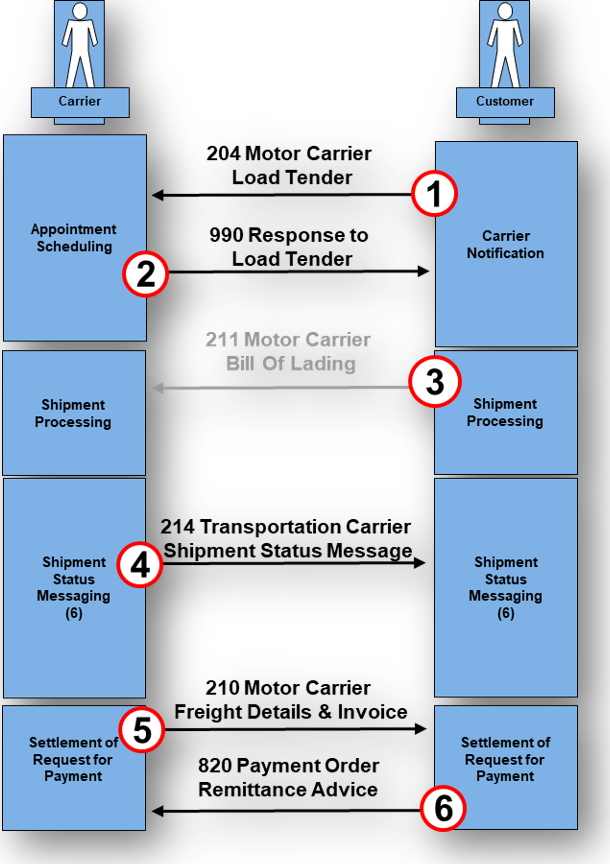
- Shipper sends EDI 204 Load Tender.
- Carrier receives and evaluates the shipment details.
- Carrier responds with EDI 990 indicating acceptance, conditional acceptance, or rejection.
- If accepted, shipment is scheduled.
- If rejected or no response is received, the load is reassigned to another carrier
What are the Best Practices for using the EDI 990?
- Foster Collaboration: Build stronger relationships by meeting SLAs,
- providing audit trails, and notifying partners of issues
- Respond Promptly: Adhere to partner-specific timelines and send before the "Must Respond By" timestamp in the EDI 204.
- Automate: Integrate with TMS and leverage automation to generate 990s instantly, reducing manual entry and eliminating phone/email confirmations.
- Ensure Data Accuracy: Validate against the original EDI to maintain integrity.
- Test Thoroughly: Conduct end-to-end testing, validate formats, control numbers, and data accuracy.
- Provide Clear Decline Reasons: When rejecting, include detailed reasons
- Monitor and Audit Regularly: Track response times, error rates, and rejections.
- Handle Exceptions Proactively: For original tenders only (not changes or cancels
- Maintain a backup plan for system downtime, such as manual notifications.
What Transactions are associated with the EDI 990 Response to a Load Tender?
| Transaction | Name | Relationship to the 214 |
|---|---|---|
| EDI 204 | Motor Carrier Load Tender | The tender that initiates a shipment. |
| EDI 210 | Motor Carrier Freight Details & Invoice | Final invoicing typically follows the delivered (D1) 214 status event. |
| EDI 211 | Motor Carrier Bill of Lading | Provides detailed shipment information that the 214 may reference in status updates. |
| EDI 214 | Transportation Carrier Shipment Status Message Advice | Provides movement updates throughout the shipment lifecycle. |
| EDI 997 / 999 | Functional Acknowledgment / Implementation Acknowledgment | Acknowledge receipt of the 214 or other transportation messages. |



Explore Our Integration Solutions

PartnerLinQ Integration Solutions
Connect Everything. Integrate Intelligently.
Future-Proof Your Business with Composable, AI Powered Connectivity.