
What is EDI 214 - Transportation Carrier Shipment Status Message? How Does EDI 214 Work?
EDI 214 is an ANSI ASC X12 transaction set used to communicate real-time shipment status updates between carriers, shippers, brokers, and consignees. It reports milestones such as pickup, in transit, arrival, and delivery using AT7 status codes, enabling automated freight visibility across truck, rail, and intermodal networks.
The 214 answers the most operationally critical supply-chain questions:
“Where is my freight — and what just happened?”
What Is the Purpose of AT7? 
Used to provide shippers, consignees, and other stakeholders with updates on the status of shipments, the EDI 214 - Transportation Carrier Shipment Status Message communicates key milestones (e.g., picked up, in transit, delivered…) enabling near real-time tracking and better coordination across supply chains.
Tracking Freight in ‘near real time’ is paramount, particularly in Unified Commerce where ‘Shipment Status Details’ updates reflected in the AT701 (Shipment Status Indicator Code) element can be sent in near real time back to the shipper (e.g., online retailer). Statuses that indicate key milestones (e.g., picked up, in transit, delivered) go a long way to ensure success among trade partners (e.g., customers, consumers, vendors, intermediaries, and carriers).
It provides real-time or near real-time updates on freight movement, including: 
- Pickup
- Departure
- Arrival
- Delivery
- Terminal events
- Intermodal handoffs
- Exceptions and appointment changes
The 214 communicates pickup, in-transit, delivery, appointment changes, and exception events using structured status indicators such as AT7.
Rail Transportation Interoperability Context
In rail-connected ecosystems, the 214 functions as the cross-network visibility bridge between motor carrier updates and rail event workflows governed by AAR-aligned operational standards.
While the EDI 214 is traditionally associated with truckload and LTL carriers, it plays a critical interoperability role in rail and intermodal environments where uniformity is heavily influenced by the Association of American Railroads (AAR) operating frameworks effecting most major North American rail operators, a group that includes:
- Alaska Railroad Corporation
- BNSF Railway Company
- Canadian National Railway Company
- Canadian Pacific Kansas City
- CSX Transportation
- Florida East Coast Railway
- Iowa Interstate Railroad
- Metra
- National Railroad Passenger Corporation
- Norfolk Southern Corporation
- Union Pacific Railroad
- Vermont Rail System
- Wheeling & Lake Erie Railway
- Anacostia Rail Holdings Company
- Genesee & Wyoming Inc.
- R.J. Corman Railroad Group
- Watco
Operators that rely on industry uniformity for:
- Waybill exchange
- Terminal event tracking
- Interchange reporting
- Intermodal ramp activity
- Freight invoicing and settlement
The 214 often complements rail-specific transaction sets within ecosystems such as:
- Agriculture & Grain

- Animal Feed & Milling
- Food Ingredients & Bulk Food Processing
- Mining & Raw Materials
- Utilities (Coal, Aggregates)
- Aggregates & Cement
- Refined Fuels & Energy Distribution
- Oil & Gas
- Chemicals & Petrochemicals
- Ethanol & Biofuels
- Plastics & Resin Manufacturing
- Hazardous Materials Transport
- Automotive Manufacturing (OEM)
- Automotive Tier 1 & Tier 2 Suppliers
- Finished Vehicle Logistics
- Retail (Big Box & National Chains)
- E-commerce & Intermodal Fulfillment
- Consumer Packaged Goods (CPG)
- Metals & Steel
- Forest Products & Lumber
- Building Materials & Construction Supply
- Paper & Packaging
What Does the EDI 214 Do?
The EDI 214 supports the movement of freight (logistics execution) by giving visibility into shipments as the progress. It underpins the shipment and invoicing (EDI 210) processes, exception management, and most importantly, it supports the customer experience through accurate, timely updates answering the key question, “Where’s my stuff?”
The EDI 214:
- Reports shipment milestones (Picked Up, Departed, Arrived, Delivered)
- Communicates appointment updates and delays
- Provides event timestamps and location data
- Links shipment status to PRO, BOL, PO, SID, and SCAC identifiers
- EDI 214 triggers freight invoice eligibility
- Supports invoice validation (EDI 210/410)
- Enables carrier performance measurement
It converts carrier system events into structured, automated, real-time freight visibility across trading partner networks.
Who Uses the EDI 214? 
- Motor carriers (TL and LTL)
- 3PL providers and freight brokers
- Retailers and omnichannel distributors
- Manufacturers and shippers
- Intermodal and rail operators
- Final-mile delivery providers
When Is the EDI 214 Required?
Many large retailers and enterprise shippers mandate 214 compliance as part of transportation onboarding program, the EDI 214 is typically required when:
- A carrier accepts an EDI 204 Load Tender
- Mandated - Contractual SLAs mandate shipment visibility
- Retail compliance programs require real-time status
- Omnichannel fulfillment depends on delivery confirmation
- Invoice generation depends on delivery event validation
Is the EDI 214 Mandated Under Regulation?
No, the EDI 214 is not federally mandated as a regulation, but it may be:
- Required
- as part of a contractual SLAs
- as part of a Retail compliance programs
- as part of an Omnichannel fulfillment obligation
- Contractually Embedded
- as part of an enterprise transportation agreements
- as part of retailer compliance scorecards
- as part of audit and accrual validation
- Embedded in strong industry standardization
- Rail and intermodal operators (e.g., CN Rail-style workflows) often use structured shipment status standards aligned with EDI 214 principles
How does EDI 214 work?
EDI 214 works by transmitting structured shipment milestone events from a carrier’s system to trading partners using standardized AT7 status codes. Each transaction identifies the shipment, defines the event (e.g., picked up or delivered), includes a timestamp, and updates ERP or TMS systems in near real time.
How Does the EDI 214 Work in the Business Workflow?
Positioning the EDI 214 at the center of lifecycle, upstream transactions become those transactions that occur before the first EDI 214 is issued and downstream transactions occur after the first EDI 214 is sent.
Below are our revised Upstream and Downstream transaction tables, expanded to fully account for rail and intermodal interoperability alongside truckload workflows.
Upstream Transactions
Transactions that initiate, authorize, or define shipment movement prior to or alongside the first EDI 214 status event.
| Transaction | Official Name | Mode | Role Relative to EDI 214 |
|---|---|---|---|
| EDI 204 | Motor Carrier Load Tender | Truck | Initiates motor carrier shipment; first 214 typically follows pickup |
| EDI 990 | Response to Load Tender | Truck | Carrier acceptance/rejection prior to first status event |
| EDI 404 | Rail Carrier Shipment Information (Bill of Lading) | Rail | Establishes shipment-level rail movement data before status reporting |
| EDI 417 | Rail Carrier Waybill Interchange | Rail | Governs waybill exchange between rail carriers; 214 may normalize milestone visibility |
| EDI 753 | Routing Request | Multi-Modal | Defines routing prior to shipment movement |
| EDI 754 | Routing Instructions | Multi-Modal | Confirms routing parameters |
| EDI 211 | Motor Carrier Bill of Lading | Truck | Provides shipment details referenced in status updates |
Downstream Transactions
Positioning the EDI 214 at the center of the lifecycle, downstream transactions become those transactions that occur after the first 214 is issued in some industries and use cases vary.
| Transaction | Official Name | Mode | Relationship to EDI 214 |
|---|---|---|---|
| EDI 214 | Transportation Carrier Shipment Status Message | Truck / Intermodal | Provides milestone visibility that triggers downstream financial and operational workflows |
| EDI 322 | Terminal Operations and Intermodal Ramp Activity | Rail / Intermodal | Communicates terminal events; may complement or precede certain 214 updates |
| EDI 210 | Motor Carrier Freight Details & Invoice | Truck | Invoice typically follows “Delivered” AT7 event |
| EDI 410 | Rail Carrier Freight Details and Invoice | Rail | Rail billing event following movement confirmation |
| EDI 812 | Credit/Debit Adjustment | Rail / Truck | Adjusts freight billing based on exceptions or corrections |
| EDI 820 | Payment Order / Remittance Advice | Multi-Modal | Confirms payment against 210 or 410 invoices |
| EDI 824 | Application Advice | Multi-Modal | Communicates 214 error & rejection status, data validation, or processing issues |
| EDI 997 / 999 | Functional / Implementation Acknowledgment | Multi-Modal | Confirms receipt and structural compliance of transmitted transactions |
Typical End-to-End Workflow Example
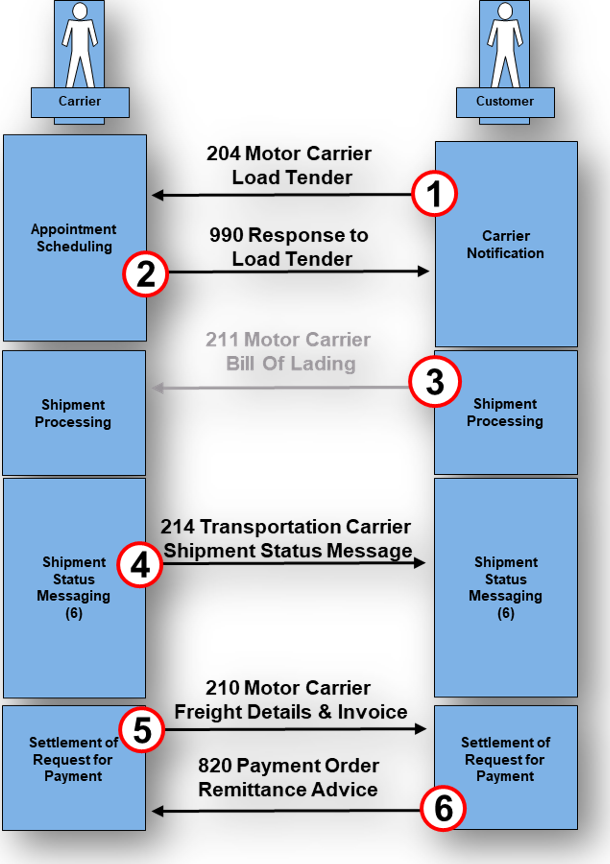
- Shipper issues EDI 204 (Load Tender).
- Carrier responds with EDI 990.
- Carrier executes pickup and transmits first EDI 214 (Picked Up).
- Carrier sends in-transit updates (AT7).
- Final EDI 214 confirms delivery.
- Carrier submits EDI 210 invoice.
- Shipper validates delivery event and processes payment.
End-to-End Workflow Example (Rail & Intermodal)
- Shipper transmits EDI 404 (Rail Carrier Shipment Information / Bill of Lading).
- Origin rail carrier validates shipment and establishes waybill authority.
- If interline movement is required, originating carrier transmits EDI 417 (Waybill Interchange) to connecting rail carrier.
- Rail terminal or ramp generates EDI 322 (Terminal Operations / Intermodal Ramp Activity) for yard, grounding, or interchange events.
- Rail or intermodal partner transmits EDI 214 (Shipment Status Message) to normalize arrival, departure, and interchange milestones.
- Final placement or delivery event is transmitted via EDI 214 (Delivered / Placed).
- Rail carrier issues EDI 410 (Rail Carrier Freight Details & Invoice).
- If billing discrepancies arise, EDI 812 (Credit/Debit Adjustment) is transmitted.
- Shipper transmits EDI 820 (Payment Order / Remittance Advice).
- If processing errors occur, EDI 824 (Application Advice) communicates corrections or rejections.
Industry-Specific Workflow Variations
Retail / Omnichannel
- Heavy reliance on delivery confirmation events.
- Appointment compliance impacts chargebacks.
Manufacturing
- Status feeds ERP production scheduling.
- In-transit updates support JIT operations.
Freight Brokerage
- High-volume event monitoring.
- Exception alerts drive customer updates.
Rail & Intermodal
- Terminal arrival/departure events dominate workflow.
How Does PartnerLinQ Use the EDI 214?
PartnerLinQ uses the 214 to proactively provide  pickup, in-transit, and delivery status in event-driven ecosystems within a centralized orchestration framework, orchestrating EDI 214 flows as part of a unified execution layer:
- Reducing exception noise through code governance.
- Aligning PRO, SID, PO, and SCAC identifiers across partners.
- Mapping AT7 status codes to enterprise workflows.
- Normalizing substitute status codes.
- Connecting 214 visibility directly to 210 invoice validation.
Where Is the EDI 214 Used?
- North American truckload & LTL
- Retail compliance programs
- Distribution networks
- Intermodal transportation
- Freight broker ecosystems
- Enterprise transportation management systems (TMS)
Purpose, Key Features, and Business Use Cases of EDI 214
The primary purpose of the Transportation Carrier Shipment Status or Message (214) is to notify trading partners of shipment status updates in order to support operational efficiency, invoicing, and performance measurement of carriers; communicate precise updates regarding the shipment’s progress, such as its location, condition, or events (e.g., picked up, in transit, delivered, or delayed), enabling real-time tracking and coordination between trading partners in the supply chain.
Operational Purpose
The Operational Purpose of the EDI 214 is to provide structured shipment status visibility across trading partner networks in near real time.
Key Features
- Supports Real-time or near real-time freight visibility
- AT7 shipment status indicators
- Communicates critical milestones: pickup, delivery, delays
- AT702 appointment reason codes
- Supports truckload and LTL carriers
- Event timestamps (G62)
- Location tracking (MS1)
- Equipment identification (MS2)
- Links shipment updates with PRO, SID, PO, and other references
- Exception reporting (Q7)
What Business Use Cases does the EDI 214 support?
- Retailers tracking omnichannel deliveries
- Shippers monitoring performance of LTL and TL carriers
- Accrual, reversal, invoicing and remittance processing
- Consignees coordinating receiving operations
- Brokers providing visibility services
Industry Applications 
- Delivery confirmation (shipper/retail)
- Raw Material tracking (manufacturing)
- Visibility Services (freight broker)
Operational Visibility
- Shipment dashboards
- Carrier Score Carding
- Compliance Monitoring (SLA)
Compliance Reporting
- Delivery performance tracking
- Appointment adherence reporting
Financial Reconciliation
- Invoice validation (210)
- Accrual confirmation
- Remittance alignment
Supply Chain Coordination
- Dock scheduling
- Receiving coordination
- Exception escalation
Exception Management
- Delay alerts
- Shortage or damage reporting
- Automated workflow triggers
What Information Is Required in the EDI 214?
An EDI 214 requires shipment identifiers (such as PRO number and SCAC), a shipment status code (AT701), event date and time, and transaction control segments (ST and SE). Many implementations also require reference numbers such as BOL, PO, or waybill numbers for accurate system matching and freight invoice eligibility.
While companion guides may vary, the following elements are typically required under ASC X12 4010 and most implementations.
Required Segments
| Segment | Purpose |
|---|---|
| ST | Transaction Header |
| B10 | Shipment Identification |
| LX | Line Counter |
| AT7 | Shipment Status Details |
| SE | Transaction Trailer |
Required Shipment Identifiers
At least one primary shipment identifier is required — often multiple are used to ensure w downstream ERP/TMS systems are able to match the event to the correct shipment record.
- SCAC (Standard Carrier Alpha Code)
- PRO Number (carrier tracking number)
- Shipment Identification Number (SID)
- Bill of Lading (BOL) number
- Purchase Order (PO) number (often required by retailers)
Optional Segments
| Segment | Purpose |
|---|---|
| MS1 | Event Location |
| MS2 | Equipment Details |
| Q7 | Exception Codes |
| K1 | Remarks |
| L11 | Reference Numbers |
| G62 | Dates/Times |
Summary Table of Key Segments
| Component | Key Segment | Element |
|---|---|---|
| Transaction Control | ST Transaction Set Header | ST02 Transaction Set Control Number |
| SCAC (Standard Carrier Alpha Code) | B10 Beginning Segment | B1003 Standard Carrier Alpha Code |
| PRO Number (carrier tracking number) | B10 Beginning Segment | B1001 Reference Identification |
| Shipment Identification Number (SID) | B10 Beginning Segment / L11 Business Instructions and Reference Number | B1001 Reference Identification L1102 Reference Identification Qualifier |
| Bill of Lading (BOL) number | L11 Business Instructions and Reference Number | L1102 Reference Identification Qualifier |
| Purchase Order (PO) number (often required by retailers) | L11 Business Instructions and Reference Number | L1102 Reference Identification Qualifier |
| Status Event | AT7 Shipment Status Details | AT701 Shipment Status Code |
| Location | MS1 Equipment, Shipment, or Real Property Location | MS104 Longitude Code MS105 Latitude Code |
| Equipment | MS2 Equipment or Container Owner and Type | MS203 Equipment Description Code |
| Exception | Q7 | |
| Notes | K1 |
What Status and Reason Codes Are Used with the EDI 214?
Status and Reason Codes are found in the AT7 Shipment Status Detail segment they are used to provide detailed information about the status of a shipment at a specific point in time.
| Code | Meaning |
|---|---|
| AF | Departed Pick-Up |
| L1 | Loading |
| P1 | Departed Terminal |
| AJ | Tendered for Delivery |
| AV | Available for Delivery |
| CB | Completed Shipment |
| D1 | Completed Unloading |
| X1 | Arrived at Delivery |
What Is the Purpose of the AT7 – Shipment Status Details Segment?
The AT7 segment in EDI 214 communicates the shipment milestone event, including what happened, when it happened, and why. It contains the shipment status code (AT701), optional reason code (AT702), and event timestamp, serving as the core visibility trigger within the transaction.
What Is the Purpose of the AT701?
AT701 is the Shipment Status Indicator Code within the AT7 segment of EDI 214. It identifies the specific operational milestone that occurred, such as pickup, arrival, or delivery, and acts as the primary event trigger for shipment visibility, SLA tracking, and freight invoicing workflows.
Without the AT701, The AT7 segment has no defined operational meaning.
Operational speaking Tracking Freight in 'near real time' is paramount and the 'Shipment Status Details' reflected in the 'AT701' should always be sent immediately (e.g., in near real time) to interested parties.
"Picked Up" and "Delivered" notifications are particularly important to freight visibility and may be integrated into the invoicing and remittance process to ensure that partners and carriers remuneration takes place in the most efficient way possible perhaps even contractually (SLA).
Acceptable substitute references for "Picked Up" might include:
- AF Carrier Departed Pick-up Location with Shipment
- BA Connecting Line or Cartage Pick-up
- CP Completed Loading at Pick-up Location
- L1 Loading
- LC Shipment Container Loaded to Chassis
- OA Out-Gate
- P1 Departed Terminal Location
- RD Carrier Departed Rail Ramp
- X3 Arrived at Pick-up Location
- X8 Arrived at Pick-up Location Loading Dock
Acceptable substitute references for "Delivered" might include
- CB Completed Shipment
- CD Carrier Departed Delivery Location
- D1 Completed Unloading at Delivery Location
- J1 Delivered to Connecting Line
- S1 Trailer Spotted at Consignee's Location
- X1 Arrived at Delivery Location
- X5 Arrived at Delivery Location Loading Dock
Acceptable substitute references for "En Route" might include
- AJ Tendered for Delivery
- AL Shipment Conveyance Loaded to Rail Car
- AM Loaded on Truck
- AV Available for Delivery
What Is the Purpose of the AT702?
AT702 is the Shipment Status or Appointment Reason Code in the AT7 segment of EDI 214. It explains why a shipment event occurred, such as missed delivery or consignee unavailable, providing context for exception management, performance reporting, and chargeback prevention.
Its purpose is to provide context explaining why a shipment status event occurred, “’what happened?’, ‘why did it happen?’, the AT702 is typically used when:
- A delivery was missed or delayed
- An address was incorrect
- A consignee was unavailable (closed)
- A rescheduling occurred
Otherwise, it’s a normal shipment and AT701 = NS Normal Status
Reason Codes (AT702 Examples)
| Code | Meaning |
|---|---|
| A1 | Missed Delivery |
| A2 | Incorrect Address |
| AD | Customer Requested Future Delivery |
| AO | Weather or Natural Disaster Related |
| B1 | Consignee Closed |
| BG | Other |
| BT | Returned to Shipper |
| CU | Customer Unavailable |
| NS | Normal Status |
What are the Benefits of the EDI 214?
The EDI 214 improves transportation visibility by providing real-time shipment milestone updates, enabling automated invoice validation, SLA monitoring, carrier performance tracking, and exception management across truck, rail, and intermodal networks.
The EDI 214 represents an elevation of integration from reactive infrastructure to governed execution becoming a critical transaction for centralized EDI management, shipment tracking, and integration governance. It provides real-time freight status updates using standardized AT7 status codes, enabling structured milestone reporting across truck, rail, and intermodal networks.
By transforming transportation visibility from reactive tracking into measurable execution control, the EDI 214 supports unified lifecycle tracking, exception governance, and SLA performance monitoring. It connects upstream transactions such as EDI 204 Load Tenders with downstream financial workflows including EDI 210 and EDI 410 invoices.
As part of an overall enterprise transportation strategy, the 214 becomes foundational to automation, analytics, carrier score-carding, and AI-driven supply chain orchestration.
Operational Benefits
- Real-time freight visibility
- Reduced manual status calls
- SLA enforcement
- Improved dock coordination
Financial Benefits
- Faster invoice validation (210)
- Reduced billing disputes
- Accurate accrual tracking
Compliance Benefits
- Retail performance adherence
- Transportation KPI monitoring
- Reduced chargebacks
What are the benefits of Automating the EDI 214?
Automating the EDI 214 Transportation Carrier Shipment Status Message transforms shipment tracking from manual status monitoring into real-time, system-driven transportation execution.
- Automation ensures that AT7 shipment status codes, timestamps, and reference identifiers are transmitted immediately upon event occurrence — eliminating delays, manual updates, and inconsistent milestone reporting.
Benefits of Automating the EDI 214:
- Eliminates manual tracking calls
- Reduces email and phone updates
- Standardizes status code interpretation
- Integrates directly into ERP & TMS
- Supports predictive exception handling
Regulatory and Compliance Considerations
- While not federally mandated, EDI 214 compliance may be required as part of contractually embedded SLAs. Major retailers, enterprise shippers, brokers, testing and onboarding programs often require the 214.
- EDI 214 compliance may also be:
- Required
- as part of a contractual SLAs
- as part of a Retail compliance programs
- as part of an Omnichannel fulfillment obligation
- Contractually Embedded
- as part of an enterprise transportation agreements
- as part of retailer compliance scorecards
- as part of audit and accrual validation
- Embedded in strong industry standardization
- Rail and intermodal operators (e.g., CN Rail-style workflows) often use structured shipment status standards aligned with EDI 214 principles
EDI 214 Technical Structure, Format, and Versions
Hierarchical Loop Structure
- The 214 transaction uses a Hierarchical Loop Structure to define an information hierarchy across information source (reference), Shipment Identification (SID), equipment, event, status, and location.
Hierarchical Loop Structure
- Header (ST, B10)
- LX Loop (Event Counter)
- AT7 Loop
- (Status Details)
- Location Loop (MS1/MS2)
- Trailer (SE)
File Format and Delimiters
The EDI 214 follows standard X12 delimiter conventions and is transmitted within Functional Group HR. Typical Production Delimiters include:
- Segment Separator - hex 15 (NAK) or hex 7E (~)
- Element separator - hex 7C (|) or hex 2A (*)
- Sub-element Separator - hex 3E (>)
Version Differences
Most transportation networks use 4010, some partners accept 5010, industry (AAR) or customized companion guides provided by partners. Multiple transport monitoring workflows are normal, some partners use VAN, others direct AS2, others API
Limitations of the EDI 214
Version & Companion Guide Constraints
- Substitute status codes vary by retailer.
- Companion guides generally override base standard.
Timing & Frequency Limitations
Originally sent up to 6 time per trip to avoid/minimize VAN costs, many of the largest shippers and consignees require the Transportation Carrier Shipment Status Message (214) several to many times per day and some have been known to request updated statuses several times per hour in order to track freight effectively and evaluate carrier performance. Timing made possible through the advent of AS2, SFTP, FTPS and other secure messaging protocols
- High frequency updates can generate excessive data.
- Over-messaging increases exception noise.
Code Interpretation Risk
Multiple AT7 codes may indicate similar events (e.g., picked up, in transit, delivered, or delayed) While alignment between partners may be essential for compliance, data curated into canonical data models tends to normalize through acceptable substitute references.
Are Implementation Guidelines and Sample Files Available for the X12 EDI 214?
Yes. PartnerLinQ provides sample transactions and implementation guides. EDI 214 implementation guides illustrate both inbound and outbound flows, segment layouts, and valid data examples and support testing and partner onboarding.
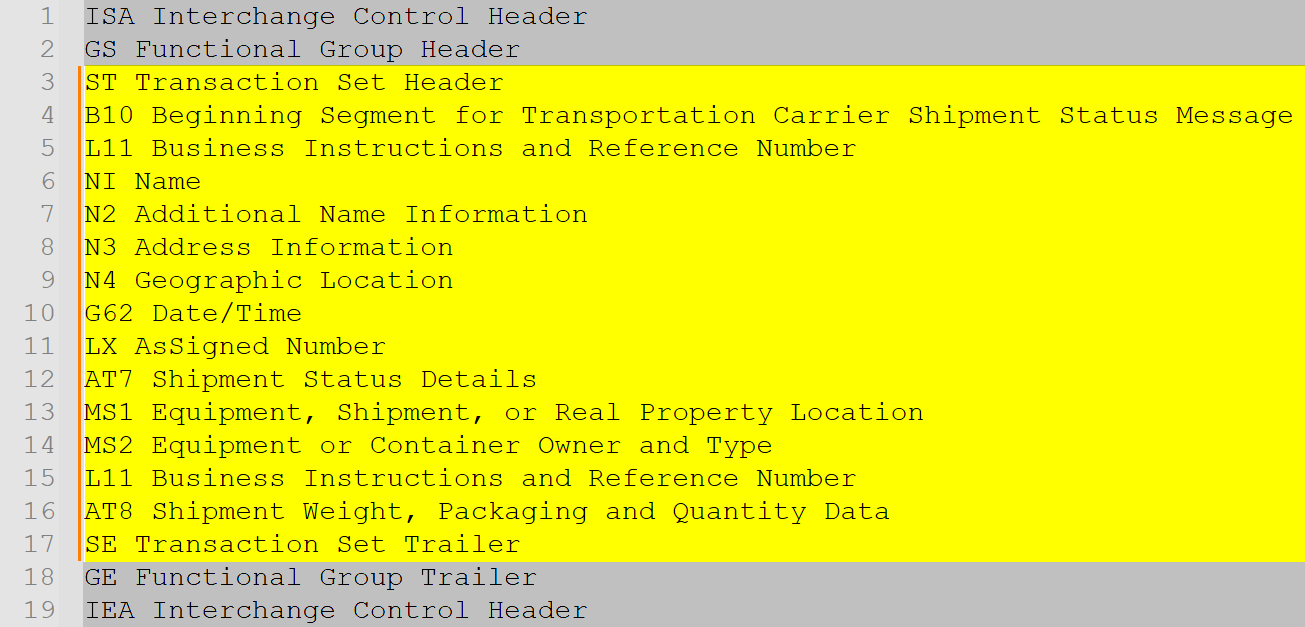
EDI 214 Example (X12 Sample Format)
ST*214*0001~

B10*16696904*0085098529*WVAS~

LX*1~

AT7*X3*NS***20210409*1141*MT~

L11*0037782401*CR~

L11*2092028715*DO~

SE*7*0001~
EDI 214 Implementation guide (Companion Guides)
Customized specification documents for use in on boarding and technical development are also available through PartnerLinQ Support and Guideline Management.
Trading Partner Requirements
Customized mapping, testing, and validation documentation are also available.
Common EDI 214 Errors and Rejection Scenarios
Common EDI 214 errors include missing AT7 status codes, incorrect timestamps, invalid shipment identifiers, out-of-sequence events, and companion guide violations. These issues often trigger 997/999 rejections or 824 application advice responses and may delay billing or distort SLA reporting.
The EDI 214 – Transportation Carrier Shipment Status Message is highly structured and event-driven. While rare, errors do occur due to identifier mismatches, status code misuse, timing violations, or companion guide noncompliance. The most common rejection categories across truck, rail, and intermodal implementations can be found below:
Structural Errors (997/999)
These are syntax-level failures detected during validation, identified to the sender via the EDI 997 (Functional Acknowledgment) or 999 (Implementation Acknowledgment). Rejected messages require correction and re-transmission by the sender.
- Invalid delimiters
- Missing required segments (ST, B10, AT7, SE)
- Incorrect segment order
- Missing required elements
- Invalid element formatting (date/time fields)
- Missing mandatory AT7 elements (status code or timestamp)
- Segment count mismatch in SE
Data Validation Errors
The AT701 defines a milestone event in the shipment lifecycle and while acceptable substitute references are available "Picked Up" and "Delivered" notifications are particularly important to freight visibility and may be integrated into the invoicing and remittance process to ensure that partners and carriers remuneration takes place in the most efficient way possible perhaps even contractually (SLA)
- Invalid AT7 code - Using non-approved status codes
- Using substitute codes not permitted by companion guide
- Invalid ‘order of operations’ - Sending delivery code before pickup
- Sending duplicate final delivery event
Identifier Mismatch Errors
- mismatch
- BOL inconsistency
- Waybill number mismatch with EDI 404
Version Compliance Errors
- Using incorrect X12 version/release
- Companion guide violation
Top 10 Preventable EDI 214 Errors
| # | Preventable Error | Root Cause | Operational Impact | Prevention Strategy |
|---|---|---|---|---|
| 1 | Missing AT7 Status Code (AT701) | Event not mapped in carrier system | Status ignored or rejected – cash flow impact | Use AT7 validation before transmission |
| 2 | Missing Event Date/Time (AT705/AT706) | Timestamp not captured or formatted incorrectly | SLA distortion, invoice delays | Require system-generated timestamps with time zone governance |
| 3 | Invalid or Non-Approved Status Code | Using code not allowed by companion guide | Hard rejection or compliance chargeback | Maintain partner-specific status code governance matrix |
| 4 | PRO / Shipment ID Mismatch | Identifier not synchronized between systems | Visibility failure in ERP/TMS | Implement pre-transmission identifier validation |
| 5 | Duplicate Delivery Event | System retransmits final milestone | Invoice/Payment risk - workflow errors | Add duplicate event suppression logic |
| 6 | Event Sequence Error (e.g., Delivered before Pickup) | Out-of-order system integration | Dashboard corruption, audit risk | Use lifecycle sequencing rules |
| 7 | Missing Required Reference (PO, BOL, Waybill) | Companion guide not enforced | Application rejection (824) | Companion guide compliance validation layer |
| 8 | Incorrect SCAC | Carrier code misconfigured | Shipment not recognized | Maintain SCAC master data governance |
| 9 | Reason Code Misuse (AT702) | Generic or incorrect delay reason | SLA penalties, chargeback exposure | Standardize reason code usage by scenario |
| 10 | Missing Location or Equipment (MS1/MS2) | Incomplete event reporting | Rail/intermodal blind spots | Require equipment + terminal mapping for intermodal events |
Basic Questions for EDI Integration with the 214
- Are there Samples and Specs available?
- What is the general direction of the transaction?
- Are they Inbound to the client or Outbound from the client to another party?
- Are there more than one trading partner exchanging the Transportation Carrier Shipment Status or Message (214)?
- Are there other interested parties?
- What transactions might these interested parties be a party to?
- Is a Transportation Carrier Shipment Status or Message (214) a timed event?
- What upstream transaction initiates it?
- What downstream transaction depends on it?
- Are notifications involved/needed?
- Is there any SLA for 214 Inbound? Outbound?
- What SLA governs timing?
- Are notifications triggered by events?
- How are status updates handled? Are there automatic notifications to business partners?
- Is there automation? (an internal system trigger) or are Transportation Carrier Shipment Status or Message (214) business message transactions triggered manually?
- Are changes/updates to Transportation Carrier Shipment Status or Message automatically triggered? (Is there an internal system trigger) Or do transactions require human intervention to be sent?
- How are changes to the Transportation Carrier Shipment Status or Message (214) managed?
- How does the client handle the AT701 Shipment Status Code?
- How does the client handle the AT702 Shipment Status or Appointment
- Are substitute AT7 codes allowed?
- Are substitute Reason Codes permitted?
- Is customization required for specific customers? (e.g., acceptable substitute code list references for "Arrived" or "Departed")
- How are exceptions handled?
- Is automation or manual review required?
Best Practices for Using the EDI 214
Effective use of the EDI 214 requires more than simply transmitting status updates. It requires governance of milestone logic, identifier alignment, timestamp integrity, and cross-mode consistency across truck, rail, and intermodal workflows.
Functional Acknowledgments (997) are industry best practice, generally automatically generated, and should be sent back on receipt of Transportation Carrier Shipment Status or Message (214) business message
Below are the best practices that reduce rejection risk, improve SLA performance, and strengthen financial accuracy.
- Align references (PRO, SID, PO).
- Transmit Status Events in Near Real Time
- Validate acknowledgments (997/999).
- Avoid batching milestone updates
- Send pickup, arrival, and delivery events in near real time
- Capture Accurate Timestamps with Time Zone Governance
- Enforce Logical Event Sequencing
- Prevent “Delivered” events before pickup.
- Standardize/govern AT701 Status Code Usage
- Maintain partner-specific validation rules.
- Monitor SLA compliance.
- Ensure lifecycle sequencing logic (Pickup → In Transit → Delivered).
- Minimize unnecessary event noise.
- Align Rail & Intermodal Interoperability
- Align terminal events 322 with 214 milestone reporting.
- Standardize delay classifications (weather, consignee unavailable, etc.).
- Use reason codes only when context is required.
- Integrate 214 into Financial Workflow Governance
- Ensure “Delivered” status triggers invoice eligibility.
- Align milestone validation with 210 and 410 billing.
Transactions Associated with the EDI 214
| Transaction | Name | Relationship to the 214 |
|---|---|---|
| EDI 204 | Motor Carrier Load Tender | The tender that initiates a shipment; the 214 provides movement updates throughout the shipment lifecycle. |
| EDI 210 | Motor Carrier Freight Details & Invoice | Final invoicing typically follows the delivered (D1) 214 status event. |
| EDI 211 | Motor Carrier Bill of Lading | Provides detailed shipment information that the 214 may reference in status updates. |
| EDI 753 / 754 | Routing Request / Routing Instructions | May precede or define the routing that later appears in 214 updates. |
| EDI 820 | Payment Order/Remittance Advice | Often triggered after the 210 invoice is issued following the delivery status update. |
| EDI 824 | Application Advice | Communicates corrections or issues with transmitted 214 data. |
| EDI 990 | Response to a Load Tender | Carrier acceptance/rejection often precedes the first 214 event. |
| EDI 997 / 999 | Functional Acknowledgment / Implementation Acknowledgment | Acknowledge receipt of the 214 or other transportation messages. |
Rail Transactions Associated with the EDI 214
- 404 — Rail Carrier Shipment Information (Bill of Lading)
- 417 - Rail Carrier Waybill Interchange document
- 322 — Terminal Operations and Intermodal Ramp Activity
- 410 — Rail Carrier Freight Details and Invoice
- 824 — Application Advice)
- 812 — Credit/Debit Adjustment)
- 820 — Payment Order/Remittance Advice
EDI 214 FAQs
What is an EDI 214 used for?
EDI 214 is used to communicate real-time shipment status updates from carriers to shippers, brokers, and consignees. It reports milestones such as pickup, in transit, arrival, and delivery using AT7 status codes, enabling automated freight visibility, SLA monitoring, and invoice validation across truck, rail, and intermodal transportation networks.
How does EDI 214 differ from EDI 210?
EDI 214 provides shipment status updates during freight movement, while EDI 210 is used to transmit the freight invoice after delivery. The 214 communicates operational milestones such as pickup and delivery, whereas the 210 communicates financial charges. In most workflows, a “Delivered” AT7 event in the 214 precedes issuance of the 210 invoice.
What information is required in an EDI 214?
An EDI 214 requires shipment identifiers such as PRO number and SCAC, an AT701 shipment status code, event date and time, and transaction control segments (ST and SE). Many implementations also require reference numbers such as BOL, PO, or rail waybill numbers to ensure accurate matching in ERP or TMS systems.
What is the AT7 segment in EDI 214?
The AT7 segment is the core event-reporting component of the EDI 214. It identifies the shipment milestone (via AT701), provides an optional reason code (AT702), and includes the event timestamp. AT7 transforms physical freight movement into structured, machine-readable milestone data for operational and financial systems.
Is EDI 214 required by law?
EDI 214 is not federally mandated by regulation. However, it is commonly required through contractual SLAs, retailer compliance programs, and transportation onboarding agreements. Many enterprise shippers and rail operators require 214 status reporting to ensure shipment visibility, performance measurement, and accurate freight billing.
How does EDI 214 work in rail and intermodal transportation?
In rail and intermodal environments, EDI 214 complements rail transactions such as EDI 404 (Rail Bill of Lading), 417 (Waybill Interchange), and 322 (Terminal Activity). It normalizes arrival, departure, and delivery milestones into standardized status updates that integrate with enterprise ERP and TMS visibility platforms.



Explore Our Integration Solutions

PartnerLinQ Integration Solutions
Connect Everything. Integrate Intelligently.
Future-Proof Your Business with Composable, AI Powered Connectivity.