
Transaction Identity
| Attribute | Description |
|---|---|
| Transaction Name | Motor Carrier Load Tender |
| X12 Transaction Set | EDI 204 |
| Industry Usage | Transportation, Logistics, Retail Distribution, Manufacturing |
| Primary Purpose | Tender shipment details from a shipper, broker, or 3PL to a motor carrier |
| Typical Sender | Shipper, Retailer, Broker, 3PL, Distribution Center |
| Typical Receiver | Truckload Carrier, LTL Carrier, Freight Broker |
| Common Preceding Transactions | Internal TMS shipment creation, planning events |
| Common Following Transactions | EDI 990 Response to Load Tender, EDI 214 Shipment Status, EDI 210 Freight Invoice |
| Standard Version | Commonly X12 4010, 5010, or later |
What Is the EDI 204?
The EDI 204 Motor Carrier Load Tender is an ANSI X12 transaction used to electronically tender freight shipments from a shipper, broker, or logistics provider to a motor carrier. The document communicates pickup locations, delivery locations, equipment requirements, and scheduling instructions so carriers can evaluate and accept transportation loads.
What Is a Motor Carrier Load Tender?
A motor carrier load tender is a transportation request sent from a shipper, broker, or logistics provider to a motor carrier offering a shipment for pickup and delivery. In EDI environments, the request is transmitted electronically using the EDI 204 transaction set.
What Does the EDI 204 Do?
The EDI 204 electronically transmits a shipment tender to a carrier so that freight movements can be scheduled and executed. The transaction communicates operational details including shipment identifiers, stop locations, scheduling windows, equipment requirements, and reference numbers needed to coordinate pickup and delivery.
Standardized tender information allows carriers to evaluate loads quickly, allocate equipment, and respond electronically while maintaining consistency across transportation management systems and trading partner networks.
What Is EDI 204 Used For?
The EDI 204 is used to electronically tender freight shipments to motor carriers. It replaces manual load tendering by sending structured shipment information—including origin, destination, equipment requirements, and pickup schedules—directly from a shipper or broker system to a carrier’s transportation management system.
Who Uses the EDI 204?
The EDI 204 is widely used across the logistics ecosystem.
| Role | Usage |
|---|---|
| Shippers | Tender freight shipments to carriers |
| Retailers / Distribution Centers | Notify carriers of pickup loads |
| Freight Brokers | Coordinate loads between shippers and carriers |
| 3PL Providers | Manage transportation tendering and carrier selection |
| Motor Carriers | Receive and evaluate freight tenders |
Manufacturers,  wholesalers, and retailers frequently generate the EDI 204 through transportation management systems to initiate shipment execution across their carrier networks.
Who Sends the EDI 204?
The EDI 204 is typically sent by shippers, retailers, manufacturers, freight brokers, or third-party logistics providers (3PLs). These organizations generate the load tender from a transportation management system (TMS) and transmit it to motor carriers to request pickup and delivery of freight shipments.
Why Do Companies Use the EDI 204?
Companies use the EDI 204 to automate freight tendering and eliminate manual load assignment processes. Standardized electronic tenders improve carrier coordination, reduce shipment planning errors, support faster responses, and integrate directly with transportation management systems and downstream logistics transactions.
What Industries Use the EDI 204?
The EDI 204 Motor Carrier Load Tender is widely used in industries that rely on truck transportation, including retail distribution, manufacturing, consumer goods, food and beverage logistics, and third-party logistics operations where shippers coordinate shipments with multiple motor carriers.
When Is the EDI 204 Required?
The EDI 204 is typically required whenever a shipper or broker needs to formally tender freight to a motor carrier in an automated transportation workflow. Many logistics contracts specify electronic tendering through EDI as the primary method for load assignment because the standardized format eliminates ambiguity and reduces delays.
When Is the EDI 204 Sent? 
The EDI 204 is sent when a shipment has been planned and is ready to be offered to a carrier for transportation. It typically follows shipment creation in a shipper’s transportation management system and precedes the carrier’s response transaction, the EDI 990 Response to Load Tender.
What Is the Difference Between EDI 204 and EDI 990?
The EDI 204 is used by a shipper or broker to tender a shipment to a carrier, while the EDI 990 Response to Load Tender is used by the carrier to accept or reject the load. Together, these transactions create a standardized workflow for electronic freight tendering and carrier response.
What Happens If a Carrier Does Not Respond to an EDI 204?
If a carrier does not respond to an EDI 204 load tender, the shipper may cancel the tender or offer the shipment to another carrier. Many tenders include a “Must Respond By” deadline, after which the shipment may be reassigned to maintain transportation schedules.
Is the EDI 204 a Bill of Lading (BOL)? 
The EDI 204 primarily functions as a shipment tender rather than a bill of lading. However, some implementations allow the transaction to contain bill-of-lading details and serve as the operational instruction that triggers shipment execution.
Is the EDI 204 Mandated Under Regulation?
No, the EDI 204 transaction is not a federal regulation or mandates. Transportation networks frequently require electronic tendering through partner agreements or carrier contracts. Standardization ensures operational alignment between shippers, carriers, and logistics platforms.
How Does the EDI 204 work in the Business Workflow?
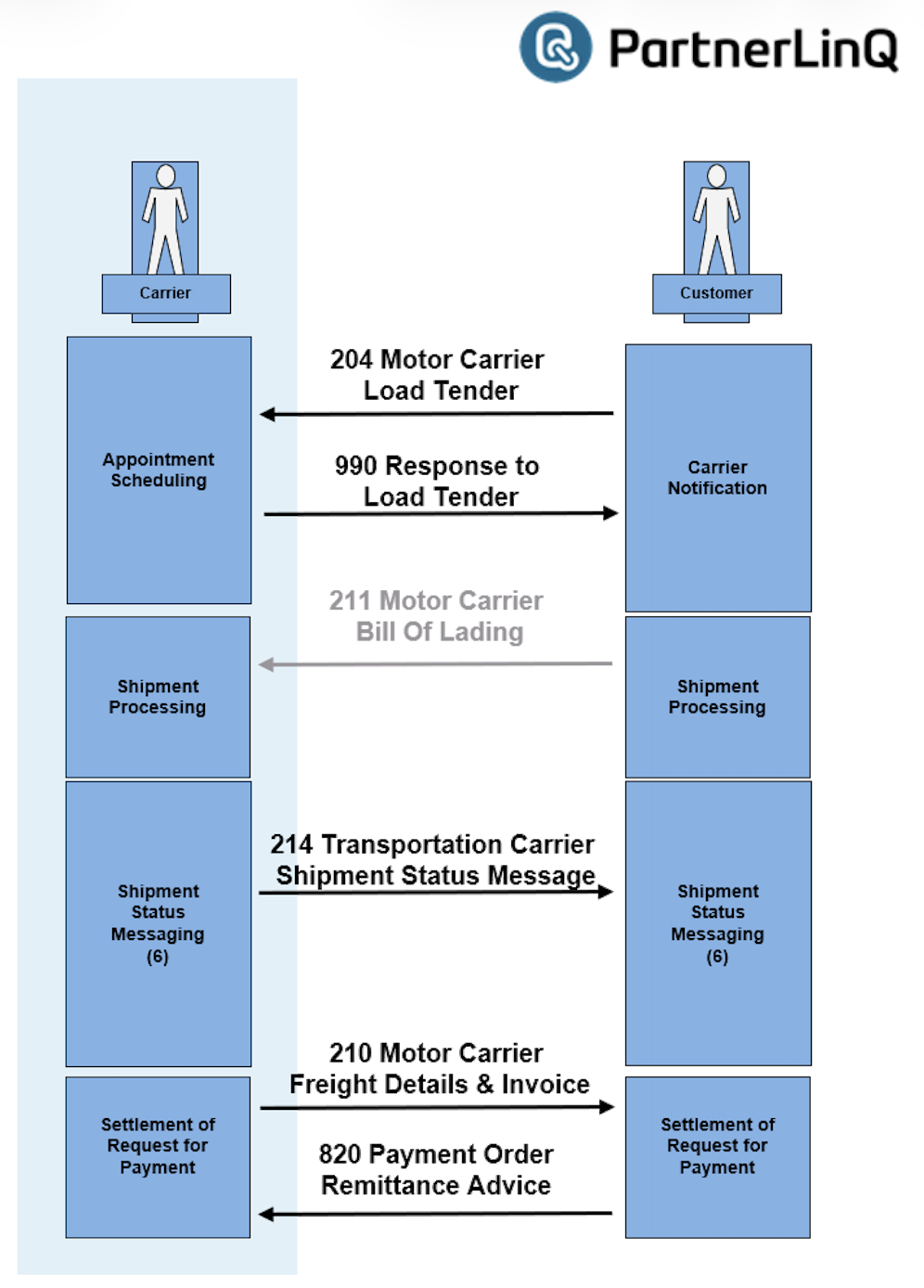
The EDI 204 functions as the first operational transaction in many motor carrier workflows, initiating shipment execution.
EDI 204 Workflow Diagram Table
| Step | Transaction | Description |
|---|---|---|
| 1 | Shipment Creation | Shipment created in shipper TMS |
| 2 | EDI 204 | Shipment tender sent to motor carrier |
| 3 | EDI 990 | Carrier accepts or rejects load |
| 4 | EDI 214 | Shipment status updates provided |
| 5 | EDI 210 | Carrier sends freight invoice |
| 6 | EDI 820 | Payment issued |
What Transactions Come Before and After the EDI 204?
The EDI 204 appears early in the transportation execution workflow. Internal shipment planning events occur before it. After the load tender is sent, carriers respond using EDI 990, provide status updates through EDI 214, and issue freight invoices using EDI 210 Motor Carrier Freight Details and Invoice.
Upstream Transactions
Positioning the EDI 204 at the center of the business workflow, upstream transactions are those t that take place leading up to the EDI 204. Upstream transactions typically establish the tender), the response and any shipment status updates that typically occur before the EDI 210 is generated.
| Transaction | Purpose |
|---|---|
| Internal TMS shipment creation | Shipment planning and carrier selection |
| Internal purchase order fulfillment | Triggers transportation requirement |
Downstream Transactions
Positioning the EDI 204 at the center of the lifecycle, downstream transactions occur after the EDI 204 submission, they may confirm the load tender or respond to errors within the submission or include transactions that support accruals, invoicing, financial reconciliation and channel accounting; in fact several response transactions may occur after the EDI 204 is received:
| Transaction | Purpose |
|---|---|
| EDI 997 | Functional Acknowledgement |
| EDI 990 | Carrier response to load tender |
| EDI 812 | Freight Accrual |
| EDI 214 | Shipment status updates |
| EDI 211 | Bill of lading information |
| EDI 210 | Invoice |
| EDI 824 | Application Advice |
| EDI 812 | Credit/Debit Adjustment |
| EDI 820 | Payment Order/Remittance Advice |
| EDI 812 | Freight Accrual Reversal |
End-to-End Workflow Example
- Shipper creates shipment in a Transportation Management System (TMS).
- System generates an EDI 204 Load Tender with shipment details.
- Carrier receives the tender and evaluates equipment availability.
- Carrier responds using EDI 990 indicating acceptance or rejection.
- Shipment execution begins.
- Status updates are transmitted via EDI 214.
- Carrier issues invoice through EDI 210.
Industry-Specific Workflow Variations
| Industry | Workflow Variation |
|---|---|
| Retail Distribution | Tenders often represent store replenishment shipments, high-volume tendering and automated response deadlines |
| Manufacturing | Multi-stop shipment tenders with equipment requirements frequently linked to production schedules |
| Food Distribution | Time-sensitive tender acceptance for refrigerated loads |
| 3PL Logistics Operations | Brokers distribute automated tenders that cascade across multiple carrier and transportation ecosystems |
| Automotive Logistics | Just-in-time shipments, linked to production schedules where time is of the essence |
| Intermodal Logistics | Tenders coordinate truck segments within multimodal shipments |
Cross-Standard Canonical Mapping
| Standard | Equivalent Message |
|---|---|
| ANSI X12 | 204 Motor Carrier Load Tender |
| EDIFACT | IFTMIN (Instruction Message) |
| SAP IDoc | SHPMNT |
| Transportation APIs | Shipment tender or dispatch message |
EDI 204 vs EDIFACT IFTMIN
| Standard | Message | Purpose |
|---|---|---|
| ANSI X12 | EDI 204 | Motor carrier load tender |
| EDIFACT | IFTMIN | Transport instruction message |
| SAP IDoc | SHPMNT | Shipment processing document |
| APIs | Shipment Tender Endpoint | Real-time dispatch instruction |
How Does PartnerLinQ Use the EDI 204? 
PartnerLinQ uses the EDI 204 Motor Carrier Load Tender to automate shipment tendering across trading partner networks. The platform transmits standardized shipment information to motor carriers while coordinating downstream responses such as the EDI 990 tender response and operational status updates.
Automated orchestration improves shipment planning, reduces manual errors, and strengthens execution visibility across logistics ecosystems.
Where Is the EDI 204 Used?
The EDI 204 appears in transportation workflows across industries that rely on carrier networks.
| Industry | Application |
|---|---|
| Retail | Store replenishment shipments |
| Manufacturing | Distribution of finished goods |
| Food & Beverage | Time-sensitive refrigerated transportation |
| Consumer Goods | Distribution center to retailer logistics |
| Third-Party Logistics | Multi-carrier freight brokerage |
What Is the Purpose of the EDI 204?
The purpose of the EDI 204 Motor Carrier Load Tender is to electronically communicate shipment details from a shipper or broker to a motor carrier so the carrier can evaluate and accept the transportation request. Standardized tender information improves shipment planning, reduces manual entry errors, and accelerates carrier response times.
How Does the EDI 204 Work?
The EDI 204 workflow begins when a shipper generates a shipment in a transportation management system. The system sends the load tender electronically to the carrier. The carrier reviews the shipment details and responds using EDI 990 to accept or reject the tender before transportation execution begins.
What Information Is Included in an EDI 204?
An EDI 204 includes shipment identifiers, pickup and delivery locations, scheduling windows, equipment requirements, carrier identifiers, reference numbers, commodity descriptions, and special handling instructions. These data elements enable carriers to evaluate the load and determine whether they can accept the transportation request.
| Information Category | Description / What’s Included | Primary Segment(s) |
|---|---|---|
| Transaction Control Information | Transaction set header, control numbers, version IDs | ST, B2, B2A, SE |
| Load / Shipment Identification | Load tender number, shipment number, BOL, reference IDs, SCAC | B2, B2A, L11 |
| Shipper, Consignee & Parties | Name, address, shipper, consignee, bill-to, carrier, facility details | N1, N2, N3, N4, PER |
| Geographic & Routing Information | Origin/destination, routing sequences, intermediary stops | S5 Loop, N1 Loop, G62 |
| Dates & Times | Pickup/delivery dates, time windows, appointments | G62, DTM |
| Equipment Details | Equipment type, size, trailer numbers, seals, temperature set points | AT5, N7, W09 |
| Commodity & Line Item Details | Commodity descriptions, NMFC codes, freight class, handling units | L5, H1, H2, L0, L1 |
| Weight, Volume & Metrics | Total weight, cube, units, pallets, load dimensions | L0, L1, W09 |
| Rates, Charges, & Payment Terms | Base rate, fuel charges, accessorial rating, freight terms | CD3, AT8, L3 |
| Hazardous Materials | Hazmat indicator, UN/NA codes, contact and emergency info | H1, H2, PER |
| Accessorial / Special Services | Lumper, liftgate, inside delivery, security requirements | L11, AT8, NTE |
| Special Handling Instructions | NTE remarks, loading instructions, temperature controls | NTE, AT5 |
| Contact Information | Dispatch contacts, phone numbers, emails | G61 |
| Stop-off Information | Multiple pickups/deliveries, stop sequences, stop windows | S5 Loop, N1/N3/N4, G62 |
| Carrier Response Requirements | Acknowledgment expectations (e.g., via EDI 990) | L11, NTE |
| EDI Compliance & Control Segments | Control total, closing of transaction set | SE |
Are There Industry-Specific Responses to the EDI 204?
The primary response transaction is the EDI 990 Response to a Load Tender, which allows carriers to accept, reject, or conditionally accept the shipment offer.¹
Functional acknowledgments such as EDI 997 or 999 confirm receipt and syntactical validation of the message.
What Is the Difference Between EDI 204 and EDI 990?
The EDI 204 is used by a shipper or broker to tender a shipment to a carrier, while the EDI 990 Response to Load Tender is used by the carrier to accept or reject the load. Together, these transactions create a standardized workflow for electronic freight tendering and carrier response.
What Is the Difference Between EDI 204 and EDI 214?
The EDI 204 is used to tender shipments to carriers, while the EDI 214 Transportation Carrier Shipment Status Message communicates operational updates such as pickup, in-transit status, delays, and delivery confirmation after the shipment has been accepted.
What Is the Purpose, Key Features, and Business Use Cases of the EDI 204?
The purpose of the EDI 204 is to electronically tender shipments to motor carriers, including truckload carriers. It communicates shipment, equipment, and scheduling details in a structured format, eliminating the need for paper-based tenders and reducing delays in freight execution
Key Features of the EDI 204 - Motor Carrier Load Tender include: …
- Provides shipment details (origin, destination, equipment, schedule
- Acts as a legal bill of lading when required
- Supports tender acceptance/rejection workflow with EDI 990
- Enables downstream integration with invoices (210) and shipment status (214)
- Reduces manual data entry errors by standardizing tender details
Common use cases for the EDI 204 - Motor Carrier Load Tender include:
- Retailers tendering loads to carriers for pickup
- Shippers providing detailed scheduling and equipment needs
- Brokers coordinating shipments between multiple carriers
- Carriers receiving early notifications for load planning
Operational Purpose
The primary purpose of the EDI 204 is to electronically tender shipments to motor carriers while communicating all shipment execution requirements in a standardized format.
Key Features 
- Communicates details such as origin, destination, and equipment requirements
- Supports tender acceptance workflows through the EDI 990 response
- Integrates with downstream status and invoicing transactions
- Reduces manual data entry errors
- Enables automated shipment planning
Business Use Cases
Business use cases for the EDI 204 - Motor Carrier Load Tender include:
- Retailers tendering loads to carriers for pickup
- Shippers providing detailed scheduling and equipment needs
- Brokers coordinating shipments between multiple carriers
- Carriers receiving early notifications for load planning
Industry Applications
| Use Case | Description |
|---|---|
| Retail Load Tendering | Retailers tender shipments to distribution carriers |
| Manufacturing Logistics | Production shipments scheduled with carriers |
| Freight Brokerage | Brokers distribute tenders to available carriers |
Operational Visibility
Standardized shipment information improves load planning and allows carriers to evaluate tenders quickly.
Compliance Reporting
Contractual response timing can be monitored through standardized date and time segments.
Financial Reconciliation
Accurate shipment details support downstream EDI 210 freight invoices.
Supply Chain Coordination
Tender data aligns logistics partners across shipper, broker, and carrier networks.
Exception Management
Electronic responses allow rejected tenders to be reassigned quickly.
What Information Is Included in an EDI 204?
An EDI 204 includes shipment identifiers, pickup and delivery locations, scheduling windows, equipment requirements, carrier identifiers, reference numbers, commodity descriptions, and special handling instructions. These data elements enable carriers to evaluate the load and determine whether they can accept the transportation request.
What Information Is Required in the EDI 204?
EDI 204 requires shipment identifiers, carrier invoice information, routing details, quantities, weight, and freight charge calculations necessary to bill transportation services. Key elements include the invoice number, carrier SCAC, bill of lading or PRO number, shipment references, and detailed rate and charge segments used to validate and reconcile transportation costs.
Quick Segment Reference
| Segment | Description |
|---|---|
| ST | Transaction set header |
| B2 | Shipment identification |
| B2A | Transaction purpose |
| L11 | Reference numbers |
| G62 | Date and time details |
| N1 / N3 / N4 | Party identification and address |
| S5 | Stop-off details |
| AT5 | Handling requirements |
| N7 | Equipment details |
| SE | Transaction trailer |
What Segments Are in an EDI 204?
Common segments in the EDI 204 Motor Carrier Load Tender include the ST Transaction Set Header, B2 Shipment Identification, B2A Transaction Purpose, L11 Reference Numbers, G62 Date/Time, N1/N3/N4 Party Identification, S5 Stop-off Details, N7 Equipment Information, and SE Transaction Trailer, which closes the transaction.
| Segment | Purpose / Information Carried |
|---|---|
| ST – Transaction Set Header | Starts the EDI 204; identifies transaction type and control numbers |
| B2 – Beginning Segment for Shipment Information | Identifies shipper, carrier, SCAC, shipment ID, and transportation terms |
| B2A – Set Purpose | Indicates purpose of the load tender (e.g., original, cancellation, update) |
| L11 – Business Instructions & Reference Numbers | Multiple reference numbers: PRO, BOL, load number, customer reference IDs |
| G62 – Date/Time | Pickup and delivery dates/times; earliest/latest windows |
| MS3 – Interline Information | Used to provide details about interline carrier arrangements when the shipment involves multiple carriers |
| AT5 – Bill of Lading Handling Requirements | Special handling, temperature, load blocking/bracing, protective services |
| PLD – Pallet Information | Number of pallets, pallet type, and pallet weight details |
| N1 – Party Identification | Identifies parties such as shipper, consignee, broker, carrier, bill-to, etc. |
| N3 – Address Information | Street address |
| N4 – Geographic Location | City, state, ZIP, country |
| N7 – Equipment Details | Trailer number, tractor number, equipment ID |
| S5 – Stop Off Details | Indicates origin and subsequent stops, incremented sequentially (1, 2, 3, etc.) |
| SE – Transaction Set Trailer | Ends the EDI 204; contains segment count and control number |
Required Segments
| Segment | Purpose |
|---|---|
| ST | Begins transaction |
| B2 | Shipment identification |
| B2A | Tender purpose |
| N1 | Party identification |
| S5 | Stop sequence |
| SE | Transaction trailer |
Optional Segments
| Segment | Purpose |
|---|---|
| L11 | Reference numbers |
| AT5 | Special handling instructions |
| PLD | Pallet information |
| MS3 | Interline carrier information |
Required Identifiers
| Identifier | Example |
|---|---|
| Shipment Identification Number | SID |
| Carrier SCAC | Standard Carrier Alpha Code |
| Bill of Lading | BOL reference |
Required Dates
| Segment | Purpose |
|---|---|
| G62 | Pickup / delivery dates |
| G62 (Qualifier 64) | Must respond by deadline |
Required Reference Numbers
| Segment | Purpose |
|---|---|
| L11 | Load number, customer reference |
Summary Table of Key Segments
| Segment | Name | Purpose |
|---|---|---|
| ST | Transaction Set Header | Begins EDI transaction |
| B2 | Beginning Segment | Shipment identification |
| B2A | Transaction Purpose | Indicates original, cancellation, or change |
| L11 | Reference Numbers | Load identifiers |
| G62 | Date / Time | Pickup or response deadlines |
| N1 | Party Identification | Shipper, consignee, carrier |
| N3 | Address Information | Street details |
| N4 | Geographic Location | City, state, postal code |
| S5 | Stop Off Details | Pickup / delivery sequencing |
| N7 | Equipment Details | Trailer or container information |
| SE | Transaction Trailer | Ends transaction |
What Status and Reason Codes Are Used with the EDI 204?
The EDI 204 Motor Carrier Load Tender uses status and reference codes to communicate the intent of the transaction and any required action by the receiving carrier. These codes typically appear within the B2A Transaction Set Purpose Code, G62 Date/Time qualifiers, and related reference segments. Together, they help carriers determine whether a shipment is an original tender, change, cancellation, or confirmation.
Standardized status indicators allow transportation systems to interpret shipment instructions consistently while enabling automated responses such as EDI 990 Response to Load Tender.
Status Codes
The most common status codes used in the EDI 204 appear in the B2A01 Transaction Set Purpose Code element. This element communicates the operational status of the load tender and indicates how the receiving carrier should interpret the transaction.
The B2A Transaction Set Purpose Code segment is used to indicate the intent of the document, such as whether it is an original load tender, a replacement, a cancellation, perhaps even an update.
The actual status indicated by the B2A01 Transaction Set Purpose helps the carrier understand the action required for the load tender generally improving shipment planning for both shippers and carriers. The B2A01 Transaction Set Purpose Code conveys status such as:
| Code | Status Meaning | Operational Context |
|---|---|---|
| 00 | Original | Indicates the initial load tender being offered to the carrier |
| 01 | Cancellation | Cancels a previously issued load tender |
| 04 | Change | Updates an existing load tender with revised shipment details |
| 06 | Confirmation | Confirms previously transmitted tender information |
Reason Codes
The EDI 204 transaction itself rarely carries explicit rejection reason codes, because carriers typically communicate acceptance or rejection reasons through the EDI 990 Response to Load Tender. However, contextual information embedded in reference segments can communicate operational intent. Common sources of reason indicators include:
| Code | Status Meaning | Operational Context |
|---|---|---|
| 00 | Original | Indicates the initial load tender being offered to the carrier |
| 01 | Cancellation | Cancels a previously issued load tender |
| 04 | Change | Updates an existing load tender with revised shipment details |
| 06 | Confirmation | Confirms previously transmitted tender information |
Industry-Specific Code Sets
| Code Type | Description | Purpose |
|---|---|---|
| SCAC | Standard Carrier Alpha Code | Identifies the motor carrier |
| NMFC Codes | National Motor Freight Classification | Defines commodity classification |
| Equipment Codes | Trailer or equipment identifiers | Indicates required equipment type |
| Stop Sequence Codes | S5 loop sequence values | Defines order of pickup and delivery stops |
Transportation implementations often incorporate additional identifier systems that act as operational codes within the EDI 204 workflow.
What are the Benefits of the EDI 204 - Motor Carrier Load Tender?
Benefits from using the EDI 204 - Motor Carrier Load Tender include:
- Improved shipment planning and carrier acceptance rates
- Improved deliveries to end points
- Reduced manual errors and processing delays
- Increased compliance with contractual response times
- Improved data structures for invoicing (210) and shipment status (214)
Operational Benefits 
- Faster shipment tendering
- Improved carrier coordination
- Standardized shipment data
Financial Benefits
- Accurate freight rating and invoicing
- Reduced billing disputes
Compliance Benefits
- Contractual response timing enforcement
- Traceable shipment communication
What Are the Benefits of Automating the EDI 204?
Automation reduces manual dispatch activity while improving carrier response times and shipment planning accuracy.
Are There Regulatory and Compliance Requirements for the EDI 204?
No there are no federally mandated regulations surrounding the EDI 20, transportation partners often define EDI tendering requirements through carrier contracts and trading partner agreements rather than regulatory mandates.
EDI 204 Technical Structure, Format, and Versions 
Hierarchical Loop Structure
The transaction uses structured loops to organize shipment information, stop sequences, and party identification.
File Format and Delimiters
Using the following Production Delimiters on all EDI transmissions sent to Vendors, Carriers, Trading and Solution partners will enable consistent EDI parsing across trading partners:
- Segment Separator – hex 15 (NAK) or hex 7E (~)
- Element separator – hex 7C (|) or hex 2A (*)
- Sub-element Separator – hex 3E (>)
Version Differences
Companion guides often define implementation-specific requirements, common X12 EDI versions include:
| Version | Usage |
|---|---|
| X12 4010 | Most common |
| X12 4020 | Some logistics networks |
What Are the Limitations of the EDI 204?
Version or Companion Guide Constraints
Trading partners frequently define implementation variations through companion guides.
Jurisdiction-Specific Requirements
Regional logistics requirements may introduce additional reference numbers or scheduling constraints.
Timing and Frequency Limitations
Carriers must respond within defined time windows to avoid tender cancellation.
Are Implementation Guidelines and Sample Files Available for the EDI 204?
PartnerLinQ provides implementation guides, sample payloads, and testing resources to support onboarding and technical development.
EDI 204 Example File (X12 Sample)
Example simplified structure:
ST*204*0001~
B2*SCAC*123456~
B2A*00~
L11*LOAD123*SI~
G62*64*20260310~
N1*SH*SHIPPER NAME~
N3*123 MAIN STREET~
N4*CITY*ST*12345~
S5*1~
N1*CN*CONSIGNEE NAME~
SE*15*0001~
Annotated Segment Example
| Segment | Example | Meaning |
|---|---|---|
| ST | ST*204*0001 | Start of the transaction |
| B2 | B2*SCAC*123456 | Shipment identification |
| B2A | B2A*00 | Original load tender |
| L11 | L11*LOAD123*SI | Shipment reference |
| G62 | G62*64*20260310 | Must respond by date |
| N1 | N1*SH*SHIPPER NAME | Shipper identification |
| S5 | S5*1 | Stop sequence |
| N1 | N1*CN*CONSIGNEE NAME | Consignee identification |
| SE | SE*15*0001 | End of transaction |
What Are the More Common EDI Errors and Rejection Scenarios for the EDI 204?
| Error Type | Description |
|---|---|
| Structural Errors | Missing required segments |
| Data Validation Errors | Invalid dates or identifiers |
| Identifier Mismatch | Incorrect SCAC or shipment ID |
| Version Compliance Errors | Wrong X12 version used |
| Industry-Specific Rejections | Carrier contract rule violations |
Top Preventable EDI 204 Errors
| Error | Cause | Prevention |
|---|---|---|
| Missing shipment ID | Required reference missing | Always include SID |
| Invalid SCAC | Carrier code incorrect | Validate SCAC list |
| Missing pickup date | G62 not populated | Include pickup window |
| Incorrect stop sequence | Stops mis-ordered | Validate S5 numbering |
| Version mismatch | Wrong X12 version | Align partner guides |
What are the Basic Questions for EDI Integration of the EDI 204 - Motor Carrier Load Tender?
- Key integration questions for the EDI 204 include:
- Are there Samples and Specs available?
- What is the general direction of the transaction?
- Are they inbound or outbound?
- Are AS2, VAN, or SFTP connections used?
- Are there more than one trading partner exchanging the EDI 204 - Motor Carrier Load Tender?
- Are there other interested parties?
- What trading partner requirements apply?
- What version is supported?
- What other transactions might these interested parties be a party to?
- What response to the EDI 204 - Motor Carrier Load Tender transaction is expected or sent?
- Is a response to the transaction a timed event?
- Are there samples and specs of the response transaction available?
- How is response timing managed (G62)?
- What validation rules apply?
- Are changes supported?
- How are changes to the EDI 204 business message managed today?
- Are notifications involved/needed?
- How are changes to the EDI 204 - Motor Carrier Load Tender managed?
- How are cancellations, confirmations, and changes handled (B2A01)?
- Is there automation? (an internal systems trigger) Or are the EDI 204 - Motor Carrier Load Tenders triggered manually?
- Are responses and changes automatically triggered? (an internal systems trigger) Or do transactions require human intervention?
- What systems generate or receive the transaction?
- How are one-time addresses handled in ERP?
- Are SKU or UPC identifiers used?
- What identifiers are required (SKU, UPC, GTIN)?
- Are SCAC codes included, corrected, validated, or confirmed?
- What testing process is required?
- What validation rules apply?
What are the Best Practices for using the EDI 204 - Motor Carrier Load Tender?
- Always include a unique Shipment Identification Number (SID).
- Ensure SCAC codes are validated and current.
- Use 'Must Respond By' G62 segments to avoid delays.
- Provide complete stop-off and equipment details.
- Confirm that 997 acknowledgments are exchanged promptly
What Transactions Are Associated with the EDI 204?
| Transaction | Name | Relationship |
|---|---|---|
| EDI 990 | Response to Load Tender | Accepts or rejects tender |
| EDI 214 | Shipment Status | Provides shipment updates |
| EDI 210 | Freight Invoice | Carrier billing |
| EDI 215 | Pickup Manifest | Dispatch documentation |
| EDI 820 | Payment Order | Freight settlement |
| EDI 824 | Application Advice | Validation errors |
| EDI 997 / 999 | Functional Acknowledgment | Syntax confirmation |
Transportation EDI Transaction Ecosystem
The EDI 204 Motor Carrier Load Tender operates within a sequence of transportation transactions that coordinate shipment tendering, carrier response, shipment execution, invoicing, and settlement across the logistics network.
| Sequence | Transaction | Name | Operational Role |
|---|---|---|---|
| 1 | Internal TMS Event | Shipment Planning | Shipment created and carrier selected |
| 2 | EDI 204 | Motor Carrier Load Tender | Shipper offers shipment to carrier |
| 3 | EDI 990 | Response to Load Tender | Carrier accepts or rejects shipment |
| 4 | EDI 214 | Shipment Status Message | Carrier provides pickup and delivery updates |
| 5 | EDI 210 | Motor Carrier Freight Invoice | Carrier invoices shipper |
| 6 | EDI 820 | Payment Order / Remittance | Payment issued for freight services |
What Is the EDI 204 Workflow?
The EDI 204 workflow begins when a shipper sends a Motor Carrier Load Tender to a carrier offering a shipment for transportation. The carrier responds with EDI 990 to accept or reject the load. After acceptance, shipment updates are communicated through EDI 214, followed by EDI 210 freight invoicing and payment settlement using EDI 820.
EDI 204 vs Other Transportation EDI Messages
| Transaction | Name | Purpose |
|---|---|---|
| EDI 204 | Motor Carrier Load Tender | Shipment offer sent to carrier |
| EDI 990 | Response to Load Tender | Carrier accepts or rejects load |
| EDI 214 | Transportation Shipment Status | Carrier reports shipment progress |
| EDI 210 | Motor Carrier Freight Invoice | Carrier bills shipper |
Transportation EDI Message Family
The EDI 204 Motor Carrier Load Tender belongs to a family of transportation execution messages that coordinate shipment tendering, execution, and financial settlement.
| Category | Transaction | Description |
|---|---|---|
| Tendering | EDI 204 | Shipment offer sent to carrier |
| Response | EDI 990 | Carrier acceptance or rejection |
| Execution | EDI 214 | Shipment tracking updates |
| Documentation | EDI 211 | Bill of lading information |
| Financial | EDI 210 | Freight invoice |
| Settlement | EDI 820 | Payment or remittance |
FAQs
What is EDI 204 used for?
The EDI 204 is used to electronically tender shipments to motor carriers so that freight movements can be scheduled and executed efficiently.
Who sends the EDI 204?
Shippers, brokers, and 3PL providers typically send the EDI 204 to motor carriers.
What transaction follows the EDI 204?
Carriers respond with an EDI 990 Response to Load Tender, followed by operational updates through the EDI 214.
What segments are included in the EDI 204?
Key segments include ST, B2, B2A, L11, G62, N1, S5, N7, and SE.
Footnotes
- EDI 204 Motor Carrier Load Tender description and segment details sourced from PartnerLinQ implementation documentation and transaction explanation materials.



Explore Our Integration Solutions

PartnerLinQ Integration Solutions
Connect Everything. Integrate Intelligently.
Future-Proof Your Business with Composable, AI Powered Connectivity.