Executive Summary
LTL operates as a distributed business process, while not much of a surprise, such statements need to be made every now and again to underline a very basic understanding. That understanding: A Less-than-truckload shipment can move through multiple shipper systems, carrier networks, terminals, transportation management systems, freight-audit applications, customer environments, and multiple electronic transactions including remuneration and accounting before the commercial lifecycle can be considered complete.
The industry as a whole has spent decades improving the availability of shipment information, yet these siloed attempts to build visibility from an individual status event do not provide visibility into the complete transportation process.
A load tender, a carrier response, a shipment milestone, an exception, a delivery event, a freight invoice; all considered related business events. Yet, when they remain separated by systems, partners, or transaction boundaries, operations teams still need to reconstruct what happened before determining what requires action, before understanding what happens next, before making an operational decision.
Connected LTL visibility brings events into a common operational context. Tender, carrier response, freight accrual, shipment status, invoice, and accrual reconciliation collectively describe what was requested, committed to, what the organization expects to owe, what is actually happening, and what at least one of the parties is ultimately asked to pay. Operational control begins when connected events can be correlated to identify exceptions, understand their business impact, and determine what requires action.
Freight Activity: The U.S. Bureau of Transportation Statistics reported that its Freight Transportation Services Index declined 1.3% month over month in May 2026 and 0.3% year over year.
Freight Expenditures: Cass Information Systems reported June freight expenditures increasing 11.2% year over year even as shipment volumes declined 4.1%, with the increase in expenditures primarily attributable to rates.
Freight Rates: DAT Freight & Analytics reported that June truckload rates increased substantially faster than freight volumes, with spot linehaul rates rising at least 39% year over year across van, refrigerated and flatbed equipment while volumes remained flat or lower—an imbalance DAT attributed to tighter truck capacity rather than stronger freight demand.
The implication extends beyond mere transportation pricing as freight networks become more dynamic, competitive service increasingly depends on turning distributed transaction events into shared operational context. In other words, adding another tracking interface does not provide the much-needed visibility into the complete transportation process.
The LTL Market Is Becoming More Dynamic
The LTL market truly is becoming more dynamic, what PartnerLinQ executives describe as market compression, these are periods in which participation, pressure, pricing, and positioning can change simultaneously to produce nonlinear outcomes. The impact is wide reaching, affecting business behavior on multiple levels from operations to operating economics - the latter including divestitures, acquisitions, and so on. The strategic issue is therefore larger than whether shipment volumes rise or fall; the strategic issue is how quickly organizations can recognize and respond to what those changes mean.
Market compression increases the operational value of connected information. Changes in participation, pressure, pricing, and positioning can alter carrier relationships, transportation costs, capacity decisions, and service expectations independently of shipment volume. LTL organizations therefore need more than shipment location; they need enough operational and financial context to understand how changing network conditions affect individual transportation commitments.
Visibility begins before the shipment ever moves
The transportation process begins (electronically) with an EDI 204 Motor Carrier Load Tender.
The shipper, broker, retailer, distribution center, or 3PL may initiate this transaction, the 204 communicates shipment information required by the carrier to evaluate, accept, and execute the load, including origin and destination information, equipment requirements, scheduling instructions, and shipment references.
The carrier responds to the 204 in support of the electronic tender-response process using the EDI 990 Response to a Load Tender, establishing whether the shipment tender has been accepted or rejected. These two transactions establish something operationally significant: intent and commitment.
Freight Accrual Connects Operational Commitment to Financial Visibility
Transportation visibility has a financial dimension long before the carrier submits an invoice. Once the shipment has been tendered and a transportation commitment begins to take shape, the shipper may need to recognize the expected freight expense even though the final carrier invoice has not yet arrived. Within the Load-to-Invoice process, the EDI 812 - Credit/Debit Adjustment - Freight Accrual provides a transaction mechanism for communicating and tracking expected costs, a process recognizable to shippers, brokers, retailers, distributors, and 3PLs alike – most likely by their accounting teams.
The timing of the accrual generally depends on the organization's internal business rules. An accrual may be established when the EDI 204 Motor Carrier Load Tender is issued, when the carrier accepts the load by way of the EDI 990 Response to a Load Tender, or when shipment execution reaches a defined milestone such as pickup, delivery, or another defined lifecycle event. The EDI 812 can carry shipment references, purchase-order information, tracking identifiers, accrual values, and relevant dates that connect the financial expectation to the transportation activity that created it. This introduces another important layer of operational context:
intent → financial expectation → commitment…
The tender establishes the transportation requirement. The carrier response establishes whether the carrier has accepted that requirement. Freight accrual establishes the expected financial obligation associated with the movement and depending on organizational business rules, that expectation may arise at tender, acceptance, pickup, delivery, or another defined lifecycle event.
…execution → actual cost → reconciliation
What gets interesting is financial expectations, the financial expectation in this flow is impermanent. For example: If the carrier rejects the tender, fails to pick up the shipment, or a defined business condition takes place, it invalidates the expected expense. The accrual can be reversed, automatically or facilitated by way of the 812 during the shipment lifecycle and when the shipment lifecycle ends and the carrier submits the EDI 210 Motor Carrier Freight Details and Invoice, the accrual can be reversed/reconciled against the actual freight charges. The resulting process is one that connects transportation execution with financial controls.
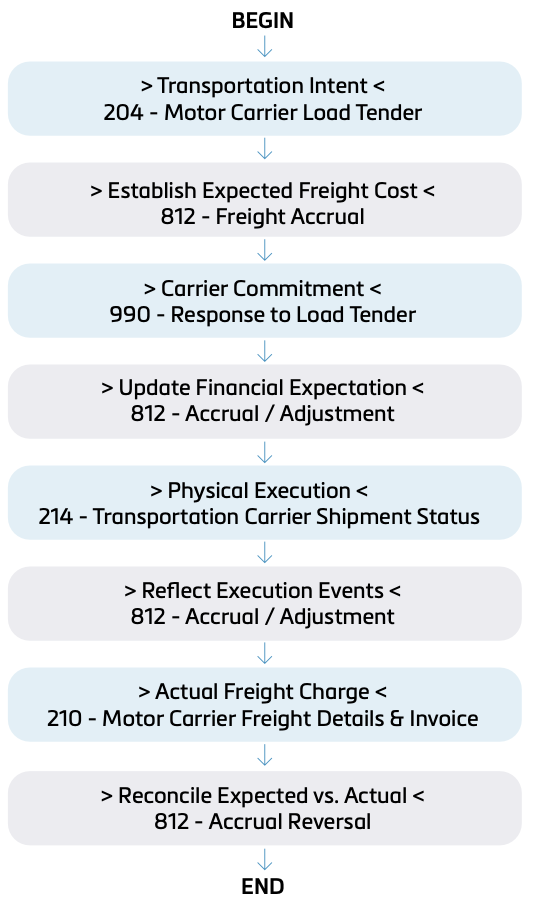
The exact sequence and triggering events can vary by organization, and that variability is itself significant. Freight accrual is not simply a document inserted into a fixed EDI sequence; it is a business process governed by events occurring during and throughout the shipment lifecycle.
A tender can create an expected obligation. An acceptance strengthens that expectation. A pickup signal can confirm that transportation service is underway. The shipment-status event provides additional execution context. The invoice eventually replaces an estimated financial obligation with the carrier's actual charge.
This means connected transportation visibility can answer more than what was supposed to happen or what is happening to the freight now, it can also help answer questions related to finance. What financial obligation has the transportation process created, and does that obligation still reflect what is actually happening?
That relationship becomes especially important when shipment, carrier, accounting, and settlement information reside in different systems. A TMS may manage the tender. EDI transactions may communicate carrier acceptance and shipment status. An ERP may hold the accrual. Accounts payable or freight-audit systems may eventually process the invoice.
Connecting shipment, carrier, accounting, and settlement information across systems is an important step toward operational control. The objective is not to centralize every process in one application, but to preserve enough context across systems and partners to understand what happened, identify what changed, and determine what requires action.
Shipment Status is an Event Stream, Not the Entire Story
Once the freight is on the move, the EDI 214 Transportation Carrier Shipment Status Message provides structured shipment-status information across the transportation lifecycle. The EDI 204 and EDI 990 are considered upstream transactions widely associated with the 214, they establish the shipment and carrier response before shipment-status reporting begins. The business value of the 214 occurs/increases when shipment events can be interpreted alongside the tender, the carrier commitment, the shipment references, scheduling requirements, customer expectations, and other information surrounding the load, in short together, collectively they answer the primary freight question, “Where’s my stuff?”
What is enough context?
A shipment event becomes operationally meaningful when it can be interpreted against the transportation process surrounding it. A delayed 214 status, for example, becomes more useful when connected to the original 204 tender, the carrier's 990 response, the expected freight obligation represented through the 812, shipment requirements, and eventually the 210 invoice.
The objective is not to make every event actionable. Rather, connected context helps determine which events represent normal execution, which represent exceptions, and which exceptions create service, operational, customer, or financial consequences (another word for ‘scorecarding’). Connected context when used in this way allows transportation teams to move from seeing an event to understanding why it matters.
Transaction → Event → Context → Exception → Business Impact → Action
The closer an organization can move shipment information through the progression, the closer visibility moves toward operational intelligence.
The Transportation Lifecycle through Settlement
Settlement closes the financial loop that began before the shipment moved. The EDI 210 Motor Carrier Freight Details and Invoice[9] provides the actual freight charge, while the 812 can support reversal or reconciliation of the financial expectation established earlier in the transportation lifecycle. The resulting comparison connects planned transportation activity, actual execution, expected cost, and actual cost.
This creates a more complete Load-to-Invoice view. Instead of treating transportation and accounting as separate information flows, organizations can relate what was tendered, accepted, accrued, executed, invoiced, and reconciled as connected stages of the same commercial process.
The value extends well beyond accounting accuracy. Differences among expected execution, actual shipment events, expected freight cost, and invoiced charges can themselves become operational signals—providing additional context for exception management, carrier performance, freight audit, and future transportation decisions.
Visibility to Operational Control
Connected visibility establishes what is happening across the transportation lifecycle. Operational control goes further by using that context to determine what requires attention, what business consequence is developing, and what action should follow. The distinction is important: visibility informs; operational control connects information to decisions and execution.
For LTL operations, that means relating transportation intent, carrier commitment, freight accrual, shipment status, invoice, and reconciliation across systems (TMS, WMS, ERP, EDI, and API), and partners responsible for the movement. A missing acceptance, a delayed pickup, an unexpected status, a changing accrual, or an invoice variance becomes more valuable when evaluated as part of the same shipment lifecycle rather than as an isolated transaction—providing context that can help identify risk.
Operational control requires sufficient connectivity among applications (TMS, WMS, ERP, EDI, and API), partners, transactions, and business rules to recognize meaningful exceptions and coordinate the appropriate response while existing systems continue performing their established roles.
Executive Thesis
Competitive LTL service increasingly depends on turning distributed transaction events into shared operational context. The advantage does not come from collecting more shipment status information; it comes from connecting transportation intent, commitment, financial expectation, execution, settlement, and reconciliation sufficiently well to recognize exceptions and coordinate action across the network.
The Operational Context Progression
Operational intelligence develops as transaction data acquires business context. A transaction records an event; related events establish context; context identifies meaningful exceptions; exceptions reveal potential business impact; and business impact determines where action is required. Connecting those stages is what allows transportation visibility to progress toward operational control.
- Physical Flow — What is happening to the freight?
- Transaction Flow — What was requested, accepted, reported, and communicated?
- Financial Flow — What is expected to be owed, adjusted, invoiced, and reconciled?
Connected operational context emerges when physical freight movement, transaction activity, and financial events can be interpreted as parts of the same transportation process. Together, these flows explain what was expected, what was communicated, what actually occurred, what it cost, and where execution diverged—providing the context needed to identify exceptions and coordinate action.
What Does Operational Control Change?
Connected context can help teams identify missing carrier responses, delayed milestones, changing financial expectations, shipment exceptions, and invoice variances without reconstructing the lifecycle manually across multiple systems. The result is a more focused operating model in which people investigate meaningful exceptions rather than every transaction.
The business consequence is very practical: earlier exception awareness, better prioritization, stronger freight-cost context, more informed carrier-performance analysis, and greater continuity between transportation operations and financial settlement.
Operational control does not eliminate transportation variability; it improves the organization's ability to recognize and respond to it.
The Integration and Orchestration Opportunity
Transportation organizations do not necessarily need another system of record to create connected operational context. What transportation organizations need is an integration and orchestration layer. That's where the opportunity lies: within an interconnected internal ecosystem. While TMS, ERP, WMS, freight-audit, carrier, and accounting applications can continue performing the functions for which they were designed an integration and orchestration layer connects the transactions and events moving among them.
Such a layer provides a common foundation for EDI and API connectivity, partner communications, transaction validation, mapping, business rules, exception visibility, and workflow orchestration.
What is connected LTL visibility?
Connected LTL visibility is the ability to interpret physical freight movement, transaction activity, and financial events as parts of the same transportation process. It connects what was requested, accepted, accrued, executed, invoiced, and reconciled so teams can identify meaningful exceptions, understand their business impact, and determine what requires action.
PartnerLinQ represents one approach to a connected visibility architecture, its role perhaps best understood as a connective and orchestration layer capable of relating partner transactions and enterprise application events across the transportation lifecycle while enhancing and preserving existing systems of record. The business case ultimately depends on whether that connected context helps an organization identify meaningful exceptions earlier and coordinate execution more effectively.
Conclusion: Operational Control Begins with Connected Context
Tender, acceptance, accrual, shipment status, invoice, and reconciliation events collectively describe the commercial, operational, and financial lifecycle surrounding that shipment. Connecting those events creates a more complete understanding of what was expected, what occurred, and where execution diverged.
The progression from load status to operational control occurs when connected information can distinguish normal activity from meaningful exceptions, relate those exceptions to business consequences, and help the appropriate teams determine what should happen next. This is where visibility becomes operationally valuable—not because more data is available, but because the relationships among events are better understood.
Physical Flow + Transaction Flow + Financial Flow
↓
Connected Operational Context → Operational Intelligence → Operational Control.
The strategic opportunity for transportation organizations operating across multiple partners and systems is a connected execution model capable of carrying context from transportation intent through commitment, financial expectation, physical execution, settlement, and reconciliation.
Footnotes
- Market Compression in Transportation Markets for Shippers and Carriers
- EDI 204 - Motor Carrier Load Tender
- EDI 990 - Response to a Load Tender
- EDI 812 - Credit/Debit Adjustment (Freight Accrual)
- EDI 214 - Transportation Carrier Shipment Status Message
- EDI 210 – Motor Carrier Freight Details and Invoice (X12 4010)
- ..and PartnerLinQ.com

Explore Our Integration Solutions

PartnerLinQ Integration Solutions
Connect Everything. Integrate Intelligently.
Future-Proof Your Business with Composable, AI Powered Connectivity.