
IN THIS BLOG
What is Phantom Inventory?
Phantom inventory is stock recorded in systems as available but not physically present. It occurs when inventory transactions—such as receipts, shipments, and adjustments—are delayed or unsynchronized, causing discrepancies between the ERP and warehouse reality, leading to inaccurate available-to-promise (ATP), missed orders, and financial misstatements.
Phantom inventory is one of the most persistent and costly execution failures in modern supply chains.
Organizations operating across ERP, WMS, and 3PL environments frequently encounter discrepancies between system-reported inventory and physical stock. These gaps are not caused by a lack of visibility—but by a lack of synchronized execution across inventory transactions.
Introduction
It starts quietly—an unposted receipt, a missed adjustment, a delayed shipment confirmation. Over time, these gaps compound into phantom inventory that distorts availability, disrupts fulfillment, and erodes confidence across the supply chain.
The Reality Behind Phantom Inventory
Phantom inventory is not a reporting issue. It is an execution failure that emerges when physical inventory and system-of-record inventory fall out of sync. In modern, multi-enterprise supply chains—especially those dependent on 3PLs, distributed warehouses, and high-velocity fulfillment—this gap becomes unavoidable without synchronized, transaction-level visibility.
The consequences are immediate and compounding:
- Orders are accepted against inventory that does not exist
- Perishable goods expire before they are properly accounted for
- Financial records drift from operational reality
- Customer experience degrades due to missed or delayed fulfillment
In fresh, perishable, and regulated supply chains, the problem accelerates if left unaddressed. Shelf-life compression, lot-level traceability requirements, and volatile demand patterns introduce an increased latency risk. When supplier, warehouse, and ERP systems are not synchronized in near real time, phantom inventory becomes systemic.
The Root Cause: Latency Accumulation across Inventory Transactions
Phantom inventory is the cumulative effect of latency across core warehouse and inventory transactions. Phantom inventory occurs when core EDI transactions—943 (inbound notice), 944 (receipt), 940 (ship order), 945 (shipment confirmation), 947 (adjustment), and 846 (inventory visibility)—fall out of sync. Each delay compounds the gap between physical inventory and system records, resulting in inaccurate availability and fulfillment failures.
Definition
Advance shipment notice for internal stock transfers between facilities or 3PLs, including item, quantity, and arrival details
Confirms physical receipt of goods into the warehouse, including quantities, variances, and traceability data
Instruction from ERP/depositor to warehouse to pick, pack, and ship specified goods
Confirms actual shipment execution, including quantities shipped, substitutions, and shortages
Communicates inventory adjustments such as gains, losses, damage, expiration, or reclassification
Provides a time-stamped snapshot of inventory availability across locations and systems
Role in Inventory Lifecycle
Prepares warehouse for inbound inventory and aligns expectations
Establishes system-of-record inventory position
Initiates outbound inventory movement
Decrements inventory and closes fulfillment loop
Reconciles physical vs. system inventory
Publishes available-to-promise (ATP) signal
Risk if Delayed
Warehouse unprepared; receiving delays; inbound mismatches
Warehouse unprepared; receiving delays; inbound mismatches
Orders released against inaccurate stock; fulfillment risk increases
Inventory not reduced in time; overselling and ATP distortion
Discrepancies persist; phantom inventory accumulates
Downstream systems act on false inventory data
Why Does Phantom Inventory Happen?
Phantom inventory occurs when inventory transactions are not synchronized in real time. Delays in or missing receipt confirmation (EDI 944), shipment confirmation (EDI 945), or inventory adjustments (EDI 947) creates gaps between physical stock and system records, leading to inaccurate inventory visibility and fulfillment errors.
How Do You Fix Phantom Inventory?
Phantom inventory is resolved by synchronizing inventory transactions across systems. This requires event-driven updates, real-time EDI/API integration, and automated inventory adjustments (EDI 947) to ensure that physical inventory and system-of-record data remain aligned.
The EDI 947: The Control Point for Inventory Truth
The EDI 947 – Warehouse Inventory Adjustment Advice is the transaction designed to reconcile drift—aligning physical inventory with system-of-record balances when discrepancies are identified, in near real time.
What the 947 Does?
- Synchronizes physical vs. book inventory
- Reports inventory gains, losses, and reclassifications
- Triggers alternate workflows (exception, cycle count)
- Maintains audit and compliance traceability
Without the 947, discrepancies accumulate silently—leading to stockouts, over-promising, and financial misstatement. Under the Sarbanes-Oxley Act (SOX), public companies are required to ensure that financial statements are accurate, complete, and supported by effective internal controls, a financial misstatement—whether due to error or fraud— a financial misstatement signals a breakdown in those controls.
The Closed-Loop Inventory Execution Model
Inbound Visibility (943 → 944)
The EDI 943 prepares the warehouse with inbound shipment detail and traceability and the EDI 944 confirms what was actually received, including variances that may have occurred during transit including over, short or damaged (OSD) product; a condition which may be the result of shipping or receiving damage of product or products.
The Inventory Signal (846)
The EDI 846 publishes a time-stamped inventory snapshot available-to-promise (ATP) signal. The transaction is structured so that inventory positions can be reported as of a specific date and time and may be reported at the total product level even broken down by lot and batch numbers, or other identifiers which allow the parties to precisely synchronize product inventories.
Outbound Execution (940 → 945)
The Warehouse Shipping Order (EDI 940) specifies what products to ship and the EDI 945 confirms actual shipment execution using a flexible data structure that allows for shipment reporting at the shipment, order, tare (pallet), and pack.
Reconciliation (947)
The EDI 947 corrects discrepancies and restores inventory truth by providing detailed information about modifications to inventory records, as might be the case when the warehouse operator encounters over, short or damaged (OSD) product; a condition which may be the result of warehouse damage, receiving damage, or previously concealed damage of product or products, within a carton and/or within a shipment previously received.
Cross-Standard Canonical Mapping
Lifecycle Layer
Inbound Inventory Lifecycle
Inbound Inventory Lifecycle
Inventory Visibility Signal
Execution & Fulfillment
Execution & Fulfillment
Inventory Adjustment Control
Business Function
Stock Transfer Shipment (Pre-Advice)
Stock Transfer Receipt Confirmation
Inventory Availability / ATP Snapshot
Warehouse Shipping Instruction
Shipment Confirmation
Inventory Adjustment / Reconciliation
ANSI X12
943 – Warehouse Stock Transfer Shipment Advice
944 – Warehouse Stock Transfer Receipt Advice
846 – Inventory Inquiry/Advice
940 – Warehouse Shipping Order
945 – Warehouse Shipping Advice
947 – Warehouse Inventory Adjustment Advice
EDIFACT
DESADV (Despatch Advice)
RECADV (Receiving Advice)
INVRPT (Inventory Report)
ORDERS / HANMOV
DESADV (outbound)
INVRPT (delta) / ADJINV (variant)
SAP IDoc
SHPMNT / DELVRY
WMMBXY / MBGMCR
INVRPT / MATMAS (extended)
DELVRY / SHPMNT
DELVRY / SHPMNT
MBGMCR / WMMBXY
Phantom Inventory in Perishable & Fresh Supply Chains
Phantom inventory behaves differently across industries—but the root cause remains the same: latency between physical events and digital updates.
Grocery & Related Products
High-velocity, perishable inventory amplifies risk. Shelf-life compression means delays in 944 (receipt) or 947 (adjustment) lead directly to spoilage, that is items being discounted as sellable stock. Promotions and demand spikes further distort available-to-promise (ATP) when the EDI 846 signals lag behind.
Retail & Wholesale Apparel (E-commerce Focus)
Omnichannel fulfillment depends on precise available-to-promise (ATP) conditions. Phantom inventory emerges when 945 shipment confirmations lag, behind causing online storefronts to oversell. Returns processing without timely 947 adjustments creates inflated inventory positions across DCs and stores.
Health & Beauty Aids (HBA)
Lot-controlled and expiration-sensitive Health & Beauty Aids (HBA) inventories require precision. Phantom inventory results from delayed 944 receipts or missing 947 reclassifications (e.g., hold → sellable). Compliance and brand risk increase when expired or quarantined goods remain “available.”
Food & Beverage Manufacturing
Production variability and batch-based inventory introduce frequent if not constant adjustments s. Without real-time 947 updates, yield variances and spoilage remain unaccounted for. This leads to incorrect replenishment signals driven by outdated 846 snapshots.
Logistics Services / 3PL Networks
Multi-client warehouses create visibility fragmentation. Phantom inventory thrives in environments where 3PL execution (944, 945) is not synchronized with depositor ERP systems. Blind spots emerge when adjustments (947) are delayed or not automated.
Healthcare Distribution (Cardinal, McKesson, AmerisourceBergen-type models)
Regulated, serialized, and lot-tracked inventory requires absolute accuracy. Phantom inventory introduces compliance risk, recall exposure, and patient safety concerns. Delays in 947 adjustments or 846 updates compromise traceability and audit readiness.
Key Insight
Across all industries when transactions fall out of sync, phantom inventory emerges.
- The 846 tells you what you think you have
- The 947 tells you what actually changed
The Real Problem: Visibility Without Execution Control
Dashboards don’t fix inventory, transactions do.
- The 846 provides visibility
- Regularly exchange stating what you think you have
- Perfect for cycle counting
- The 947 re-enforces truth
- Unscripted, irregular exchange indicating what has actually changed
- Perfect for exceptions
Without synchronized execution, visibility becomes misleading.
The Solution: Transaction-Level Synchronization
Eliminating phantom inventory requires:
- Event-driven EDI (not batch latency)
- Cross-system synchronization (ERP, WMS, OMS, partners)
- Exception governance (947-triggered workflows)
- Canonical data normalization
- An Execution Control Layer to orchestrate transactions

Transaction Layering Model (Execution Control View)
Inventory accuracy is not achieved at a single point—it is governed across layers. Inbound transactions establish inventory, visibility transactions publish it, execution transactions consume it, and adjustment transactions correct it. When all layers operate in sync, inventory becomes a controlled, reliable signal. When any layer operates independently, phantom inventory emerges.
Lifecycle Layer
Inbound Inventory Lifecycle
Inventory Visibility Signal
Execution & Fulfillment
Inventory Adjustment Control
Transactions
EDI 943
EDI 944EDI 846
EDI 940
EDI 945EDI 947
Purpose
Establish inbound inventory position and validate receipt
Publish time-stamped inventory availability (ATP)
Initiate and confirm outbound inventory movement
Reconcile discrepancies and enforce inventory truth
What It Controls
Physical-to-system inventory creation
Cross-system and partner visibility
Inventory consumption and order fulfillment
Exception handling and inventory correction
Failure Outcome
Inventory never properly established → phantom availability begins
Systems act on incorrect inventory → overselling, misallocation
Inventory not decremented → ATP distortion, missed shipments
Discrepancies persist → phantom inventory accumulates
Inventory Execution Lifecycle
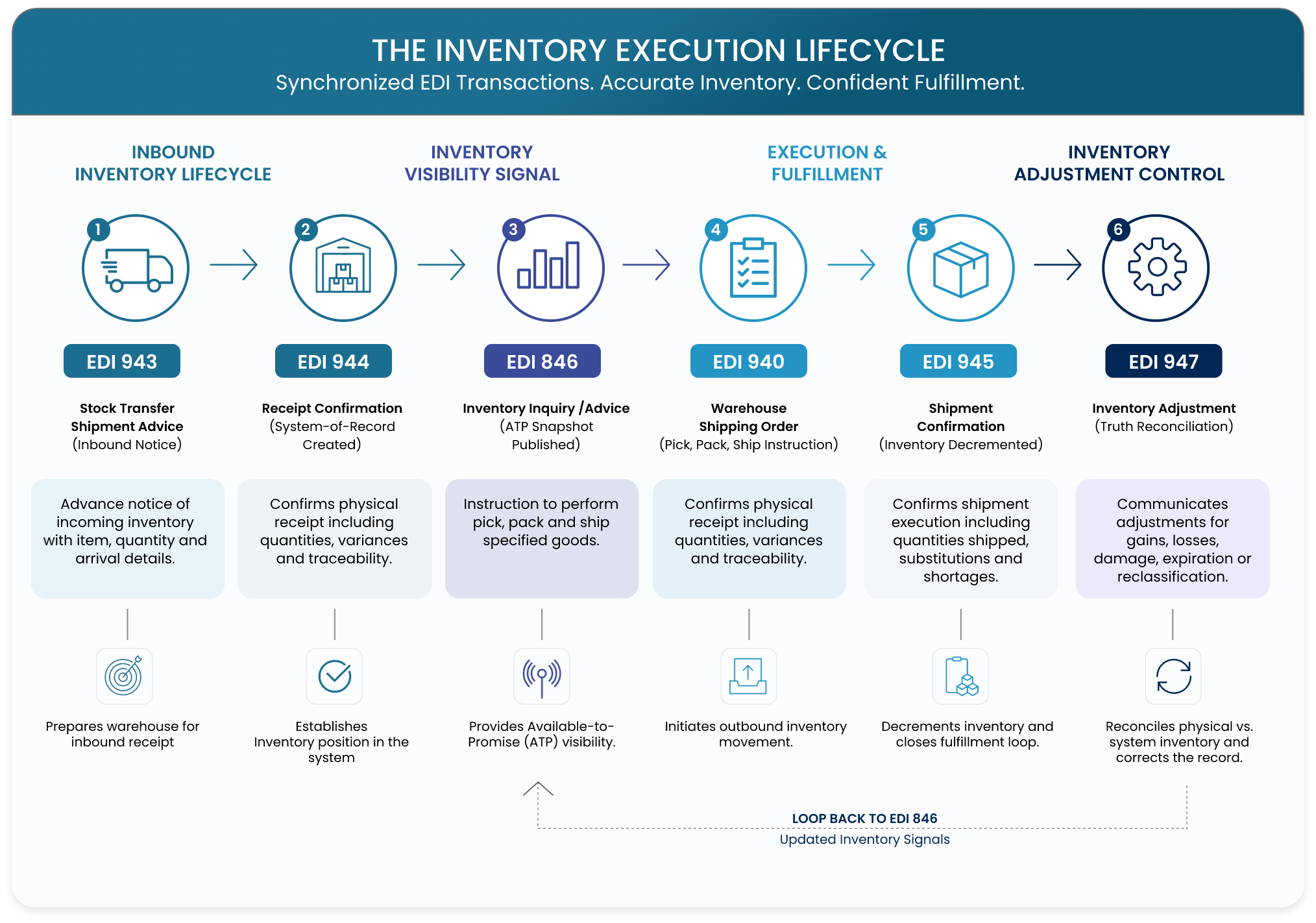
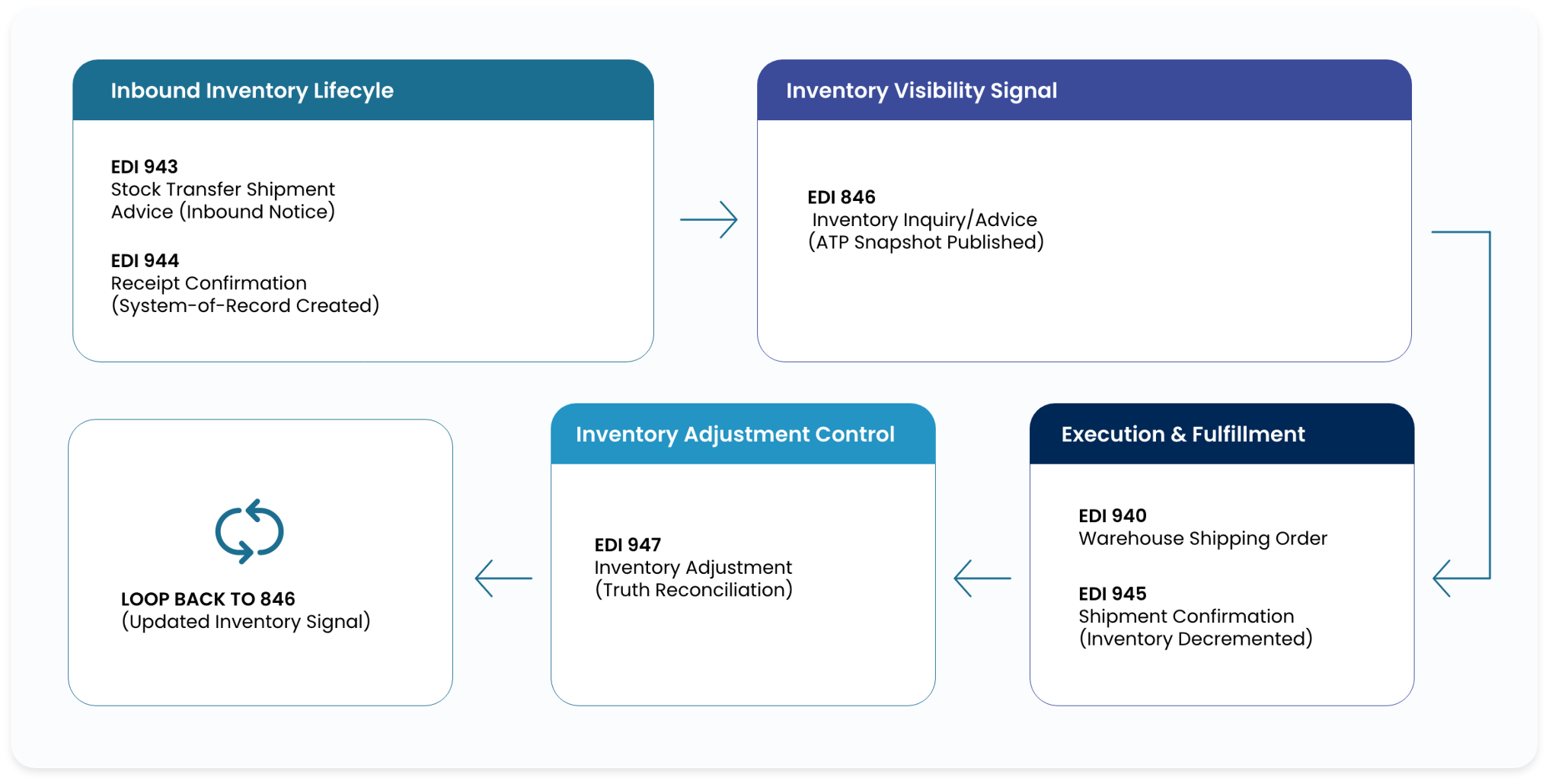
The inventory lifecycle operates as a closed loop: inbound inventory (943/944) establishes stock, the 846 publishes availability, outbound execution (940/945) consumes inventory, and the 947 reconciles discrepancies—feeding corrected inventory back into the 846 signal.
Before vs After Table
Condition
Inventory Accuracy
ATP Reliability
Financial Reporting
3PL Visibility
Without Execution Control
System vs physical mismatch
Frequently incorrect
Misstatements, audit risk
Fragmented
With Execution Control
Fully synchronized
Real-time accurate
SOX-aligned accuracy
Unified
Architecture Insight:
Phantom inventory is not a transaction problem—it is a layering failure across inbound, visibility, execution, and adjustment systems.
Explore PartnerLinQ
Eliminating phantom inventory requires more than visibility—it requires control over how inventory moves, updates, and reconciles across your entire supply chain. PartnerLinQ enables:
- Real-time synchronization across ERP, WMS, and 3PL systems
- Event-driven inventory visibility (EDI 846)
- Automated discrepancy resolution (EDI 947)
- End-to-end execution control across inbound, outbound, and adjustment workflows
Explore how synchronized execution eliminates phantom inventory at the source.
- Multi-Standard EDI Intelligence
- Warehouse & 3PL integration
- Unlocking the Power of Multi-Enterprise Supply Chain Business Networks
If your inventory cannot reconcile in real time, phantom inventory is not a possibility—it is already happening.
Learn EDI
- What is EDI
- Inventory Visibility Signal
- Inventory Adjustment Control
- Execution & Fulfillment
- Inbound Inventory Lifecycle
People Also Ask
What is phantom inventory?
Phantom inventory is stock recorded in systems as available but not physically present. It results from delays or errors across transactions like receipts, shipments, and adjustments. This mismatch leads to inaccurate available-to-promise (ATP), missed orders, and financial discrepancies.
What causes phantom inventory?
Phantom inventory is caused by latency between physical inventory events and system updates. Missing or delayed transactions such as EDI 944 (receipt), 945 (shipment), and 947 (adjustment) create gaps between warehouse reality and ERP records.
How does EDI prevent phantom inventory?
EDI prevents phantom inventory by synchronizing inventory data across systems in near real time. Transactions like EDI 846 provide visibility, while EDI 947 corrects discrepancies, ensuring alignment between physical stock and system-of-record inventory.
What is the difference between EDI 846 and 947?
EDI 846 reports current inventory status as a snapshot, while EDI 947 communicates inventory adjustments and corrections. The 846 shows what inventory exists; the 947 updates that inventory when discrepancies occur.
Why is phantom inventory dangerous in e-commerce?
Phantom inventory leads to overselling, canceled orders, and poor customer experience in e-commerce. When online systems rely on inaccurate inventory data, fulfillment failures increase and brand trust declines.
How does phantom inventory impact financial reporting?
Phantom inventory distorts inventory valuation, leading to inaccurate financial statements. It impacts cost of goods sold (COGS), working capital, and audit outcomes, especially when adjustments are not properly recorded.
Can 3PL providers cause phantom inventory?
Yes, phantom inventory often originates in 3PL environments when warehouse execution systems are not synchronized with client ERP systems. Delayed receipts, shipments, or adjustments create visibility gaps.

How do perishable goods increase phantom inventory risk?
Perishable goods increase risk due to shelf-life constraints. Delays in inventory updates can result in expired or spoiled goods being counted as available, leading to financial loss and compliance issues.
What role does real-time data play in inventory accuracy?
Real-time data ensures that inventory changes are reflected immediately across systems. This reduces discrepancies, improves fulfillment accuracy, and eliminates phantom inventory caused by delayed updates.
What industries are most affected by phantom inventory?
Industries with high velocity or regulated inventory—such as grocery, e-commerce retail, pharmaceuticals, and 3PL logistics—are most affected due to the need for precise, real-time inventory synchronization.
Is phantom inventory a financial risk?
Yes. Phantom inventory can lead to financial misstatements by overstating inventory assets and distorting cost of goods sold (COGS). This creates audit risk and potential compliance issues under financial reporting frameworks such as SOX.
Is Phantom Inventory a SOX Issue?
Yes. Phantom inventory can lead to financial misstatements by overstating inventory assets and distorting cost of goods sold (COGS). Under the Sarbanes-Oxley Act, this represents a failure in internal controls and can trigger audit findings or material weaknesses.
What is the difference between inventory accuracy and inventory visibility?
Inventory visibility shows what systems report, while inventory accuracy reflects physical reality. Phantom inventory occurs when visibility exists without accuracy, typically due to delayed or missing inventory transactions.
Can real-time inventory eliminate phantom inventory?
Real-time inventory significantly reduces phantom inventory by ensuring that all inventory transactions—receipts, shipments, and adjustments—are immediately reflected across systems, minimizing discrepancies between physical and digital inventory.
What systems are involved in phantom inventory?
Phantom inventory typically occurs across ERP, WMS, OMS, and 3PL systems when these platforms are not synchronized through real-time data exchange and transaction-level integration.
How do inventory adjustments (EDI 947) prevent phantom inventory?
EDI 947 prevents phantom inventory by communicating inventory corrections such as damage, loss, or reclassification, ensuring that discrepancies are resolved and system inventory aligns with physical stock.

Executive Insight
Phantom inventory is not a mystery. It is the predictable outcome of fragmented execution across inventory transactions. Organizations that operationalize EDI as a synchronized execution framework eliminate phantom inventory at its source.
What is an execution control layer?
An execution control layer is a unified orchestration framework that governs how EDI, APIs, and enterprise integrations operate across supply chains. It standardizes data through a canonical model, manages transformation logic and transport protocols, and delivers real-time visibility, control, and scalability without introducing integration sprawl.
#ExplorePartnerLinQ: Standards-First Processing
Epilogue
Eliminating phantom inventory demands synchronized execution across every transaction, every partner, and every system. The fix isn’t another report—it’s control over how inventory moves, updates, and reconciles at the transaction level.