
What Is EDI Cycle Counting?
EDI cycle counting is the process of synchronizing physical warehouse inventory counts with ERP and warehouse management system records using Electronic Data Interchange (EDI). Organizations use EDI-driven inventory reconciliation to reduce phantom inventory, improve warehouse visibility, automate inventory adjustments, strengthen fulfillment accuracy, and support inventory synchronization across manufacturers, distributors, retailers, and third-party logistics providers.
What Is Phantom Inventory?
Phantom inventory occurs when warehouse or ERP systems report inventory that is unavailable, missing, damaged, misplaced, or no longer physically present. Phantom inventory is commonly caused by delayed transaction synchronization, inaccurate inventory adjustments, warehouse process failures, shipment discrepancies, and disconnected inventory visibility across supply chain systems.
#PartnerLinQInsight
Introduction
The struggle for inventory reconciliation is real. It happens every day and it consumes real-time, the impact is real and there are real implications, after all you can’t sell what you don’t see. Visibility gaps between internal ERP and physical warehouse stock means explaining why the shipment is going to be late. When third-party providers (3PL) are involved it means more work, more email, more telephone calls, activities often extending beyond regular shipping hours.
The use of EDI in cycle counting extends the use of EDI standards to automate the synchronization of inventory data across supply chain partners. Synchronization of inventory implies several process steps that include balances, updates, and audits. Audits, a key tool in automating the synchronization of inventories across supply chain partnerships, cycle counts, a timely audit of specific products and or locations, are key relieving phantom inventory.
What Is the Difference Between a Cycle Count and a Physical Inventory?
Cycle counting is an ongoing inventory audit process where specific inventory and locations or product groups and their locations are counted at scheduled intervals throughout the course of normal warehouse operations. Physical inventory counting is different and typically involves counting the entire warehouse inventory at one time, a process often requiring operational shutdowns, temporary staff, or temporary interruptions of fulfillment or put-away.
Why is Cycle Counting better than an annual physical inventory?
Cycle counting improves inventory accuracy because it is a continual audit throughout the warehouse or operation. A year-round activity - without requiring operational suspensions or closure. Unlike an annual physical inventory, cycle counting enables organizations to identify inventory discrepancies early, reduce operational disruption, improve visibility, and support ongoing inventory reconciliation across warehouse networks.
Automated cycle counts messages to warehouse staff by way of RF devices between waves can be an positive impact an operation when coupled with fast moving items in multiple slots and pick mods.
How does the struggle for inventory reconciliation begin?
The struggle for inventory reconciliation begins when physical warehouse activity and system inventory records fall out of synchronization. Delayed transaction processing, disconnected warehouse systems, shipment timing gaps, and limited inventory visibility create discrepancies between what inventory systems report and what physically exists inside the warehouse. As these visibility gaps grow, organizations experience shipment delays, phantom inventory, replenishment inaccuracies, and increased operational complexity across warehouse and supply chain operations.
Why Is Cycle Counting Important?
Cycle counting improves inventory accuracy by continuously validating physical warehouse inventory against system inventory records. Accurate cycle counting helps organizations reduce shipment delays, eliminate phantom inventory, improve available-to-promise calculations, support warehouse accountability, and strengthen inventory synchronization across supply chain partners.
How can I predict inventory levels?
Predicting inventory levels requires more than forecasting demand and AI (artificial intelligence). Accurate inventory prediction depends on synchronized inventory events, real-time warehouse visibility, shipment activity, replenishment timing, inventory adjustments, and continuous reconciliation between ERP systems and physical warehouse inventory.
How Does EDI Support Cycle Counting?
EDI supports cycle counting by automating inventory synchronization between warehouses, ERP systems, manufacturers, distributors, and 3PL providers. Transactions such as the EDI 846, 947, 943, 944, 940, and 945 help organizations monitor inventory balances, communicate inventory movement, confirm receipts, validate shipments, and reconcile inventory adjustments in near real time.
How Does EDI Support Near Real-Time Inventory Visibility?
EDI supports near real-time inventory visibility by automating the exchange of inventory balances, shipment confirmations, warehouse receipts, inventory adjustments, and replenishment events between warehouse systems, ERP platforms, trading partners, and supply chain applications. Automated inventory synchronization reduces visibility delays, improves warehouse coordination, and helps organizations respond faster to inventory discrepancies, fulfillment disruptions, and inventory exceptions across distributed warehouse operations.
Inside a modern warehouse operation, RF (Radio Frequency) handheld devices, mobile scanners, forklift-mounted terminals, and barcode scanning systems can be used to continuously capture warehouse events as inventory moves through receiving, put-away, picking, packing, cycle counting, replenishment, and shipping workflows. These RF-driven inventory events are transmitted into the warehouse management system (WMS) in near real time, creating a continuous stream of operational inventory updates.
The EDI 846 Inventory Inquiry/Advice transaction plays a critical role in extending that warehouse visibility beyond the four walls of the warehouse. The EDI 846 can be used to automatically communicate inventory balances, product availability, reserved inventory, replenishment status, and inventory position updates between manufacturers, distributors, retailers, suppliers, and logistics providers.
EDI supports near real-time inventory visibility by automating the exchange of inventory balances, shipment confirmations, warehouse receipts, and inventory adjustments between supply chain partners. Automated inventory synchronization reduces visibility delays, improves warehouse coordination, and helps organizations respond faster to inventory discrepancies and fulfillment disruptions.
Why Is Warehouse Inventory Visibility Important?
Warehouse inventory visibility is important because organizations cannot efficiently fulfill orders, replenish inventory, or coordinate warehouse operations without accurate inventory data. Real-time inventory visibility helps reduce shipment delays, improve inventory accuracy, minimize phantom inventory, and strengthen supply chain coordination.
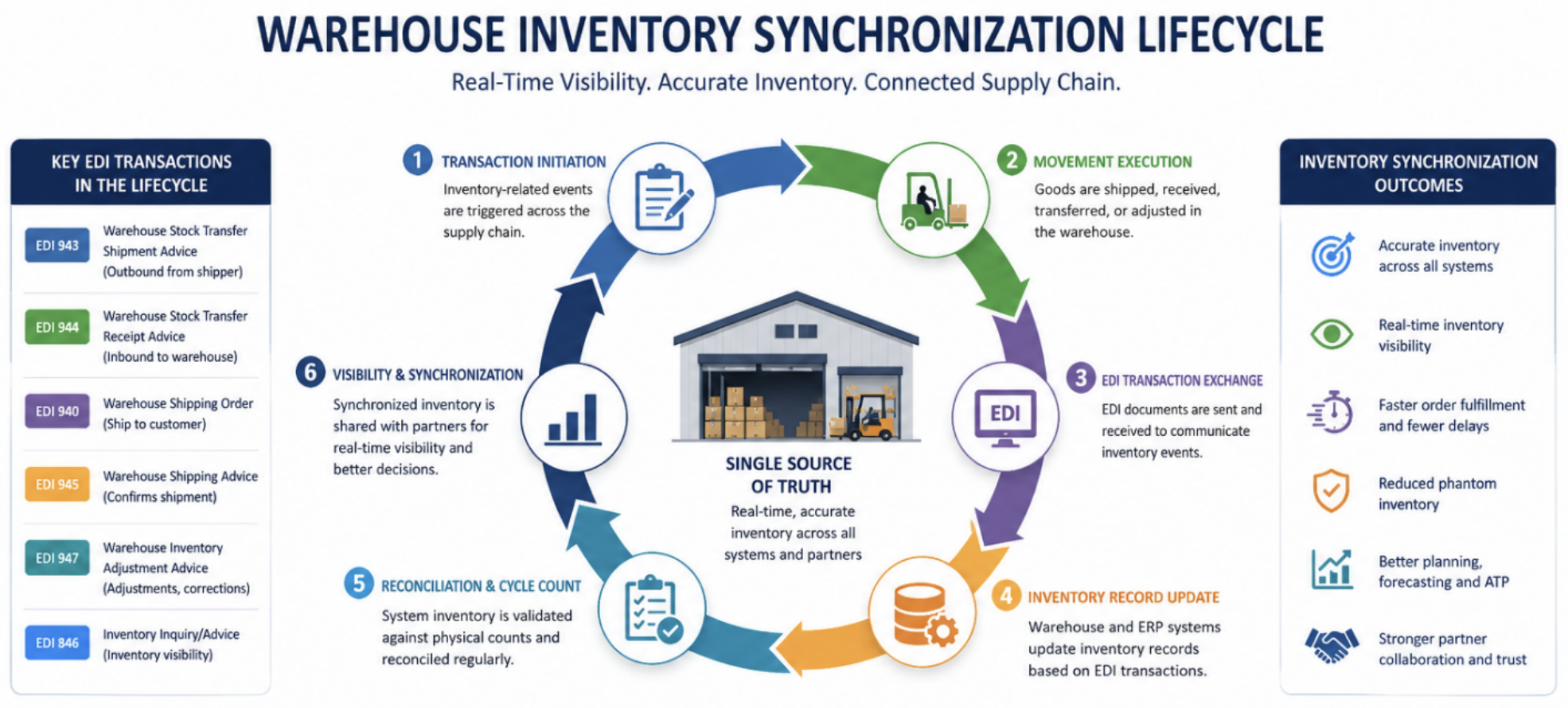
What Does Warehouse Inventory Synchronization Look Like?
Paired EDI transactions carry the burden of inventory accountability. Manufacturers and warehouses alike rely on changes to the static state to account for inventories. Movement by which inventory accounting becomes defined leaves little room for inventory reconciliation. The ‘movement’ is a primary function and inventory reconciliation state an afterthought. Regarded as secondary influence, less critical, and a critical miscalculation; inventory reconciliation is critical path to better inventory accountability.
Warehouse Lifecycle State | Supporting EDI Transactions | Operational Objective |
Inbound Inventory Movement | EDI 943, EDI 944 | Synchronize warehouse receipts |
Outbound Inventory Movement | EDI 940, EDI 945 | Synchronize fulfillment execution |
Inventory Reconciliation State | EDI 947 | Correct inventory discrepancies |
Inventory Visibility State | EDI 846 | Communicate inventory availability |
Inventory Audit State | Cycle Counting + EDI 947 | Validate inventory accuracy |
Supply Chain Visibility State | EDI 846 + ERP/WMS synchronization | Support real-time visibility |
Executive Insight
“Inventory synchronization is not a transaction — it is a continuous operational lifecycle where movement, visibility, reconciliation, and accountability converge in real time across the supply chain.”
How Do EDI Transactions Support Inventory Accountability?
EDI supports cycle counting by automating inventory synchronization between warehouses, ERP systems, manufacturers, distributors, and 3PL providers. Transactions such as the EDI 846, 947, 943, 944, 940, and 945 help organizations monitor inventory balances, communicate inventory movement, confirm receipts, validate shipments, and reconcile inventory adjustments in near real time.
What transactions represent changes to the static state?
Consider the path of EDI deployment, a path that exists largely to ship products to a customer and the first of many changes where the seller uses the EDI 940 Warehouse Shipping Order to advise the warehouse operator to make a shipment on the sellers behalf to which the warehouse responds with an EDI 945 - Warehouse Shipping Advice confirming that the shipment has been made.
The second and equally weighted set of changes takes place when the manufacturer ships to the warehouse and the warehouse acknowledges receipt. The EDI 943 Warehouse Stock Transfer Shipment Advice notifies the warehouse regarding the inbound stock transfer between facilities and the EDI 944 Warehouse Stock Transfer Receipt Advice confirms the receipt of goods into the warehouse with the manufacturer.
While the occurrence of these independently oriented sets of paired transactions occurs non-sequentially when compared to the traditional workflow, it sets up a fallacy that simply says beginning balance plus additions minus shipments equals ending balance.
Beginning Balance (BB) + additions - shipments =================== Ending Balance (BB) |
What Causes Inventory Reconciliation Problems?
Inventory reconciliation problems typically result from delayed transaction processing, inaccurate warehouse receipts, shipment discrepancies, inventory adjustments, damaged inventory, missing synchronization events, and limited visibility between ERP systems and physical warehouse inventory. Third-party logistics operations can further complicate inventory accountability when transaction timing and inventory events are not synchronized.
Why Inventory Synchronization Maturity Differs Between 3PL Providers?
Unfortunately, not all third-party logistics (3PL) providers operate with the same level of inventory synchronization maturity. Perhaps the underlying issues that plague inventory reconciliation lies on the path to EDI deployment, perhaps an overestimate of motion. Perhaps the assumption that all third-party logistics (3PL) providers operate with the same level of synchronization maturity creates visibility gaps across warehouse operations; no matter the view, an understanding of Over, Short, & Damaged (OSD) inventory conditions is essential to warehouse inventory reconciliation and in the context of phantom inventory, a required undertaking.
Communicating Over, Short, & Damaged (OSD) takes place initially in the Item Detail Exceptions (W13) where the W13 Item Detail Exception in the EDI 944 is used to identify specific quantities of items relative to their condition on arrival, specifically the receipt of items, which are over, short or damaged condition.When used properly the Warehouse Stock Transfer Receipt Advice (944) is used by the public warehouse to notify a seller when a transfer of product has been received at the warehouse and to to report overages and shortages of product, damaged product. The 944 can even be used to provide product status, such as warehouse lot number, production codes, and shelf slots which also makes it helpful with tracking internal movements between embargoed inventory and that which is slated for sales.
While the EDI 947 (Warehouse Inventory Adjustment Advice) is the standard solution for notifying a company of stock changes due to "Over, Short, and Damaged" (OSD) product, spoilage, or when there are concealed damages, there are other options as well.
What Should Inventory Synchronization Include?
Effective warehouse inventory management is the result of timely events and event processing. Manufacturers that use separate warehouse operations for storage shipments and deliveries may find significant "leakage" or manual errors in their inventory data when timely events and event processing are lacking. Ideally this process should include inventory reconciliation state and change at the same time.
What Are Static State Transactions in EDI?
Non-movement inventory state transactions are considered ‘static’, they include non-sequential transactions. These Non-sequential inventory reconciliation state transactions include the EDI 947 (Warehouse Inventory Adjustment Advice), a mechanism used for notifying a company of stock changes due to late detection of "Over, Short, and Damaged" (OSD) product, product spoilage, even concealed damages or when products are damaged in transfer by the warehouse operator the EDI 947 is the standard default solution.
The second warehouse inventory or inventory reconciliation state transaction is the EDI 846 Inventory Inquiry/Advice transaction provides a standardized mechanism for communicating inventory status between trading partners. The EDI 846 communicates product inventory levels at a time in between product movement. It enables sellers, warehouses, and buyers to exchange real-time data about available stock, reserved quantities, and replenishment opportunities.
What Is Inventory Synchronization?
Inventory synchronization is the process of maintaining consistent inventory data across warehouse systems, ERP platforms, trading partners, and supply chain applications. Inventory synchronization helps organizations reduce inventory discrepancies, improve warehouse visibility, support fulfillment accuracy, and ensure that inventory balances reflect real-time warehouse activity.
How does warehouse inventory synchronization work?
Warehouse inventory synchronization works by continuously exchanging inventory events, inventory balances, shipment confirmations, receipts, and inventory adjustments between warehouse systems, ERP platforms, and supply chain partners. EDI automation helps maintain consistent inventory visibility across operational systems and trading partner networks.
Why Is a Single Source of Truth Important for Inventory Synchronization?
A single source of truth ensures that warehouse systems, ERP platforms, trading partners, and supply chain applications operate from synchronized inventory data. Consistent inventory synchronization improves warehouse visibility, reduces phantom inventory, strengthens fulfillment accuracy, and minimizes reconciliation delays across distributed warehouse operations.
What is cycle counting?
Cycle counting is simply a snapshot of a product or an inventory at a time when a product of a group of products is not in motion, in other words - a physical count of items at a specified rate and time.
The objective of cycle counting is to produce a new balance figure with which to balance future inventory valuation, an audit method that is continuous, ongoing, where inventory locations are tallied and products are counted and during regularly scheduled business hours.
What this means typically an item, in all of it locations are counted after picking and put-away has concluded for the day, for the shift, for the week – at a predetermined period such that the audit and subsequent reconciliation does not impact operations for the seller or for the warehouse operator.
Generally speaking, the action of a cycle count acknowledge a specific inventory challenge and offers a solution to that challenge through (1) discovery of discrepancies and (2) bringing attention to the discovery of those challenges. Cycle counting does have secondary benefits as well.
How Often Should Cycle Counts Be Performed?
Cycle count frequency depends on inventory value, inventory movement volume, operational risk, and warehouse complexity. High-value or high-velocity inventory may be counted daily or weekly, while lower-risk inventory may be counted monthly or quarterly as part of an ongoing inventory reconciliation strategy.
How does cycle counting help?
Cycle counting brings much needed insight into the business of transfer, storage, picking, packing and shipment of goods that no other action delivers. Cycle counting delivers insight into processes such as put-away. If inventory is counted in its static position with inventory subsequently moving into damaged goods during the pick process, the insight gathered is one that leads to subsequent review. Perhaps the issue is in put away, perhaps in storage, perhaps it’s the packaging that causes damage during the pick cycle, whatever the case, cycle counting helps to provide an indicator which can be traced to the point of impact.
Operational Challenges and Benefits
Operational Challenge | EDI Cycle Counting Benefit |
Phantom inventory | Improves inventory accuracy |
Shipment delays | Accelerates inventory synchronization |
Manual reconciliation | Reduces operational workload |
ERP visibility gaps | Improves inventory transparency |
3PL synchronization delays | Supports real-time warehouse coordination |
Inventory discrepancies | Accelerates discrepancy detection |
Replenishment inaccuracies | Improves ATP calculations |
Warehouse accountability gaps | Strengthens audit visibility |
What Are the Benefits of Automated Cycle Counting?
Automated cycle counting improves inventory visibility, reduces manual inventory reconciliation, strengthens warehouse accountability, minimizes phantom inventory, accelerates inventory synchronization, improves order fulfillment accuracy, and supports real-time inventory decision-making across manufacturers, distributors, retailers, and third-party logistics providers.
Which EDI transactions support cycle counting?
Recommended transaction include the EDI 846, 947, 943, 944, 940, and 945 and are listed here in the Transaction Workflow Table
| Transaction | Purpose | Inventory Impact |
| EDI 943 | Communicates inbound warehouse stock transfers | Supports inbound inventory synchronization |
| EDI 944 | Confirms warehouse receipt of inventory | Validates physical inventory receipt |
| EDI 947 | Communicates inventory adjustments | Corrects inventory discrepancies |
| EDI 846 | Shares inventory balances and availability | Supports inventory visibility |
| EDI 940 | Issues warehouse shipping instructions | Initiates outbound fulfillment |
| EDI 945 | Confirms outbound warehouse shipment | Updates inventory movement status |
#LearnEDI
Why EDI Cycle Counting Matters?
EDI cycle counting strengthens warehouse visibility, improves inventory synchronization, reduces phantom inventory, and supports real-time inventory accountability across distributed supply chain operations. Organizations that synchronize inventory events, warehouse activity, ERP systems, and trading partner communications gain stronger operational control, improved fulfillment accuracy, and better inventory decision-making across the supply chain.
Organizations that treat inventory synchronization as a continuous operational lifecycle gain stronger execution control, improved warehouse visibility, and greater resilience across increasingly distributed supply chain networks.
People also ask
What is EDI cycle counting?
EDI cycle counting is the process of using Electronic Data Interchange (EDI) transactions to synchronize physical inventory counts between warehouse (WMS) and ERP inventory records. Organizations use EDI-driven inventory reconciliation to improve inventory visibility, reduce phantom inventory, automate inventory adjustments, and strengthen warehouse accountability across manufacturers, distributors, retailers, and 3PL providers.
Why cycle counting matters operationally?
Cycle counting matters operationally because inventory inaccuracies can disrupt order fulfillment, delay shipments, create phantom inventory, and reduce supply chain visibility. Continuous inventory validation helps organizations maintain accurate warehouse inventory records, improve available-to-promise calculations, reduce reconciliation delays, and support synchronized warehouse execution.
How does EDI improve inventory accuracy?
EDI improves inventory accuracy by automating inventory synchronization between warehouse systems, ERP platforms, manufacturers, retailers, distributors, and third-party logistics providers. Transactions such as the EDI 846 and EDI 947 help organizations monitor inventory balances, communicate inventory adjustments, validate warehouse activity, and reduce manual reconciliation errors.
What transactions support warehouse inventory reconciliation?
Warehouse inventory reconciliation relies on multiple EDI transactions working together across warehouse operations. The EDI 943 communicates inbound stock transfers, the EDI 944 confirms warehouse receipts, the EDI 947 communicates inventory adjustments, the EDI 846 shares inventory visibility data, the EDI 940 issues shipping instructions, and the EDI 945 confirms outbound shipments.
What causes phantom inventory?
Phantom inventory occurs when systems report inventory that does not physically exist inside the warehouse. Inventory discrepancies are commonly caused by delayed transaction processing, inaccurate warehouse receipts, shipment variances, inventory adjustments, damaged inventory, synchronization failures, and disconnected ERP or warehouse management systems.
How does the EDI 947 support inventory adjustments?
The EDI 947 Warehouse Inventory Adjustment Advice communicates inventory changes between warehouse systems and trading partners. Organizations use the EDI 947 to report inventory gains, losses, damage, shortages, overages, and reconciliation adjustments that impact warehouse inventory balances and inventory accountability.
What is the role of the EDI 846 in inventory visibility?
The EDI 846 Inventory Inquiry/Advice supports inventory visibility by communicating inventory balances, product availability, warehouse quantities, and inventory status between supply chain partners. Organizations use the EDI 846 to improve inventory synchronization, support replenishment decisions, and reduce inventory visibility gaps across warehouse networks.
How do warehouses synchronize inventory with ERP systems?
Warehouses synchronize inventory with ERP systems by exchanging inventory events, receipts, adjustments, shipment confirmations, and inventory balances through integrated warehouse management systems and EDI transactions. Synchronization helps maintain consistent inventory records between physical warehouse activity and enterprise inventory systems.
Why is inventory reconciliation important?
Inventory reconciliation is important because inaccurate inventory records can create shipment delays, inventory shortages, phantom inventory, replenishment failures, and operational inefficiencies. Reconciliation helps organizations validate warehouse inventory against system inventory records while improving inventory visibility, warehouse accountability, and fulfillment accuracy.
How do 3PL providers manage inventory synchronization?
Third-party logistics providers manage inventory synchronization by exchanging inventory movement, receipt confirmation, shipment status, and inventory adjustment transactions with customers and trading partners. EDI transactions help 3PL providers maintain synchronized inventory visibility across warehouse operations and customer ERP systems.
What is the difference between inventory movement and inventory reconciliation?
Inventory movement refers to the physical transfer, shipment, receipt, or adjustment of inventory inside warehouse operations. Inventory reconciliation focuses on validating that system inventory records accurately reflect physical warehouse inventory after inventory movement events occur.
How does cycle counting reduce inventory discrepancies?
Cycle counting reduces inventory discrepancies by continuously validating physical warehouse inventory against system inventory records throughout daily operations. Frequent inventory verification helps organizations identify inventory variances earlier, reduce reconciliation delays, improve inventory accuracy, and minimize phantom inventory exposure.
What are the benefits of automated inventory synchronization?
Automated inventory synchronization improves inventory visibility, reduces manual reconciliation effort, strengthens warehouse accountability, accelerates inventory updates, improves fulfillment accuracy, minimizes phantom inventory, and supports real-time inventory decision-making across manufacturers, distributors, retailers, and 3PL providers.
What causes inventory visibility gaps?
Inventory visibility gaps are commonly caused by delayed transaction processing, disconnected warehouse systems, inaccurate inventory adjustments, shipment timing delays, manual data entry errors, and inconsistent synchronization between warehouse management systems and ERP platforms.
How does EDI reduce shipment delays?
EDI reduces shipment delays by automating inventory communication, warehouse execution, shipment processing, inventory reconciliation, and trading partner coordination. Automated EDI transactions improve inventory visibility, reduce manual processing delays, accelerate order fulfillment, and help organizations respond faster to inventory exceptions and warehouse events.
Related Resources

Explore Our Integration Solutions

PartnerLinQ Integration Solutions
Connect Everything. Integrate Intelligently.
Future-Proof Your Business with Composable, AI Powered Connectivity.