
What is EDI 832 Price/Sales Catalog?
The EDI 832 Price/Sales Catalog transaction distributes structured product catalog and pricing information between trading partners. Manufacturers and distributors use the EDI 832 to synchronize product identifiers, descriptions, packaging details, and price lists with retailers, procurement systems, and marketplaces before ordering transactions occur.
Transaction Identity Block
| Attribute | Description |
| Transaction Name | Price / Sales Catalog |
| X12 Transaction Set | EDI 832 |
| Industry Usage | Retail, Distribution, Manufacturing, eCommerce, Wholesale |
| Primary Purpose | Exchange structured product catalog and pricing data between trading partners |
| Typical Sender | Manufacturer, Brand Owner, Distributor |
| Typical Receiver | Retailer, Marketplace Operator, Procurement System |
| Common Preceding Transactions | 816 Organizational Relationships |
| Common Following Transactions | 850 Purchase Order, 855 PO Acknowledgment, 856 ASN, 810 Invoice |
| Standard Version | ANSI X12 4010 / 5010 (varies by industry implementation) |
The EDI 832 Price / Sales Catalog transaction set supports the electronic exchange of product catalog and pricing information between trading partners. The message replaces traditional paper catalogs and allows suppliers to distribute structured product information and pricing to retailers, distributors, and procurement platforms through standardized electronic communication. The transaction typically communicates two primary information groups:
• Product identification and descriptive attributes
• Pricing and market-specific pricing conditions
Organizations use the EDI 832 to maintain synchronized product and pricing data across enterprise systems, marketplaces, and procurement platforms.
What Does the EDI 832 Do?
The EDI 832 Price/Sales Catalog is used to electronically distribute product catalog and pricing information between trading partners. Manufacturers and distributors send the EDI 832 to retailers, procurement platforms, and marketplaces so that product descriptions, packaging details, and price lists can be automatically synchronized across purchasing and ordering systems.
Who Sends the EDI 832?
The EDI 832 is typically sent by manufacturers, brand owners, and distributors who maintain authoritative product catalogs and pricing. Retailers, wholesalers, procurement platforms, and marketplaces receive the transaction to update internal product databases, synchronize pricing, and prepare downstream ordering transactions such as the EDI 850 Purchase Order.
Who typically receives an EDI 832 and what do they do with it?
Retailers, distributors, and procurement systems ingest the catalog data directly into ERP, product information management (PIM), or eCommerce platforms where it becomes authoritative product and pricing data used for downstream ordering and billing processes.
Who Uses the EDI 832?
Organizations across multiple industries use the EDI 832 to maintain product master data and pricing alignment between trading partners. Common users include:
| Role | Typical Use |
| Manufacturers | Publish product catalogs and pricing |
| Distributors | Synchronize product master data across reseller networks |
| Retailers | Maintain product listings and pricing accuracy |
| Marketplaces | Ingest product data for eCommerce catalogs |
| Procurement Platforms | Maintain supplier price lists |
When Is the EDI 832 Required?
The EDI 832 is typically required when trading partners need a standardized method to communicate catalog or pricing updates across supply-chain networks. The transaction is commonly used when:
- New products are introduced
- Pricing changes occur
- Contract pricing is established
- Promotional pricing is published
- Product descriptions or packaging configurations change
When Is the EDI 832 Sent?
The EDI 832 is sent whenever product catalog or pricing information must be distributed or updated across trading partners. Common triggers include new product introductions, price list updates, promotional pricing changes, contract pricing adjustments, or product description revisions that must be reflected in ordering systems.
Is the EDI 832 Mandated Under Regulation?
The EDI 832 is not mandated by government regulation. Industry adoption occurs primarily through trading partner agreements and supply chain integration programs.
Retail, grocery, automotive, and healthcare sectors commonly include the EDI 832 as part of vendor onboarding requirements because it ensures consistent product and pricing data across ordering systems.
How Does the EDI 832 Work in the Business Workflow?
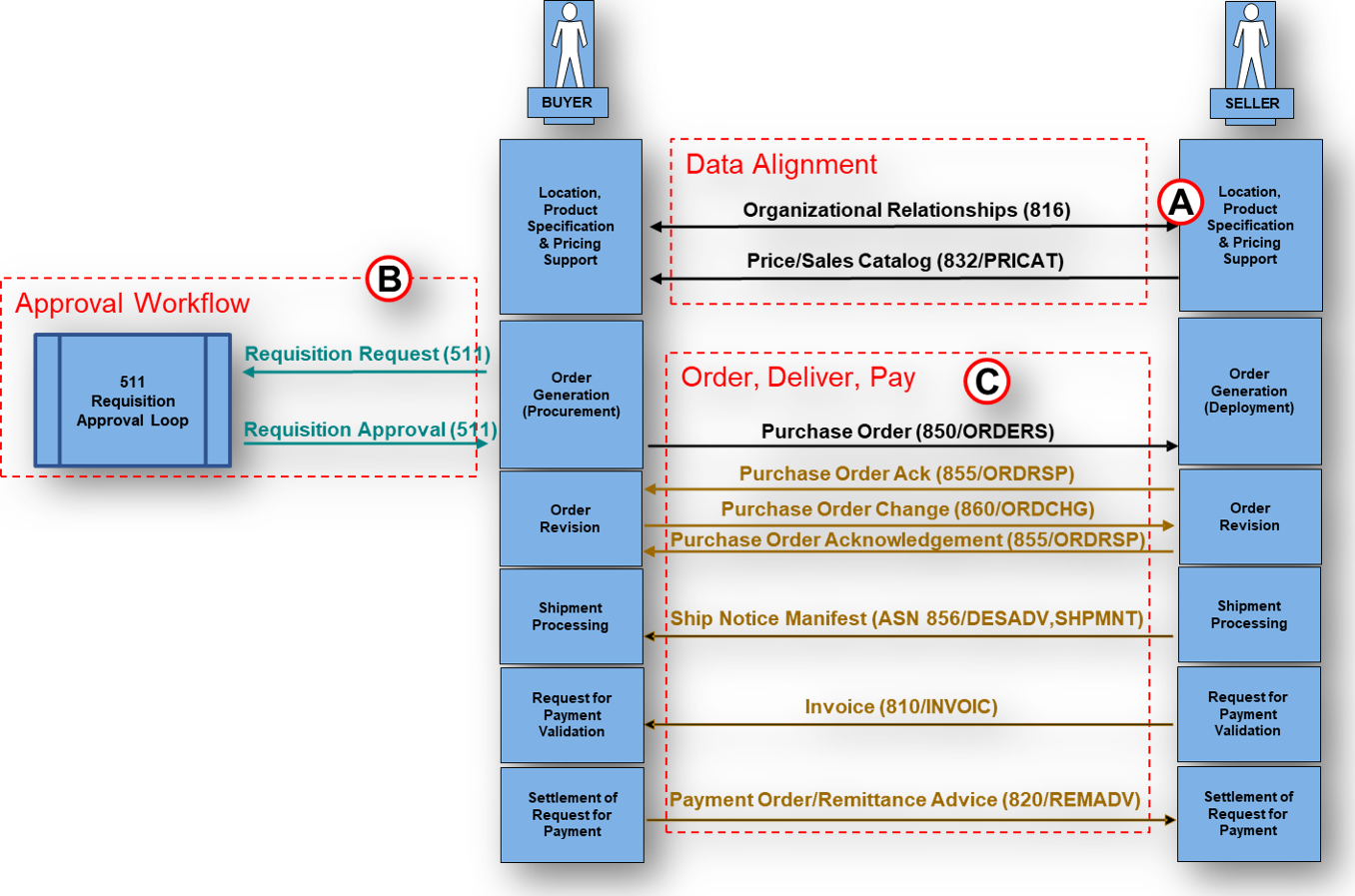
The EDI 832 typically follows trading partner setup transactions such as the EDI 816 Organizational Relationships message and precedes ordering transactions including the EDI 850 Purchase Order. Once catalog and pricing data are synchronized through the 832, downstream transactions such as the 855, 856, and 810 reference the established product and pricing data.
The EDI 832 is generally found within the Product Data Alignment phase of the broader procure-to-pay lifecycle. The diagram provided illustrates how product specification and pricing alignment occurs before ordering begins.
Data Alignment Layer
| Transaction | Purpose |
| 816 Organizational Relationships | Establish buyer/seller relationship |
| 832 Price / Sales Catalog | Distribute product catalog and pricing |
Order-to-Cash Layer
| Transaction | Purpose |
| 850 Purchase Order | Buyer places order |
| 855 Purchase Order Acknowledgment | Seller confirms order |
| 856 ASN | Seller provides shipment notice |
810 Invoice | Seller invoices buyer |
820 Remittance Advice | Buyer sends payment |
The catalog information published in the EDI 832 establishes authoritative product identifiers and pricing that downstream transactions reference.
Upstream Transactions
Positioning the EDI 832 at the center of the lifecycle, upstream transactions are those transactions that organizations use to collect catalog information, inventory, and pricing detail (e.g., catalog data) and generate the EDI 832. The following upstream transactions typically precede the EDI 832, these transactions establish the initial commercial transaction:
| Transaction | Role |
| 816 Organizational Relationships | Establish trading partner relationship |
| Product information Management (PIM) Processes | Define catalog and pricing master data |
Downstream Transactions
Positioning the EDI 832 at the center of the lifecycle, downstream transactions respond to detail reported by the EDI 832 and may confirm receipt or request adjustment. The EDI 832 supports downstream activities including transactions that support order to cash processes and financial reconciliation:
| Transaction | Role |
| 511 Requisition Request | Request to add information to internal catalog so that an order may be placed in the future |
| 511 Requisition Approval | Request to approve and item within the internal catalog so that an order may be placed |
| 863 Report of Test Results | Provides a structured, detailed, machine-readable form for communicating inspection results – findings which ensure purpose and clear the way for the ordering process to take place. |
| 850 Purchase Order | Ordering |
| 855 Purchase Order Acknowledgment | Order confirmation |
| 860 Purchase Order Change | Used by buyers to request modifications to a previously submitted EDI 850 Purchase Order |
| 856 Advance Ship Notice | Shipment notification |
| 810 Invoice | Billing |
| 820 Payment Order / Remittance Advice | Settlement |
End-to-End Workflow Example
- Supplier publishes product catalog via EDI 832
- Buyer imports catalog into ERP / online merchandising system
- Buyer creates purchase orders referencing catalog data
- Seller fulfills orders using aligned product identifiers and pricing
Are there Industry-Specific Workflow Variations?
Yes. Industry-specific workflow variations do exist for the EDI 832 – Price / Sales Catalog, the EDI 832 – Price / Sales Catalog supports multiple industry implementations because product catalog structures, pricing governance models, and product identification frameworks vary across sectors. While the underlying transaction structure remains consistent, the operational workflow and segment usage often change depending on the trading environment.
Organizations frequently tailor the EDI 832 to support industry-specific requirements such as packaging hierarchies, contract pricing governance, regulatory identifiers, or product lifecycle management.
| Industry | Catalog Use | Implementation (Variation) |
|---|---|---|
| Retail | Item master synchronization. | Retail workflows frequently distribute full product catalogs to support large merchandising assortments. |
| Consumer Packaged Goods (CPG) | Product Information Management (PIM), multi-tier distributor, promotional, regional and contract pricing structures (distribution). | Consumer packaged goods manufacturers often use the EDI 832 to distribute pricing and product information to multiple distributors and retailers simultaneously. |
| Grocery | Barcode identifiers (UPC, GTIN), promotional pricing, seasonal catalogs, case-pack and UPC management. | Retail supply chains rely heavily on the EDI 832 to maintain synchronized product catalogs across manufacturers, distributors, and retailers. |
| Manufacturing | Distributor price lists. | Wholesale distributors frequently use the EDI 832 to maintain synchronized product master data between suppliers and reseller networks. |
| Healthcare | UDI and medical product identifiers. | Healthcare supply chains require strict product identification and regulatory tracking. The EDI 832 often supports these requirements by distributing regulated product identifiers. |
| eCommerce & Marketplace Platforms | Multi-seller catalog ingestion, attribute normalization, dynamic pricing, and pricing synchronization. | Digital marketplaces frequently ingest EDI 832 catalogs to populate product listings automatically. |
| Distribution Networks | Typical distributor catalog workflows include supplier catalog ingestion, distributor pricing overlays, and reseller price distribution. | Wholesale distributors frequently use the EDI 832 to maintain synchronized product master data between suppliers and reseller networks. |
| Automotive | Parts catalog and distributor pricing. | Automotive supply chains maintain extremely large parts catalogs that require consistent synchronization between manufacturers, distributors, and retailers. |
The EDI 832 supports a catalog publication workflow in which suppliers publish authoritative product and pricing data, buyers ingest and validate that data, and downstream ordering systems consume the information during procure-to-pay processes.
Steps to get to approved/authoritative pricing does exist in some trade relationships. Achieved primarily through a ‘Catalog Price Authorization Workflow’ where the sender publishes an EDI 832 and the Buyer responds with an EDI 845 (after performing an automated validation, the process is seldom initiated between partners. The rationale for declining a ‘Catalog Price Authorization Workflow’ most often heard is, ‘Price disputes continue.’
Cross-Standard Canonical Mapping
| X12 | EDIFACT | Description |
| 832 | PRICAT | Price / Sales Catalog |
| 850 | ORDERS | Purchase Order |
| 856 | DESADV | Advance Ship Notice |
| 810 | INVOIC | Invoice |
What Is the Difference Between EDI 832 and PRICAT?
The EDI 832 Price/Sales Catalog and EDIFACT PRICAT both distribute product catalog and pricing information between trading partners. EDI 832 is the ANSI X12 standard used primarily in North America, while PRICAT is the UN/EDIFACT equivalent used internationally. Both support catalog distribution, item identification, packaging details, and pricing synchronization
How does PartnerLinQ use the EDI 832?
PartnerLinQ enables organizations to exchange EDI 832 catalog data through a multi-enterprise integration architecture that supports traditional EDI transports and modern API-enabled connectivity. PartnerLinQ deployments allow organizations to:
• Publish full product catalogs
• Send incremental catalog updates
• Synchronize pricing across partners
• Maintain multi-market pricing structures
• Integrate product master data into ERP and eCommerce systems
Catalog exchanges can occur through:
- AS2
- VAN
- SFTP / MFTP
API-enabled integration platforms
Where Is the EDI 832 Used?
The EDI 832 appears most frequently in industries where accurate product data synchronization is critical. Common industries include:
- Retail and grocery
- Manufacturing distribution networks
- Automotive parts distribution
- Consumer goods supply chains
- eCommerce marketplaces
Are there Industry-Specific Responses to the EDI 832?
The EDI 832 does not mandate a functional business response transaction. Most implementations rely on functional acknowledgments (997 or 999) to confirm receipt and syntax validation.
Some trading relationships introduce Catalog Price Authorization workflows using the EDI 845 Price Authorization Acknowledgment, where buyers formally accept or reject catalog pricing before orders reference the price set.
What Is the Difference Between EDI 832 and EDI 845?
The EDI 832 Price/Sales Catalog distributes product catalog and pricing information between trading partners. The EDI 845 Price Authorization Acknowledgment is used to approve, reject, or conditionally accept pricing proposed in the 832 transaction. Organizations sometimes use the 845 as part of a catalog price governance workflow before orders are placed.
What Is the Purpose, Key Features, and Business Use Cases of the EDI 832?
The EDI 832 Price/Sales Catalog distributes structured product catalog and pricing information between trading partners. Its purpose is to synchronize product identifiers, descriptions, packaging details, and pricing across procurement and eCommerce systems. Key features include catalog distribution, incremental price updates, and multi-market pricing, enabling use cases such as product onboarding, contract pricing management, and promotional pricing updates.
Operational Purpose
The EDI 832 provides a standardized mechanism for distributing product master data and pricing across trading partner ecosystems.
Key Features
| Feature | Description |
| Catalog Distribution | Publish full product catalogs |
| Incremental Updates | Send only catalog changes |
| Pricing Synchronization | Maintain consistent price lists |
| Packaging Metadata | Communicate case pack and dimensions |
| Multi-Market Pricing | Support regional or contract pricing |
Business Use Cases
Use Case | Primary Purpose | Common Business Scenarios | Key Information Communicated |
Product Catalog Distribution | Share complete or partial product catalogs with trading partners | Manufacturer → Distributor item setup; Distributor → Retailer onboarding; Supplier → Marketplace enablement | Item identifiers (SKU, UPC, GTIN); descriptions; attributes; packaging hierarchy; UOMs |
Price List Publication | Communicate standard, contract, or list pricing | Annual or quarterly price updates; MSRP and wholesale pricing; contract pricing distribution | Base price (CTP); price qualifiers; effective and expiration dates; allowances and charges |
Item Setup & Maintenance | Maintain and update item master data | New item introductions; description changes; packaging or UOM updates; item discontinuations | Item status indicators (G53); revised descriptions; replacement or supersession references |
Contract & Customer-Specific Pricing | Share negotiated pricing terms | Retailer-specific pricing; distributor tier pricing; regional price variations | Customer identifiers (REF); pricing qualifiers; quantity break pricing; validity periods (SAC/DTM) |
Promotional & Temporary Pricing | Communicate time-bound pricing changes | Seasonal promotions; clearance pricing; limited-time discounts | Promotional price; start and end dates (DTM); promotion qualifiers |
Pre-Order Enablement | Prepare partners to transact prior to availability | New product launches; future assortments; seasonal merchandise planning | Future effective dates (DTM); availability indicators; introductory pricing (SAC) |
Data Synchronization Across Systems | Align product and pricing data across platforms | ERP ↔ Trading Partner sync; ERP ↔ Marketplace multi-sync; multi-channel consistency | Item master and pricing data used across downstream transactions |
What Information Is Required in the EDI 832?
The EDI 832 Price/Sales Catalog requires product identification, catalog metadata, and pricing information so trading partners can synchronize product and price lists. Required data typically includes item identifiers (SKU, UPC, or GTIN), product descriptions, packaging details, units of measure, base pricing, currency, effective dates, and trading partner identifiers used by procurement and ordering systems.
What Segments Are in the EDI 832?
The EDI 832 contains header, detail, and summary segments used to communicate catalog metadata, item information, and pricing. Common segments include ST (Transaction Header), BCT (Catalog Beginning Segment), LIN (Item Identification), PID (Product Description), PO4 (Packaging Details), CTP (Pricing Information), CTT (Transaction Totals), and SE (Transaction Trailer).
Quick Segment Reference
| Segment | Purpose |
| ST | Transaction header |
| BCT | Beginning segment for catalog |
| LIN | Item identification |
| PID | Item description |
| PO4 | Item packaging |
| CTP | Pricing information |
| CTT | Transaction totals |
| SE | Transaction trailer |
Required Segments
| Segment | Description |
| ST | Transaction Set Header |
| BCT | Beginning Segment for Price / Sales Catalog |
| LIN | Item Identification |
| CTP | Pricing Information |
| SE | Transaction Set Trailer |
Optional Segments
| Segment | Description |
| REF | Reference information |
| CUR | Currency |
| N1 | Party identification |
| DTM | Date reference |
| PID | Product description |
| PO4 | Packaging details |
| G55 | Consumer unit characteristics |
Required Identifiers
Typical identifiers communicated in the 832 include:
- SKU, GTIN, UPC
- GLN DUNS
- Vendor item number
- Buyer item number
- Contract identifier
Required Dates
| Date Type | Segment |
| Catalog effective date | DTM |
| Price effective date | DTM |
| Promotional period | DTM |
Required Financial Data
Data Element | Segment |
| Base price | CTP |
| Promotional price | CTP |
| Allowances / charges | SAC |
Summary Table of Key Segments
| Segment | Loop | Description |
| ST | Header | Transaction identification |
| BCT | Header | Catalog purpose |
| REF | Header/Detail | Reference identifiers |
| CUR | Header | Currency |
| N1 | Header | Party identification |
| LIN | Detail | Item identification |
| PID | Detail | Item description |
| PO4 | Detail | Packaging information |
| G55 | Detail | Consumer unit characteristics |
| CTP | Detail | Pricing information |
| CTT | Summary | Transaction totals |
| SE | Trailer | Transaction completion |
What Status and Reason Codes Are Used with the EDI 832?
The EDI 832 does not define transaction-specific status or reason codes. Functional acknowledgments (997 or 999) manage syntactical validation while business-level validation occurs within receiving systems.
What are the Benefits of the EDI 832?
The EDI 832 Price/Sales Catalog improves supply chain efficiency by electronically distributing product catalog and pricing information between trading partners. Key benefits include faster product onboarding, automated catalog updates, improved pricing accuracy, and consistent product data across procurement, ERP, and eCommerce systems, which reduces manual data entry and minimizes downstream order and invoice errors.
| Benefit Category | Benefit | Business Impact |
| Operational Efficiency | Automates the distribution of product catalog and pricing data | Reduces manual data entry and speeds catalog maintenance across trading partners |
| Pricing Accuracy | Synchronizes current pricing across connected systems | Reduces pricing discrepancies in purchasing, invoicing, and merchandising workflows |
| Product Data Consistency | Standardizes item identifiers, descriptions, and packaging data | Improves alignment across ERP, procurement, eCommerce, and marketplace platforms |
| Faster Product Onboarding | Supports rapid setup of new items and catalog changes | Accelerates item introduction and shortens onboarding time for buyers and sellers |
| Promotional Agility | Distributes promotional and temporary pricing updates electronically | Improves responsiveness to seasonal campaigns, discounts, and contract pricing changes |
| Supply Chain Coordination | Shares authoritative catalog data across suppliers, distributors, and retailers | Improves downstream order accuracy and strengthens partner collaboration |
| Reduced Errors | Minimizes manual rekeying of product and pricing information | Lowers the risk of order mistakes, invoice disputes, and catalog mismatches |
| System Integration | Enables direct ingestion into ERP, PIM, procurement, and eCommerce systems | Supports scalable automation and reduces dependence on spreadsheet-based catalog management |
| Multi-Market Pricing Support | Supports regional, market-specific, and customer-specific pricing structures | Improves control over pricing strategy across channels and geographies |
| Better Downstream Performance | Improves data quality for transactions that follow the catalog load | Strengthens performance in the 850, 855, 856, and 810 transaction flow |
The EDI 832 enables organizations to maintain synchronized product catalogs and pricing data across trading partner networks, improving data integrity and reducing operational friction across the procure-to-pay lifecycle.
Operational Benefits
- Faster item onboarding
- Automated catalog synchronization
- Reduced manual product setup
Financial Benefits
- Pricing accuracy across transactions
- Reduced invoice disputes
- Better contract pricing enforcement
Compliance Benefits
- Alignment with ANSI X12 standards
- Compatibility with GS1 identification frameworks
What are the Benefits of Automating the EDI 832?
Automation enables organizations to maintain synchronized product and pricing data across multiple systems simultaneously. Automated catalog processing reduces data entry errors and allows ERP, WMS, POS, and marketplace systems to operate using consistent product master data.
Are there Regulatory and Compliance Requirements for the EDI 832?
No, while the EDI 832 follows ANSI X12 standards and aligns with global product identification frameworks such as GS1, adoption occurs organically through trading partner agreement/requirements not government mandates.
EDI 832 Technical Structure, Format, and Versions
The EDI 832 Price/Sales Catalog follows the ANSI X12 standard and uses a structured format consisting of header, detail, and summary sections. The message typically includes segments such as ST, BCT, LIN, PID, PO4, and CTP to communicate catalog metadata, item identification, packaging details, and pricing. Common implementations use versions such as X12 4010 or later.
Hierarchical Loop Structure
The EDI 832 contains header, detail, and summary sections.
| Loop | Purpose |
| Header | Catalog metadata and trading partner identification |
| Detail | Partner and Market identification |
| Item Loop | Item-level product and pricing information |
| Summary | Totals and controls |
File Format and Delimiters
Using the following Production Delimiters on all EDI transmissions sent to Vendors, Carriers, Trading and Solution partners will enable consistent EDI parsing across trading partners:
- Segment Separator – hex 15 (NAK) or hex 7E (~)
- Element separator – hex 7C (|) or hex 2A (*)
- Sub-element Separator – hex 3E (>)
Version Differences
Companion guides often define implementation-specific requirements, common X12 EDI versions include:
- X12 4010 Most common retail implementation
- X12 5010 Updated element definitions
What are the Limitations of the EDI 832?
The EDI 832 does not provide built-in pricing approval or dispute resolution. Organizations typically use additional transactions or internal governance workflows to validate and authorize pricing before it becomes operational.
Are Implementation Guidelines and Sample Files Available for the EDI 832?
Yes. PartnerLinQ provides sample transactions and implementation guides. EDI 832 implementation guides illustrate both inbound and outbound flows, segment layouts, and valid data examples and support testing and partner onboarding.
Companion Guides
Trading partners frequently publish EDI 832 implementation guidelines defining segment usage and validation rules. Customized specification documents for use in on boarding and technical development are available through PartnerLinQ Support and Guideline Management.
Trading Partner Requirements
Customized mapping, testing, and validation documentation are also available. Partners may specify:
- Reporting frequency
- Distribution Model (full publication vs. changes ONLY)
- Identifier use (standards)
- Validation rules
EDI 832 Example File (X12 Sample)
* for illustrative purposes only (Not from a specific companion guide publication)
EDI 832 Example File (Annotated)
* for illustrative purposes only (Not from a specific companion guide publication)
EDI 832 Example File (Annotated)Annotated Segment Explanation
| Segment | Example | Meaning | Purpose |
| ISA | ISA*00*… | Interchange Control Header | Starts the EDI interchange and identifies sender/receiver IDs, date, time, and version |
| GS | GS*SC*NNNNNNNNN*NNNNNNNNN… | Functional Group Header | Identifies the group of catalog transactions being transmitted |
| ST | ST*832*103788001 | Transaction Set Header | Indicates the message is an EDI 832 Price/Sales Catalog |
| BCT | BCT*PC*000*001*001 | Beginning Segment for Catalog | Defines catalog purpose and identifier |
| N1 | N1*SF*BONE APPETIT… | Party Identification | Identifies the catalog owner or supplier |
| LIN | LIN**VN*Vendor Number*UP*082873511005 | Item Identification | Identifies the product using vendor and UPC codes |
| REF | REF*VR*BONE APPETITE | Reference Information | Provides catalog or vendor reference identifiers |
| PID | PID*F*GEN***CINNAMON DANISH | Product Description | Provides human-readable product description |
| PO4 | PO4*1 | Packaging Information | Defines packaging structure (case pack / quantity) |
| CTP | CTP**UCP*1.4700*1*EA | Pricing Information | Defines item price and unit of measure |
| DTM | DTM*007*20260312 | Date Reference | Indicates price effective date |
| CTT | CTT*36 | Transaction Totals | Indicates number of catalog items |
| SE | SE*33*103788001 | Transaction Trailer | Ends the EDI transaction |
| GE | GE*1*3853 | Functional Group Trailer | Ends the functional group |
| IEA | IEA*1*000002615 | Interchange Trailer | Ends the EDI interchange |
* for illustrative purposes only (Not from a specific companion guide publication)
Item-Level Loop Explanation
The EDI 832 repeats the item loop for each product in the catalog, each product record typically includes:
| Segment | Role |
| LIN | Item identifiers |
| REF | Reference numbers |
| PID | Product description |
| PO4 | Packaging details |
| CTP | Pricing information |
| DTM | Price effective date |
This repeating structure allows a single EDI 832 to distribute hundreds or thousands of product records within a single catalog message.
Example Product Record Explained
Example item from the message:
* for illustrative purposes only (Not from a specific companion guide publication)
| Field | Meaning |
| Vendor Item Number | 111071 |
| UPC Code | 82873511107 |
| Product Description | Bear Claw |
| Price | $1.47 |
| Unit of Measure | Each |
What are the more common EDI errors and rejection scenarios for the EDI 832?
| Error Type | Description |
| Structural Errors | Missing segments causing 997/999 rejection |
| Data Validation Errors | Invalid pricing or identifiers |
| Identifier Mismatch | SKU or GTIN mismatch |
| Version Compliance Errors | Version mismatch with trading partner |
| Industry-Specific Rejections | Retail compliance rule violations |
What are the Basic Questions for EDI Integration with the EDI 832?
Typical integration planning questions include:
What is the general direction of the transaction?
Are inbound or outbound orders required?
Are AS2, VAN, or SFTP connections used?
Are more than one trading partner exchanging the EDI 832?
Are there other interested parties?
What trading partner requirements apply?
What version is supported?
What catalog governance processes exist?
What other transactions might these interested parties be a party to?
What response to the EDI 832 is expected or sent?
Is a response to EDI 832 a timed event?
Are notifications involved/needed?
Are there samples and specs of the response transaction available?
What validation rules apply?
How are changes to the EDI 832 business message managed today?
Is there automation? (an internal systems trigger) or are EDI 832 business message transactions triggered manually?
Are there any downstream system dependencies?
How is cross-reference management between buyer and seller item numbers managed?
Are changes supported?
Are responses and changes automatically triggered? (an internal systems trigger) Or do transactions require human intervention?
What systems generate or receive the transaction?
How are one-time addresses handled in ERP?
Are SKU or UPC identifiers used?
What identifiers are required (SKU, UPC, GTIN)?
What testing process is required?
What validation rules apply?
What are the Best Practices for using the EDI 832?
- Maintain consistent item identifiers
- Establish pricing governance workflows
- Use incremental updates when possible
- Align catalog structures with downstream order transactions
- Validate catalog data before distribution
What Transactions are associated with the EDI 832?
| Transaction | Description |
| 816 | Organizational Relationships |
| 845 | Price Authorization Acknowledgment |
| 511 | Requisition Request |
| 850 | Purchase Order |
| 855 | PO Acknowledgment |
| 860 | PO Change |
| 863 | Report of Test Results |
| 856 | Advance Ship Notice |
| 810 | Invoice |
| 820 | Payment / Remittance |
EDI 832 vs Other Product and Pricing Transactions
| Transaction | Purpose |
| 832 | Product catalog and pricing distribution |
| 845 | Price authorization or price validation |
| 850 | Purchase order |
| 855 | PO Acknowledgment |
| 860 | PO Change |
| 810 | Invoice |
| 846 | Inventory inquiry |
FAQs
What is the purpose of EDI 832?
EDI 832 distributes product catalog and pricing data between trading partners to ensure accurate ordering and billing.
Who sends the EDI 832?
Manufacturers and distributors typically send the transaction to retailers and procurement platforms.
Is EDI 832 required for ordering?
The transaction is not required but is commonly used to establish product master data before ordering transactions occur.
Footnotes:
- PartnerLinQ 832 v4010 Specification, Purpose and Overview, p.3
- PartnerLinQ 832 v4010 Specification, User Notes, p.3–4
- What is EDI 832, PartnerLinQ Overview



Explore Our Integration Solutions

PartnerLinQ Integration Solutions
Connect Everything. Integrate Intelligently.
Future-Proof Your Business with Composable, AI Powered Connectivity.