
What Is the EDI 211 Motor Carrier Bill of Lading?
The EDI 211 Motor Carrier Bill of Lading is an ANSI X12 transportation transaction used to electronically exchange the legal Bill of Lading by electronic means between shippers, motor carriers, logistics providers, and transportation systems. It establishes the official shipment record by communicating shipment parties, freight details, routing information, equipment, handling instructions, and reference information required to execute freight movement accurately and efficiently.
Executive Summary
The EDI 211 Motor Carrier Bill of Lading is the transportation document that formally establishes the legal shipment record before freight moves. Unlike a load tender, shipment status message, or freight invoice, the EDI 211 communicates the trusted Bill of Lading that transportation partners use to execute, identify, track, and reconcile freight. Combined with automation, validation, and multi-enterprise integration, it becomes the operational foundation for coordinated transportation execution.
Transaction Identity Block
| Attribute | Description |
|---|---|
| Transaction Set Number | 211 |
| Transaction Name | Motor Carrier Bill of Lading |
| X12 Functional Group | BL (Bill of Lading) |
| Document Classification | Transportation Execution Document |
| Industry Usage | Transportation & Logistics |
| Business Domain | Transportation & Logistics |
| Primary Purpose | Electronically communicate the legal Bill of Lading |
| Typical Exchange Pattern | Shipment Execution |
| Typical Sender | Shipper, Manufacturer, Distributor, 3PL |
| Typical Receiver | Motor Carrier, Freight Broker, Transportation Provider |
| Primary Objective | Electronically communicate legally recognized Bill of Lading between transportation trading partners |
| Business Value | Standardizes shipment documentation while improving transportation visibility, shipment accuracy, compliance, and operational efficiency |
| Common Preceding Transactions | 204 Load Tender, 990 Response to Load Tender |
| Common Following Transactions | 214 Shipment Status, 210 Freight Invoice, 997/999 Functional Acknowledgment |
| Primary Standards Organization | Accredited Standards Committee X12 (ASC X12) |
| Standard Version | ANSI ASC X12 Version 4010 |
What Is the Difference Between an EDI 211 and a Paper Bill of Lading?
The EDI 211 is the electronic representation of a traditional paper Bill of Lading. Both communicate shipment ownership, freight descriptions, transportation parties, and shipment instructions. The EDI 211 replaces manual paperwork with a standardized ANSI X12 transaction that supports automation, validation, transportation visibility, and system-to-system integration.
What Does the EDI 211 Motor Carrier Bill of Lading Do?
The EDI 211 communicates the official electronic Bill of Lading for a shipment. It establishes the legal transportation document while identifying shipment parties, freight, equipment, references, handling requirements, and transportation instructions so carriers can execute, monitor, and reconcile freight movement using standardized business information.
Who Uses the EDI 211 Motor Carrier Bill of Lading?
Typical Trading Partners include Manufacturers, retailers, wholesalers, distributors, warehouses, third-party logistics providers (3PLs), freight brokers, motor carriers, and transportation management systems (TMS) use the EDI 211 to exchange standardized Bill of Lading information. The transaction provides every transportation partner with a consistent shipment record before freight enters the transportation network.
Typical Trading Partners
Organization | Typical Role |
Manufacturer | Shipment Originator |
Retailer | Consignee |
Distributor | Shipping Party |
Warehouse | Shipping or Receiving Location |
Third-Party Logistics Provider | Transportation Coordinator |
Motor Carrier | Freight Carrier |
Freight Broker | Transportation Management |
Transportation Management System (TMS) | Shipment Planning and Execution |
Enterprise Resource Planning (ERP) | Business System of Record |
Can an EDI 211 Be Sent Using APIs?
Yes. Modern integration platforms frequently exchange EDI 211 documents through APIs rather than traditional VAN-only communications. APIs transport the ANSI X12 payload between cloud applications, carriers, transportation platforms, and trading partners while preserving the standard EDI document format.
Primary Business Functions
Function | Description |
Shipment Identification | Establishes the official Bill of Lading number and shipment identity. |
Transportation Authorization | Provides the carrier with the legal shipment document. |
Freight Description | Communicates commodities, quantities, weights, packaging, and handling information. |
Party Identification | Identifies the shipper, consignee, carrier, bill-to party, and additional transportation participants. |
Shipment Execution | Supports freight movement from pickup through final delivery. |
Operational Visibility | Provides standardized shipment information for transportation management and tracking systems. |
When Is the EDI 211 Motor Carrier Bill of Lading Required?
The EDI 211 is exchanged after transportation has been planned and before freight moves. It provides the carrier with the official electronic Bill of Lading, establishing the shipment's legal transportation document while communicating the operational information required to transport, identify, track, and reconcile the shipment.
Typical Transportation Lifecycle
Stage | Associated Transaction |
Transportation Planning | Internal ERP / TMS |
Load Tender | EDI 204 |
Load Acceptance | EDI 990 |
Legal Bill of Lading | EDI 211 |
Shipment Status | EDI 214 |
Freight Invoice | EDI 210 |
Functional Acknowledgment | EDI 997 / 999 |
Is the EDI 211 Motor Carrier Bill of Lading Mandated Under Regulation?
The EDI 211 is not universally mandated by law. Organizations typically exchange the transaction because it satisfies trading partner requirements, transportation agreements, operational efficiency objectives, and electronic commerce initiatives while replacing paper Bills of Lading with a standardized electronic document that supports transportation execution.
How Does the EDI 211 Motor Carrier Bill of Lading Work in the Business Workflow?
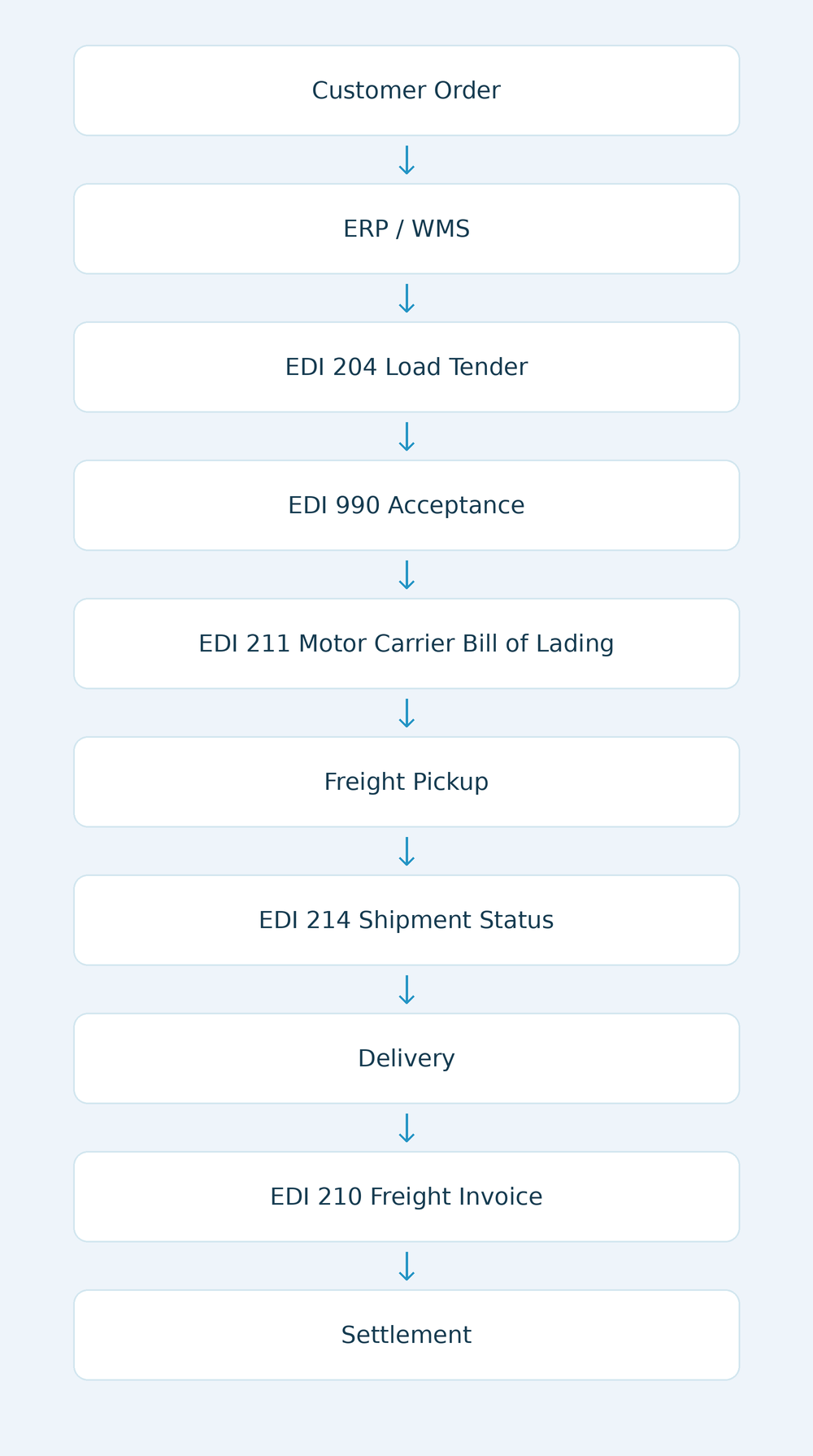
The EDI 211 serves as the legal transportation document within the shipment execution lifecycle. After a carrier accepts a load tender, the shipper issues the electronic Bill of Lading to authorize freight movement. The shipment is then tracked through status updates before freight charges are invoiced and reconciled.
Upstream Transactions
Transaction | Purpose |
Internal ERP Order | Creates shipment demand |
Warehouse Management System | Prepares freight |
EDI 204 Motor Carrier Load Tender | Offers shipment to carrier |
EDI 990 Response to Load Tender | Carrier accepts or declines shipment |
Downstream Transactions
Transaction | Purpose |
EDI 214 Transportation Carrier Shipment Status | Shipment visibility |
EDI 210 Motor Carrier Freight Details and Invoice | Freight billing |
EDI 997 Functional Acknowledgment | Technical acknowledgment |
EDI 999 Implementation Acknowledgment | Standards compliance acknowledgment |
End-to-End Workflow Example
Industry-Specific Workflow Variations
Industry | Typical Use of EDI 211 |
Retail | Distribution center replenishment |
Manufacturing | Plant-to-distribution transportation |
Food & Beverage | Temperature-controlled freight movements |
Automotive | Just-in-time production shipments |
Consumer Goods | Distribution and retail replenishment |
Third-Party Logistics | Multi-client transportation coordination |
Healthcare | Medical product transportation and compliance documentation |
Cross-Standard Canonical Mapping
ANSI X12 | EDIFACT | Business Purpose |
EDI 204 | IFTMIN | Transportation instruction |
EDI 211 | Transport Bill of Lading equivalent (implementation-dependent) | Legal shipment document |
EDI 214 | IFTSTA | Shipment status |
EDI 210 | INVOIC | Freight invoicing |
How does PartnerLinQ use the 211 Motor Carrier Bill of Lading?
PartnerLinQ uses the EDI 211 Motor Carrier Bill of Lading to digitally communicate the legal Bill of Lading between shippers and motor carriers, ensuring shipment details, freight terms, trading parties, commodities, and handling instructions are exchanged accurately before freight moves. Standardized EDI messaging, canonical data, and semantic data models reduce manual documentation while improving shipment accuracy and end-to-end transportation visibility.
Capability | Business Value |
Electronic Bill of Lading Exchange | Eliminates paper-based shipment documentation. |
Canonical Data Model | Standardizes transportation information across trading partners. |
Semantic Data Modeling | Preserves business meaning across ERP, TMS, WMS, and carrier systems. |
Business Rules & Validation | Validates shipment information before execution. |
Multi-Enterprise Connectivity | Connects shippers, carriers, brokers, warehouses, and logistics providers. |
Operational Visibility | Provides real-time access to trusted shipment information. |
Intelligent Automation | Reduces manual processing and transportation exceptions. |
Where Is the EDI 211 Motor Carrier Bill of Lading Used?
The EDI 211 is used wherever organizations exchange electronic Bills of Lading to authorize and document freight movement. Manufacturers, distributors, retailers, logistics providers, warehouses, and motor carriers rely on the transaction to establish a consistent shipment record before transportation begins.
Are there Industry-Specific Responses to the EDI 211 Motor Carrier Bill of Lading?
Yes and while the ANSI X12 standard remains consistent, trading partner implementations vary by industry. Organizations may require specific reference numbers, equipment identifiers, shipment classifications, commodity descriptions, routing instructions, or regulatory information to satisfy industry, customer, or carrier implementation requirements.
Industry | Typical Requirements |
Retail | Purchase order references, distribution center routing, appointment identifiers |
Food & Beverage | Temperature control, lot identification, handling instructions |
Automotive | Production schedules, sequencing references, supplier shipment identifiers |
Healthcare | Product traceability, regulatory references, specialized handling |
Industrial Manufacturing | Project references, equipment identification, oversized freight details |
Consumer Products | Retail routing guides, pallet identification, packaging references |
What Is the Purpose, Key Features, and Business Use Cases of the EDI 211 Motor Carrier Bill of Lading?
The EDI 211 establishes the legal transportation document supporting freight movement while providing standardized shipment information required for execution, visibility, compliance, freight settlement, and transportation coordination. It enables organizations to replace paper Bills of Lading with a trusted electronic document that improves operational efficiency across the transportation lifecycle.
Operational Purpose
The primary purpose of the EDI 211 is to communicate the legal Bill of Lading electronically before freight moves. It provides carriers with the shipment information required to identify the freight, execute transportation services, and maintain an accurate shipment record throughout transportation.
Operational Objective | Description |
Establish Shipment Identity | Creates the official Bill of Lading record. |
Authorize Transportation | Provides the legal shipment document. |
Standardize Shipment Information | Communicates consistent transportation data. |
Support Freight Execution | Enables transportation planning and movement. |
Key Features
The EDI 211 combines shipment identification, transportation instructions, party information, equipment details, freight descriptions, and shipment references into a single standardized document supporting transportation execution and shipment visibility.
Feature | Benefit |
Standardized Bill of Lading | Consistent transportation documentation |
Party Identification | Accurate shipper, carrier, and consignee information |
Equipment Information | Trailer and container visibility |
Commodity Detail | Accurate freight identification |
Reference Numbers | Improved shipment traceability |
Transportation Instructions | Reduced execution errors |
Business Use Cases
Organizations exchange the EDI 211 whenever a shipment requires a standardized electronic Bill of Lading to support freight movement, operational coordination, and transportation visibility across multiple business systems and trading partners.
Use Case | Business Outcome |
Customer Shipment | Electronic Bill of Lading creation |
Distribution Center Replenishment | Standardized transportation documentation |
Manufacturing Shipment | Plant-to-warehouse execution |
Third-Party Logistics | Multi-party shipment coordination |
Cross-Docking | Shipment identification across facilities |
Carrier Operations | Standardized transportation processing |
Industry Applications
The EDI 211 supports transportation execution across virtually every industry that exchanges physical goods. Standardized shipment documentation enables consistent freight execution regardless of commodity type, transportation mode, or trading partner relationship.
Operational Visibility
The EDI 211 improves operational visibility by establishing a trusted shipment record before transportation begins. Standardized shipment information allows transportation management systems, warehouse systems, enterprise applications, and carrier platforms to reference the same operational data throughout shipment execution.
Visibility Area | Business Benefit |
Shipment Identification | Accurate shipment tracking |
Carrier Visibility | Consistent transportation records |
Equipment Visibility | Trailer and container tracking |
Party Visibility | Standardized participant identification |
Shipment References | Improved transaction traceability |
Compliance Reporting
The EDI 211 supports transportation compliance by creating a standardized electronic record of shipment information. Consistent documentation simplifies audit preparation, trading partner compliance, internal governance, and transportation record retention while reducing dependence on manual paperwork.
Financial Reconciliation
The EDI 211 establishes shipment information that supports downstream freight auditing and invoicing. Consistent shipment identifiers, transportation references, and freight details improve reconciliation between transportation execution, carrier invoices, and financial settlement processes.
Financial Function | Business Value |
Freight Audit | Shipment verification |
Invoice Matching | Improved billing accuracy |
Cost Allocation | Shipment cost visibility |
Transportation Settlement | Reduced payment discrepancies |
Supply Chain Coordination
The EDI 211 provides every authorized transportation participant with the same shipment information before freight moves. Standardized communication improves coordination between shippers, warehouses, carriers, brokers, and consignees while reducing shipment delays caused by inconsistent documentation.
Exception Management
The EDI 211 reduces transportation exceptions by validating shipment information before execution. Standardized electronic documentation minimizes manual interpretation, missing shipment references, incomplete party information, and inconsistent freight descriptions that commonly delay transportation operations.
What Information Is Required in the EDI 211 Motor Carrier Bill of Lading?
The EDI 211 Motor Carrier Bill of Lading communicates the information required to legally identify, authorize, and execute a freight shipment. Required data includes shipment identifiers, transportation parties, carrier information, freight descriptions, equipment details, shipment dates, business references, and line-item shipment information. Together, these elements establish a standardized electronic Bill of Lading that enables accurate transportation execution, shipment visibility, freight reconciliation, and trading partner interoperability.
Unlike many X12 transactions that focus on procurement or financial exchange, the EDI 211 combines legal shipment documentation with operational transportation data. The transaction begins by identifying the shipment through the Bill of Lading header before defining transportation participants, shipment references, dates, equipment, and detailed freight information. Line-level loops provide the carrier with the commodity descriptions, handling information, marks and numbers, and purchase order references required to transport, identify, and reconcile the shipment throughout its lifecycle.
The following sections summarize the information typically exchanged within the EDI 211 before examining each segment in detail.
Quick Segment Reference
Segment | Name | Purpose | Usage |
ST | Transaction Set Header | Begins the EDI 211 transaction and identifies the transaction set. | Mandatory |
BOL | Beginning Segment for the Motor Carrier Bill of Lading | Establishes the Bill of Lading header and shipment identity. | Mandatory |
B2A | Set Purpose | Indicates whether the Bill of Lading is original, changed, confirmed, or cancelled. | Mandatory |
MS3 | Interline Information | Identifies interline carriers involved in shipment movement. | Optional |
MS2 | Equipment or Container Owner and Type | Identifies transportation equipment such as trailers or containers. | Optional |
L11 | Business Instructions and Reference Number | Communicates shipment reference numbers and business identifiers. | Optional (commonly required by trading partners) |
G62 | Date/Time | Specifies shipment-related dates and times. | Optional |
What Status and Reason Codes Are Used with the EDI 211 Motor Carrier Bill of Lading?
The EDI 211 Motor Carrier Bill of Lading does not include a comprehensive set of shipment status or reason codes like the EDI 214 Transportation Carrier Shipment Status Message. Instead, it uses document purpose codes, transportation qualifiers, reference identifiers, party identifiers, and equipment codes to communicate the intent, ownership, and operational context of the Bill of Lading. Shipment execution status is typically communicated later through the EDI 214.
Unlike operational status transactions, the EDI 211 establishes the legal shipment document before freight movement begins. Most implementation guidance focuses on identifying the purpose of the Bill of Lading, the transportation parties involved, shipment references, equipment, and routing information rather than reporting shipment progress or delivery events.
Status Codes
The EDI 211 primarily uses the B2A Set Purpose segment to communicate the business status of the Bill of Lading. These codes identify whether the transaction represents a new document, a change, a confirmation, or a cancellation, enabling trading partners to determine the appropriate business action before shipment execution.
Common B2A01 Transaction Set Purpose Codes
Code | Description | Business Meaning |
00 | Original | Creates the original electronic Bill of Lading. |
01 | Cancellation | Cancels a previously issued Bill of Lading before shipment execution. |
04 | Change | Revises an existing Bill of Lading with updated shipment information. |
06 | Confirmation | Confirms the previously communicated Bill of Lading. |
PartnerLinQ Perspective
PartnerLinQ uses the B2A Set Purpose segment to determine how a received EDI 211 should be processed. Original transactions create new shipment records, change transactions update existing transportation records, confirmations validate shipment information, and cancellations prevent obsolete Bill of Lading information from driving downstream transportation execution.
Reason Codes
Although the EDI 211 does not define standardized transportation reason codes, several segments use industry-standard qualifiers to explain references, dates, transportation parties, payment methods, and shipment characteristics. These qualifiers provide the business context required to interpret shipment information consistently across trading partners.
Common Reference Identification Qualifiers (L11)
Qualifier | Description | Typical Use |
CR | Customer Reference Number | Customer shipment reference |
EQ | Equipment Number | Trailer or container reference |
LO | Load Planning Number | Transportation planning identifier |
RU | Route Number | Carrier routing reference |
Common Shipment Method of Payment Codes (BOL02)
Code | Description | Business Meaning |
PP | Prepaid | Freight charges paid by the shipper (seller). |
CC | Collect | Freight charges paid by the receiver. |
TP | Third Party Pay | Freight charges paid by a designated third party. |
Common Date Qualifiers (G62)
Code | Description | Typical Use |
10 | Requested Ship Date / Pick-up Date | Scheduled shipment or pickup date. |
Common Transportation Party Codes (N101)
Code | Description |
CA | Carrier |
CN | Consignee |
SF | Ship From |
SH | Shipper |
ST | Ship To |
BT | Bill To Party |
PF | Party to Receive Freight Bill |
VN | Vendor |
WH | Warehouse |
Common Identification Code Qualifiers (N103)
Code | Description |
1 | D-U-N-S Number |
2 | Standard Carrier Alpha Code (SCAC) |
9 | D-U-N-S +4 |
12 | Telephone Number |
25 | Carrier Customer Code |
54 | Warehouse Identifier |
93 | Organization Assigned Identifier |
UL | Global Location Number (GLN) |
UM | GLN with Extension Component |
Industry-Specific Code Sets
Many transportation organizations extend the EDI 211 through implementation guidelines that define additional reference qualifiers, routing identifiers, equipment classifications, commodity codes, and carrier-specific business rules. These implementation-specific code sets ensure that transportation information aligns with operational processes while remaining compliant with the ANSI X12 standard.
Common Industry Extensions
Industry | Typical Code Extensions |
Retail | Routing guide references, appointment identifiers, distribution center codes |
Food & Beverage | Temperature requirements, lot references, handling instructions |
Automotive | Production sequence references, supplier shipment identifiers |
Healthcare | Regulatory shipment identifiers, product traceability references |
Third-Party Logistics | Customer-specific routing, carrier references, consolidation identifiers |
PartnerLinQ Perspective
PartnerLinQ validates status codes, qualifiers, and reference identifiers as part of its transportation integration and orchestration capabilities. Business rules ensure that document purpose codes, shipment references, carrier identifiers, equipment information, and trading partner qualifiers are complete and internally consistent before the Bill of Lading is released for transportation execution. By validating these business identifiers early in the process, PartnerLinQ reduces downstream transportation exceptions, improves interoperability across ERP, WMS, and TMS platforms, and establishes a trusted shipment record that supports the remainder of the transportation lifecycle.
What Are the Benefits of the EDI 211 Motor Carrier Bill of Lading?
The EDI 211 Motor Carrier Bill of Lading replaces paper-based Bills of Lading with a standardized electronic document that improves transportation accuracy, accelerates shipment execution, and strengthens collaboration between shippers, carriers, brokers, warehouses, and consignees. By establishing a trusted shipment record before freight moves, the EDI 211 reduces manual processing, improves operational visibility, and provides the foundation for downstream shipment tracking, freight invoicing, and transportation reconciliation.
Unlike manual Bills of Lading that often require duplicate data entry and physical document exchange, the EDI 211 enables enterprise applications, transportation management systems (TMS), warehouse management systems (WMS), and carrier platforms to exchange consistent shipment information electronically. This improves data quality, reduces administrative effort, and supports more efficient freight execution across the transportation lifecycle.
Operational Benefits - Improved Transportation Accuracy
The EDI 211 establishes a single, standardized source of shipment information before transportation begins. Consistent electronic documentation reduces transcription errors, incomplete shipment records, and conflicting transportation instructions that can delay freight movement or increase operational costs.
Benefit | Business Value |
Standardized Shipment Information | Improves data consistency across trading partners. |
Reduced Manual Entry | Minimizes keying errors and duplicate documentation. |
Accurate Party Information | Ensures shipments move to the correct locations. |
Consistent Freight Descriptions | Reduces shipment discrepancies and handling errors. |
Faster Shipment Execution
Electronic Bill of Lading exchange allows transportation partners to receive shipment information immediately rather than waiting for paper documentation. Earlier access to shipment details improves carrier planning, warehouse coordination, equipment assignment, and freight scheduling.
Benefit | Business Value |
Electronic Document Exchange | Eliminates delays associated with paper documents. |
Faster Carrier Processing | Accelerates shipment acceptance and execution. |
Improved Warehouse Coordination | Supports timely freight preparation and loading. |
Earlier Transportation Planning | Improves scheduling efficiency across logistics operations. |
Increased Operational Visibility
The EDI 211 creates a trusted shipment record that supports transportation visibility throughout the shipment lifecycle. Standardized shipment identifiers, references, equipment information, and party details allow enterprise systems to consistently identify and monitor freight as it progresses through transportation.
Visibility Area | Business Value |
Shipment Identification | Supports consistent shipment tracking. |
Equipment Visibility | Improves trailer and container identification. |
Reference Management | Simplifies shipment traceability. |
Trading Partner Visibility | Provides a shared shipment record across organizations. |
Compliance Benefits include Stronger Trading Partner Collaboration
The EDI 211 enables every authorized transportation participant to exchange the same shipment information using a standardized ANSI X12 format. Consistent electronic communication improves coordination between shippers, carriers, brokers, warehouses, and consignees while reducing misunderstandings caused by inconsistent documentation.
Participant | Collaboration Benefit |
Shippers | Standardized shipment communication. |
Motor Carriers | Accurate transportation documentation. |
Freight Brokers | Improved shipment coordination. |
Warehouses | Better shipping and receiving preparation. |
Consignees | Greater delivery readiness and visibility. |
Financial Benefits include Reduced Administrative Costs
Replacing manual Bills of Lading with standardized electronic transactions reduces printing, document handling, filing, and manual data entry. Automated document exchange allows transportation personnel to focus on shipment execution rather than administrative processing.
Cost Reduction Area | Operational Benefit |
Paper Elimination | Reduces printing and document storage. |
Automated Processing | Lowers administrative effort. |
Fewer Manual Corrections | Decreases exception handling costs. |
Improved Data Quality | Reduces operational rework. |
Better Freight Reconciliation
The EDI 211 establishes shipment identifiers and transportation references that support downstream freight auditing, carrier invoicing, and payment reconciliation. Consistent shipment information improves the ability to match transportation services with freight invoices and financial records.
Financial Benefit | Business Value |
Shipment Verification | Improves freight audit accuracy. |
Invoice Matching | Supports automated freight reconciliation. |
Reference Consistency | Simplifies transportation accounting. |
Cost Visibility | Improves shipment cost analysis. |
Enhanced Compliance and Record Management
The EDI 211 creates a consistent electronic record of transportation information that supports trading partner requirements, internal governance, and transportation record retention. Electronic documentation simplifies audits while improving document accessibility and long-term record management.
Compliance Area | Business Benefit |
Electronic Documentation | Improves document retention. |
Standardized Records | Supports internal governance. |
Audit Readiness | Simplifies transportation audits. |
Trading Partner Compliance | Meets agreed electronic communication standards. |
PartnerLinQ Perspective
PartnerLinQ extends the value of the EDI 211 beyond document exchange by transforming the electronic Bill of Lading into actionable operational intelligence. Through canonical data modeling, semantic data modeling, configurable business rules, and intelligent workflow orchestration, PartnerLinQ validates shipment information, synchronizes transportation processes across ERP, WMS, TMS, and carrier systems, and establishes a trusted shipment record that improves execution, visibility, and collaboration across the multi-enterprise supply chain.
What Are the Benefits of Automating the EDI 211 Motor Carrier Bill of Lading?
Automating the EDI 211 Motor Carrier Bill of Lading transforms a static transportation document into an intelligent, event-driven business process. By automatically generating, validating, routing, and exchanging Bills of Lading between ERP, WMS, TMS, carrier, and trading partner systems, organizations reduce manual effort, improve shipment accuracy, accelerate transportation execution, and gain real-time operational visibility across the freight lifecycle.
Automation extends beyond replacing paper documents. Business rules validate shipment data before transmission, workflows route exceptions to the appropriate teams, and integrated transportation systems synchronize shipment information across every participant. The result is faster freight execution, fewer transportation errors, and a trusted shipment record that supports downstream status updates, freight invoicing, and financial reconciliation.
Benefits of EDI 211 Automation
Automation Benefit | Business Value |
Automated Bill of Lading Creation | Eliminates manual document preparation. |
Business Rule Validation | Identifies missing or invalid shipment information before transmission. |
Real-Time Document Exchange | Accelerates communication with carriers and logistics partners. |
Reduced Manual Data Entry | Improves data accuracy and reduces administrative effort. |
Intelligent Workflow Automation | Automatically routes documents, approvals, and exceptions. |
Transportation Visibility | Provides consistent shipment information across business systems. |
ERP, WMS, and TMS Integration | Synchronizes shipment information across enterprise applications. |
Exception Management | Identifies documentation issues before freight movement. |
Faster Freight Execution | Reduces delays associated with paper documentation. |
Improved Freight Reconciliation | Supports downstream invoicing and payment processes. |
How Does the EDI 211 Support Digital Supply Chains?
Yes, the EDI 211 supports digital supply chains by replacing manual Bill of Lading documents with standardized electronic information that can be validated, routed, monitored, and shared across ERP, WMS, TMS, carrier, and trading partner systems. This improves transportation visibility, shipment accuracy, and coordinated execution.
Operational Benefits
Automation enables transportation teams to focus on managing shipments rather than preparing documentation. Standardized electronic workflows reduce repetitive administrative tasks while improving collaboration between shipping, warehouse, transportation, customer service, and finance organizations.
Operational Area | Improvement |
Shipment Processing | Faster document preparation |
Carrier Coordination | Improved transportation communication |
Warehouse Operations | Better shipment readiness |
Customer Service | Faster access to shipment information |
Transportation Planning | Improved scheduling and execution |
Why Is the EDI 211 Important?
The EDI 211 is important because it establishes the official electronic shipment record used by carriers to execute freight movement. Standardized Bill of Lading information improves shipment accuracy, reduces manual documentation, supports transportation visibility, and provides the foundation for downstream shipment status, freight invoicing, and financial reconciliation.
PartnerLinQ Perspective
PartnerLinQ automates the EDI 211 by combining standards-based EDI transformation with intelligent business process orchestration. Configurable business rules validate shipment information, workflow automation manages transportation exceptions, and canonical data modeling synchronizes information across ERP, WMS, TMS, carrier, and trading partner systems. The result is an intelligent transportation process that improves execution while providing complete operational visibility across the multi-enterprise supply chain.
Are There Regulatory and Compliance Requirements for the EDI 211 Motor Carrier Bill of Lading?
The EDI 211 Motor Carrier Bill of Lading is not mandated in any way including ANSI ASC X12 or by a single government regulation. Instead, organizations exchange the transaction to satisfy contractual trading partner requirements, transportation agreements, carrier implementation guidelines, and electronic commerce initiatives. Depending on the shipment, additional federal, state, industry, or international regulations may govern the information communicated within the Bill of Lading.
The EDI 211 itself defines a standardized electronic format for exchanging transportation information. Regulatory compliance is determined by the nature of the shipment, the commodities being transported, the transportation mode, and the jurisdictions involved rather than by the EDI transaction itself.
Common Compliance Requirements
Compliance Area | Business Requirement |
Trading Partner Agreements | Compliance with customer and carrier implementation guides |
ANSI ASC X12 | Conformance to the agreed X12 version and implementation guidelines |
Record Retention | Electronic transportation documents retained according to company and regulatory policies |
Transportation Documentation | Accurate shipment information supporting freight movement |
Internal Governance | Consistent shipment validation and approval processes |
Industry-Specific Regulatory Considerations
Different industries may require additional information within or alongside the EDI 211 to comply with applicable regulations governing transportation, safety, security, or product traceability.
Industry | Typical Regulatory Considerations |
Food & Beverage | Food traceability, sanitary transportation, temperature-controlled shipments |
Healthcare | Medical product traceability, controlled substance handling, product security |
Automotive | Customer-specific logistics compliance and supplier shipping standards |
Chemicals | Hazardous materials documentation and transportation requirements |
Retail | Retail routing guides and customer transportation requirements |
International Logistics | Customs documentation and cross-border transportation regulations |
Related Regulatory Frameworks
Although the EDI 211 is not required nor is it a regulatory transaction, organizations frequently use it within transportation processes that are governed by broader regulatory frameworks.
Framework | Relevance |
U.S. Department of Transportation (DOT) Regulations | Governs commercial transportation safety and operations. |
Federal Motor Carrier Safety Administration (FMCSA) Regulations | Regulates interstate motor carrier operations. |
Hazardous Materials Regulations (HMR; 49 CFR Parts 171–180) | Applies when transporting regulated hazardous materials. |
Food Safety Modernization Act (FSMA) – Sanitary Transportation Rule | Applies to many food shipments requiring sanitary transportation practices. |
Customs and Border Protection (CBP) Requirements | May apply to international shipments moving across U.S. borders. |
Customer Routing Guides | Define operational compliance requirements for specific trading partners. |
PartnerLinQ Perspective
PartnerLinQ helps organizations meet transportation compliance requirements by validating EDI 211 transactions against ANSI X12 standards, trading partner implementation guides, and configurable business rules before documents are exchanged. Intelligent validation, audit trails, workflow orchestration, and centralized transaction monitoring improve data quality, support regulatory readiness, and reduce the operational risk associated with inaccurate or incomplete transportation documentation.
What Is the Technical Structure of the EDI 211 Motor Carrier Bill of Lading?
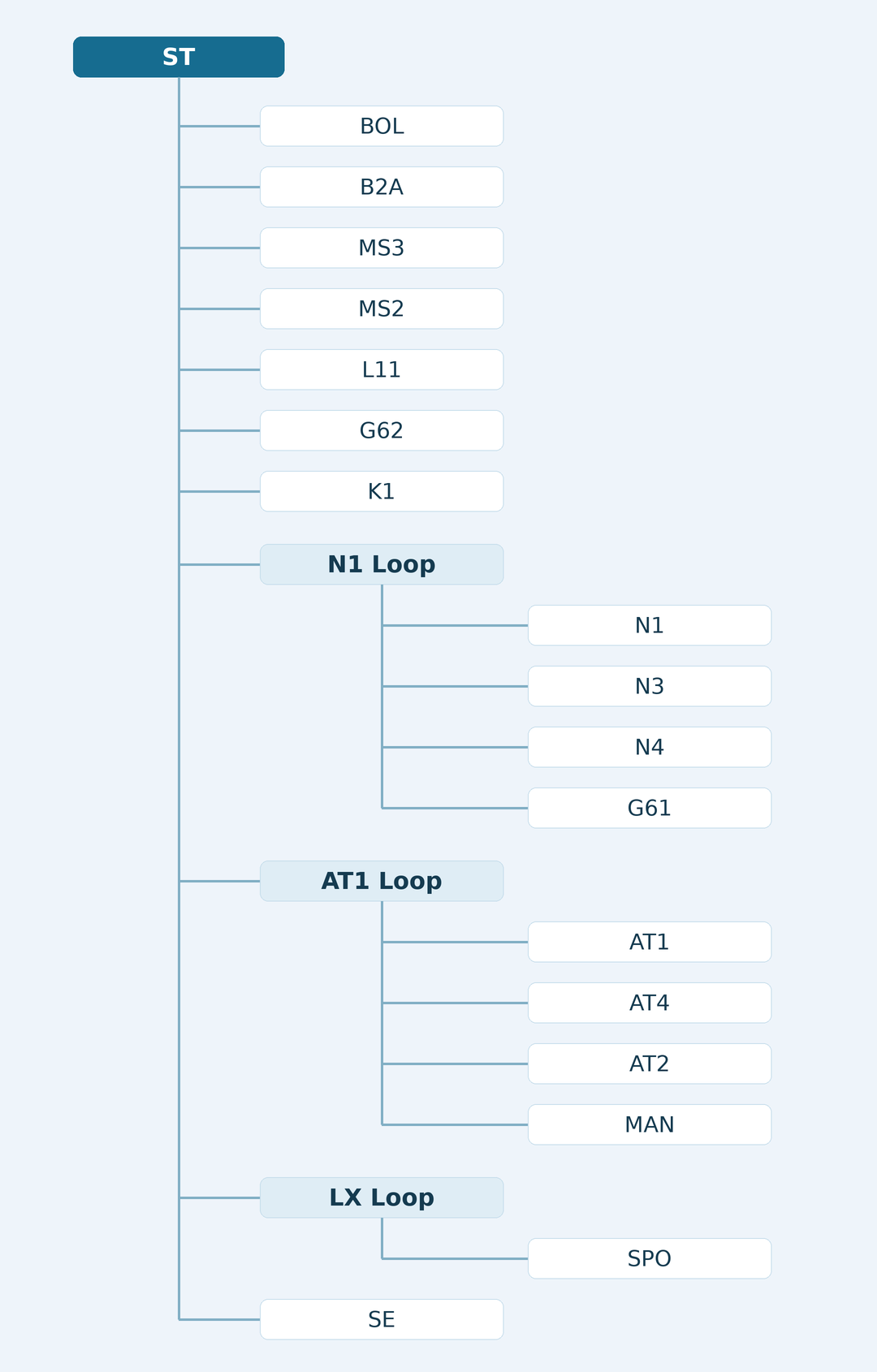
The EDI 211 Motor Carrier Bill of Lading follows the standard ANSI ASC X12 transaction structure consisting of a Header, Detail, and Summary section. The transaction organizes shipment information into logical segment groups that communicate the Bill of Lading, transportation parties, shipment references, equipment, freight details, and purchase order information while maintaining a consistent format for electronic exchange between trading partners.
Every EDI 211 begins with the ST Transaction Set Header and concludes with the SE Transaction Set Trailer. Between these segments, transportation information is organized into hierarchical loops that group related business data, making the transaction easier to validate, process, and integrate with enterprise transportation systems.
Section | Purpose | Primary Segments |
Header | Establishes the Bill of Lading and identifies shipment participants. | ST, BOL, B2A, MS3, MS2, L11, G62, K1, N1 Loop, G61 |
Detail | Defines the freight being transported and associated purchase order information. | AT1 Loop, AT4, AT2, MAN, LX Loop, SPO |
Summary | Closes the transaction and validates completeness. | SE |
Header Segment Summary
Segment | Name | Business Purpose |
ST | Transaction Set Header | Begins the EDI 211 transaction. |
BOL | Beginning Segment for Motor Carrier Bill of Lading | Establishes the Bill of Lading record. |
B2A | Set Purpose | Identifies whether the document is original, changed, confirmed, or cancelled. |
MS3 | Interline Information | Identifies participating carriers when applicable. |
MS2 | Equipment or Container Owner and Type | Identifies transportation equipment. |
L11 | Business Instructions and Reference Number | Provides shipment reference numbers. |
G62 | Date/Time | Identifies shipment-related dates and times. |
K1 | Remarks | Communicates transportation remarks. |
N1 Loop | Party Identification | Identifies transportation organizations. |
G61 | Contact | Identifies shipment contacts. |
Detail Section
The Detail section communicates the commodities, freight descriptions, shipment characteristics, marks and numbers, and purchase order references associated with the Bill of Lading. Multiple detail loops may be included to describe every commodity or shipment component contained within the transportation document.
Detail Segment Summary
Segment | Name | Business Purpose |
AT1 | Bill of Lading Line Item Number | Begins each freight line item. |
AT4 | Bill of Lading Description | Describes the commodity or freight. |
AT2 | Bill of Lading Line Item Detail | Provides shipment detail for the commodity. |
MAN | Marks and Numbers | Identifies labels, serial numbers, or shipping marks. |
LX | Assigned Number | Begins the purchase order detail loop. |
SPO | Shipment Purchase Order Detail | Associates purchase orders with the shipment. |
Summary Section
The Summary section completes the transaction by ending the EDI document and validating the number of transmitted segments. This verification helps ensure the entire Bill of Lading has been received before processing begins.
Summary Segment
Segment | Name | Business Purpose |
SE | Transaction Set Trailer | Ends the transaction and validates segment count. |
Hierarchical Loop Structure
Rather than presenting all shipment information in a single sequence, the EDI 211 groups related business information into reusable loops. This hierarchical structure allows transportation systems to efficiently process shipment parties, freight details, and purchase order information while maintaining clear relationships between each business entity.
Loop | Purpose |
N1 Loop | Identifies each transportation party and associated address information. |
AT1 Loop | Groups information for each commodity or freight line item. |
LX Loop | Groups purchase order references associated with the shipment. |
Segment Relationships
The EDI 211 builds the transportation document progressively. Header segments establish the shipment, party loops identify who is involved, detail loops describe what is being transported, and the summary validates the completed transaction.
Transaction Integrity
The structured organization of the EDI 211 enables enterprise applications to validate shipment information at multiple levels before transportation execution. Required segments establish document integrity, loops preserve business relationships, and standardized segment sequencing ensures consistent processing across ERP, WMS, TMS, carrier, and logistics platforms.
Integrity Check | Business Value |
Required Segment Validation | Ensures mandatory shipment information is present. |
Loop Validation | Maintains relationships between shipment entities. |
Segment Sequence Validation | Confirms ANSI X12 compliance. |
Element Validation | Verifies required business data. |
Transaction Count Validation | Confirms the document was completely transmitted. |
What Delimiters Are Used?
The EDI 211 uses standard ANSI X12 delimiters including element separators, segment terminators, and component element separators. Trading partners may vary delimiter characters based on implementation requirements.
File Format and Delimiters
Using the following Production Delimiters on all EDI transmissions sent to Vendors, Carriers, Trading and Solution partners will enable consistent EDI parsing across trading partners:
- Segment Separator – hex 15 (NAK) or hex 7E (~)
- Element separator – hex 7C (|) or hex 2A (*)
- Sub-element Separator – hex 3E (>)
Which Versions of the EDI 211 Are Commonly Used?
The EDI 211 Motor Carrier Bill of Lading has been published in multiple ANSI ASC X12 releases to accommodate evolving transportation requirements and industry practices. Although the core purpose of electronically communicating the Bill of Lading remains consistent across versions, later releases introduce additional data elements, expanded code lists, and implementation refinements that improve interoperability and support more complex transportation scenarios.
Common ANSI ASC X12 Versions
Version | Status | Typical Usage |
3020 | Legacy | Early transportation implementations. |
3030 | Legacy | Limited legacy environments. |
3050 | Legacy | Historical transportation systems. |
3060 | Legacy | Legacy carrier integrations. |
3070 | Legacy | Existing transportation implementations. |
4010 | Most Common | Common across manufacturing, retail, distribution, and logistics. |
4030 | Limited Adoption | Trading partner-specific implementations. |
4040 | Limited Adoption | Transportation modernization initiatives. |
4050 | Active | Expanded transportation implementations. |
5010,5030+ | Limited Adoption | Used where supported by specific trading partner requirements. |
Why Version Compatibility Matters
Organizations exchanging EDI 211 documents must agree on a common X12 version and implementation guideline before production begins. Even when the transaction number remains the same, differences in segment usage, qualifiers, element definitions, and mandatory requirements can affect interoperability between transportation systems.
Compatibility Consideration | Operational Impact |
Segment Requirements | Required segments may vary by version. |
Code Lists | Supported qualifiers may differ. |
Element Definitions | Data requirements can change between releases. |
Trading Partner Guides | Implementation rules frequently extend the base standard. |
Translation Maps | Maps should align with the agreed implementation version. |
PartnerLinQ Perspective
PartnerLinQ supports version-aware EDI transformation and mapping, allowing organizations to exchange EDI 211 transactions across multiple ANSI X12 releases without disrupting internal business processes. By normalizing transportation data through a canonical data model and applying configurable transformation rules, PartnerLinQ enables different trading partners to communicate using their preferred implementation guides while maintaining a consistent operational view across the enterprise.
What are the Limitations of the 211 Motor Carrier Bill of Lading?
Limited Shipment Status Visibility. The EDI 211 establishes the Bill of Lading before or at shipment execution, but it does not report transportation milestones such as pickup, in transit, delayed, arrived, or delivered.
Are Implementation Guidelines and Sample Files Available for the X12 EDI 211
Yes. PartnerLinQ provides sample transactions and implementation guides. EDI 211 implementation guides illustrate both inbound and outbound flows, segment layouts, and valid data examples and support testing and partner onboarding.
Companion Guides
Trading partners frequently publish X12 EDI 211 implementation guidelines defining segment usage and validation rules. Customized specification documents for use in on boarding and technical development are available through PartnerLinQ Support and Guideline Management.
Trading Partner Requirements
Trading partners define:
- Required segments
- Frequency expectations
- Identifier standards
EDI 211 Motor Carrier Bill of Lading Example File (X12 Sample)
ISA*00*    *00*   *ZZ*SHIPPERID    *ZZ*CARRIERID   *260730*2249*U*00401*000000001*0*P*>~
GS*BL*SHIPPERID*CARRIERID*20260730*2249*1*X*004010~
ST*211*0001~
BOL*ABCD*PP*BOL20260730001*20260730*1430*PRO987654~
B2A*00~
MS2*ABCD*TR12345~
L11*LOAD78452*LO~
L11*CUSTOMER4589*CR~
G62*10*20260730~
K1*DELIVER BY APPOINTMENT ONLY~
N1*SF*PARTNERLINQ MANUFACTURING*93*SHIP001~
N3*100 INDUSTRIAL PARKWAY~
N4*CHICAGO*IL*60601*US~
G61*SH*JANE SMITH*TE*3125550185~
N1*ST*REGIONAL DISTRIBUTION CENTER*93*RDC100~
N3*7500 COMMERCE DRIVE~
N4*COLUMBUS*OH*43215*US~
G61*CN*RECEIVING OFFICE*TE*6145550147~
AT1*1~
AT4*PACKAGED CONSUMER GOODS~
AT2*120*CTN*G*L*2400~
MAN*GM*000123456789012345~
LX*1~
SPO*PO4589001**PC*120*L*2400~
SE*23*0001~
GE*1*1~
IEA*1*000000001~
What Are the Common Errors and Challenges When Implementing the EDI 211 Motor Carrier Bill of Lading?
Implementing the EDI 211 Motor Carrier Bill of Lading requires more than exchanging a correctly formatted X12 document. Organizations must ensure shipment identifiers, transportation parties, equipment information, freight details, reference numbers, and trading partner business rules are accurate before the Bill of Lading is transmitted. Most implementation issues arise from inconsistent business data rather than incorrect EDI syntax.
While ANSI X12 defines the transaction structure, every trading partner typically publishes its own implementation guide specifying required qualifiers, mandatory references, carrier identifiers, shipment dates, and operational rules. Successful implementations combine standards compliance with trading partner validation, automated business rules, and comprehensive testing.
Common Implementation Challenges
Challenge | Business Impact | Recommended Practice |
Missing Bill of Lading Numbers | Shipment cannot be uniquely identified. | Generate unique, validated Bill of Lading numbers before transmission. |
Incomplete Party Information | Carrier may be unable to execute the shipment. | Validate all N1, N3, and N4 information against master data. |
Invalid SCAC or Carrier Identifiers | Shipment processing delays. | Validate carrier identifiers before document generation. |
Missing Shipment References | Reduced shipment traceability. | Require business reference validation through configurable rules. |
Incorrect Equipment Information | Transportation execution errors. | Synchronize trailer and equipment data with the TMS. |
Inaccurate Commodity Descriptions | Freight handling and billing discrepancies. | Standardize product and commodity master data. |
Trading Partner Guideline Variations | Transaction rejection. | Maintain partner-specific maps and validation rules. |
Manual Document Creation | Increased administrative effort and errors. | Automate Bill of Lading generation directly from enterprise systems. |
Common Validation Errors
Validation Area | Typical Error |
ST / SE | Segment count mismatch |
BOL | Missing or duplicate Bill of Lading number |
B2A | Invalid transaction purpose code |
N1 Loop | Missing shipper, consignee, or carrier information |
G62 | Missing required shipment dates |
L11 | Invalid or missing reference identifiers |
AT1 Loop | Missing commodity detail |
LX / SPO | Missing purchase order references when required |
Trading Partner Challenges
While the ANSI ASC X12 standard defines the EDI 211 transaction, trading partners frequently extend the standard through implementation guidelines. These variations often require partner-specific mappings, additional reference qualifiers, mandatory business identifiers, and custom validation logic. Here are some examples:
Trading Partner Requirement | Typical Variation |
Retailers | Routing guide references, appointment numbers, store identifiers |
Manufacturers | Production references, shipment schedules |
Motor Carriers | Carrier-specific equipment identifiers and routing requirements |
Third-Party Logistics Providers | Consolidation references, customer shipment identifiers |
Distribution Networks | Warehouse identifiers and receiving instructions |
Best Practices for Successful Implementation
Organizations achieve the greatest value from the EDI 211 by combining standards-based integration with automated validation, consistent master data, and coordinated transportation processes. A disciplined implementation reduces manual intervention while improving shipment accuracy and operational reliability.
Best Practice | Business Benefit |
Standardize Master Data | Improves shipment consistency across systems. |
Validate Before Transmission | Prevents avoidable trading partner rejections. |
Automate Document Generation | Eliminates manual preparation and duplicate entry. |
Maintain Trading Partner Maps | Simplifies partner-specific compliance. |
Monitor Transaction Exceptions | Accelerates issue resolution. |
Integrate ERP, WMS, and TMS | Establishes a single, trusted shipment record. |
Perform Regression Testing | Ensures updates do not disrupt production integrations. |
Maintain Audit Trails | Supports governance and transportation accountability. |
What are the Basic Questions for EDI Integration with the 211 Motor Carrier Bill of Lading?
- Are there Samples and Specs available?
- What is the general direction of the transaction?
- Are inbound or outbound orders required?
- Are AS2, VAN, or SFTP connections used?
- Are more than one trading partner exchanging the 211 Motor Carrier Bill of Lading?
- Are there other interested parties?
- What trading partner requirements apply?
- What version is required?
- What versions are supported?
- What other transactions might these interested parties be a party to?
- What response to the 211 Motor Carrier Bill of Lading is expected or sent?
- Is a response to 211 Motor Carrier Bill of Lading a timed event? Are notifications involved/needed?
- What system generates the response?
- What response time is contractually required?
- Are there samples and specs of the response transaction available?
- Are change orders supported?
- What validation rules apply?
- How are changes to the 211 Motor Carrier Bill of Lading business message managed today?
- Is there automation? (an internal system trigger) or are 211 Motor Carrier Bill of Lading business message transactions triggered manually?
- How is automation managed (manual vs. system-triggered)?
- Are responses and changes automatically triggered? (an internal system trigger)
- Are alerting systems configured for missed response deadlines?
- Do transactions require human intervention?
- What systems generate or consume the transaction?
- How are changes to the business message managed today?
- How are one-time addresses handled in ERP?
- What identifiers are used (SSCC, GTIN)?
- Are SKU or UPC identifiers used?
- What identifiers are required (SSCC, SKU, UPC, GTIN)?
- What testing process is required?
- What validation rules must be applied?
What are the Best Practices for using the 211 Motor Carrier Bill of Lading?
Best Practice | Business Benefit |
Standardize Bill of Lading numbering | Prevents duplicate shipment records. |
Maintain accurate SCAC codes | Ensures correct carrier identification. |
Standardize addresses and location IDs | Reduces pickup and delivery errors. |
Maintain consistent commodity descriptions | Improves freight classification and handling. |
Synchronize purchase order references | Improves reconciliation across systems. |
What Transactions are associated with the 211 Motor Carrier Bill of Lading?
Transaction | Name | Relationship to the EDI 211 |
EDI 204 | Motor Carrier Load Tender | Precedes the 211 by offering the shipment to the carrier. |
EDI 990 | Response to a Load Tender | Confirms whether the carrier accepts or declines the tender. |
EDI 211 | Motor Carrier Bill of Lading | Documents the shipment and communicates the electronic Bill of Lading. |
EDI 214 | Transportation Carrier Shipment Status Message | Reports pickup, transit, delay, arrival, and delivery events after shipment execution begins. |
EDI 210 | Motor Carrier Freight Details and Invoice | Communicates freight charges and billing information after transportation services are performed. |
When Should You Use an EDI 211 Instead of an EDI 204?
While the EDI 204 and EDI 211 are both commonly exchanged transactions and part of the same shipment workflow, they serve different purposes within the lifecycle,. The EDI 204 tenders a shipment to a carrier and requests transportation services, while the EDI 211 communicates the legal Bill of Lading after transportation arrangements have been made.
Frequently Asked Questions About the EDI 211 Motor Carrier Bill of Lading
What is an EDI 211 Motor Carrier Bill of Lading?
The EDI 211 Motor Carrier Bill of Lading is an ANSI ASC X12 transportation transaction used to electronically exchange the legal Bill of Lading between shippers, carriers, logistics providers, and transportation systems. It communicates shipment information required to authorize, identify, execute, and document freight movement.
Who sends an EDI 211?
The EDI 211 is typically sent by a shipper, manufacturer, distributor, warehouse, or third-party logistics provider to a motor carrier after transportation arrangements have been confirmed and before freight is picked up.
Who receives an EDI 211?
Motor carriers are the primary recipients of the EDI 211. Transportation management systems, freight brokers, logistics providers, and other authorized trading partners may also receive the transaction as part of an integrated transportation process.
Is the EDI 211 legally recognized as a Bill of Lading?
The EDI 211 is the electronic representation of a Bill of Lading within an agreed electronic data interchange process. Whether it serves as the legally controlling transportation document depends on applicable laws, contractual agreements, trading partner requirements, and the organization's electronic commerce practices.
What transactions commonly work with the EDI 211?
The EDI 211 is commonly exchanged alongside the EDI 204 Motor Carrier Load Tender, EDI 990 Response to Load Tender, EDI 214 Transportation Carrier Shipment Status Message, EDI 210 Motor Carrier Freight Details and Invoice, and EDI 997 or 999 acknowledgment transactions.
Can an EDI 211 include multiple commodities?
Yes. The EDI 211 supports multiple freight line items through repeating detail loops, allowing organizations to communicate multiple commodities, shipment descriptions, marks and numbers, and associated purchase order information within a single Bill of Lading.
How does the EDI 211 improve transportation visibility?
The EDI 211 establishes a standardized shipment record before freight moves. Consistent shipment identifiers, transportation parties, reference numbers, and equipment information enable downstream transportation systems to accurately associate shipment status updates, freight invoices, and operational events throughout the transportation lifecycle.
How does PartnerLinQ support the EDI 211?
PartnerLinQ automates the complete EDI 211 lifecycle through standards-based translation, canonical data modeling, semantic data modeling, intelligent validation, workflow orchestration, real-time monitoring, and seamless integration with ERP, WMS, TMS, carrier, and trading partner systems. The platform transforms the electronic Bill of Lading from a simple document exchange into a coordinated transportation execution process.
Related Resources

Explore Our Integration Solutions

PartnerLinQ Integration Solutions
Connect Everything. Integrate Intelligently.
Future-Proof Your Business with Composable, AI Powered Connectivity.