
 What are VDA Message Types?
VDA message types are EDI standards defined by the German Association of the Automotive Industry (Verband der Automobilindustrie e.V.). They were developed to support the digital exchange of supply chain data between OEMs, Tier-1 suppliers, and logistics providers. Common message types include VDA 4905 (Delivery Forecast), VDA 4913 (Delivery Note), VDA 4920 (Invoice), and VDA 4939 (Payment Advice). These messages align closely with ANSI X12 and EDIFACT standards, enabling global interoperability.
How Does PartnerLinQ use VDA Messages?
PartnerLinQ integrates VDA message types into its unified connectivity layer, harmonizing German automotive EDI with global standards. The platform automates VDA transactions through SAP and non-SAP systems, providing visibility across production schedules, shipments, and billing.
What Responses to VDA Messages are expected/sent?
 VDA messages often generate responses used to acknowledge receipt, confirm business acceptance, or report exceptions for automotive transactions such as orders, delivery schedules, shipments, and invoices. These responses ensure (1) the technical delivery and (2) the business intent are both synchronized between trading partners.
Unlike EDIFACT or X12 that mostly rely on a universal acknowledgment process, VDA uses different response messages depending on whether the response is technical or business-related, for example, VDA 4905 planning schedules may trigger shipment notifications (VDA 4913) and invoices (VDA 4920). PartnerLinQ ensures these workflows align with ANSI X12 830/856/810 and EDIFACT DELFOR/DESADV/INVOIC equivalents.
Technical (Transmission-Level) Responses
These confirm that a message was successfully delivered and syntactically received.
| Response Type | Description | Business Meaning |
|---|---|---|
| OFTP / OFTP2 Acknowledgment | Confirms file transfer was completed | Message reached the receiver’s system |
| File-Level Receipt Confirmation | Confirms file was received and readable | No transport error occurred |
Functional (Business-Level) Responses
These confirm whether the business content of the message can be processed.
| Original VDA Message | Expected Response | Purpose |
|---|---|---|
| VDA 4925 – Purchase Order | VDA 4926 – Order Response | Confirms acceptance, rejection, or modification of the order |
| VDA 4913 – Delivery Forecast | Updated forecast or revised call-off | Confirms or adjusts planning data |
| VDA 4915 / 4985 – JIT Call-off / DELJIT | Revised call-off or confirmation | Confirms feasibility of delivery sequence |
Exception and Change Responses
VDA messages may also trigger business exception responses rather than simple acknowledgments.
| Scenario | Typical Response | Meaning |
|---|---|---|
| Order cannot be fulfilled | VDA 4926 with rejection and reason code | Explains why order is rejected |
| Quantity or date must change | Revised VDA 4925 or 4915 | Supersedes previous instruction |
| Pricing dispute | VDA 4908 / 4938 | Issues credit or debit adjustment |
| Message contains errors | Rejection with technical or business reason code | Requests correction and resend |
What does the VDA message workflow support?
 The VDA workflow covers core business and logistics functions: including ordering (VDA4925), Order Response (VDA 4926), delivery (4913), invoicing (4920), planning (4905), and payment (4939). PartnerLinQ bridges the VDA workflow with SAP IDocs such as DELFOR, DESADV, INVOIC, and REMADV, ensuring seamless integration with ERP systems.
Accepting an VDA order (VDA4925) message from your automotive trading partner is typically insufficient for complete EDI compliance. Most automotive trading partners will expect other VDA EDI transactions in response to or following a VDA4925 (Purchase Order) message such as:
| VDA Message | Name / Type | Purpose / Description |
|---|---|---|
| VDA 4925 | Purchase Order | Used to place an order for goods or services. |
| VDA 4926 | Order Response | Confirms receipt of the Purchase Order. |
| VDA 4925 (Order Change) | Order Change (via Purchase Order) | An updated purchase order used to support order changes. |
| VDA 4905 | Despatch Advice | Describes the contents of the shipment. |
| VDA 4987 | Advance Ship Notice (ASN) | Describes shipment contents and provides shipment notification. |
| VDA 4913 | Delivery Forecast | Also known as a call-off delivery forecast; supports supplier delivery schedules and forecasting. |
| VDA 4905 | Delivery Instruction | Provides detailed delivery instructions and call-offs. |
| VDA 4915 | Delivery Just-in-Time (JIT) | Used to provide just-in-time delivery schedules and detailed call-offs (traditional VDA format). |
| VDA 4985 | DELJIT (EDIFACT subset) | Provides JIT delivery instructions using EDIFACT syntax (VDA’s more modern version). |
| VDA 4906 | Invoice | Used to provide detailed billing for goods or services (traditional VDA format). |
| VDA 4932 | Invoice (ODETTE syntax) | Used to provide detailed billing using ODETTE syntax (VDA’s more modern version). |
| VDA 4908 | Credit Notes | Used to provide detailed credit and billing information for goods or services. |
| VDA 4938 | Invoice + Credit Notes | Provides detailed billing and credit information, similar to X12 812 Credit/Debit Adjustment (VDA modernization). |
What are the Key Features of the VDA message workflow?
 • Optimized for the automotive sector
• High data accuracy and minimal redundancy
• Synchronizes planning, shipment, and billing
• Compatible with EDIFACT, X12, and SAP IDocs
What is the Purpose of the VDA message workflow?
The purpose of VDA messages is to create standardized communication for automotive manufacturers and suppliers, reducing administrative overhead and ensuring supply chain continuity.
What Information is included in the VDA message workflow?
VDA uses multiple specialized messages to seamlessly exchange a coordinated set of commercial, planning, logistics, financial, and control data across the automotive supply-chain in Germany. Originally defined by the German Association of the Automotive Industry (Verband der Automobilindustrie e.V.), they were developed to support the digital exchange of supply chain data between OEMs, Tier-1 suppliers, and logistics providers.
Today, VDA messages support order creation, delivery forecasting, just-in-time call-offs, shipment execution, invoicing, and exception handling, each transaction designed to support tightly synchronized automotive supply-chain operations.
End-to-End View (Conceptual)
| Workflow Stage | Information Exchanged | Supporting Messages |
|---|---|---|
| Order Creation | Commercial terms, items, quantities | VDA 4925 / 4926 |
| Forecasting & Call-Off | Planned and firm demand | VDA 4913, 4915, 4985 |
| Shipping Execution | Shipment and packaging data | VDA 4905, 4987 |
| Billing & Settlement | Invoice and adjustment data | VDA 4906, 4908, 4932, 4938 |
| Exception Handling | Status and reason codes | All response/change messages |
Information included in the VDA message workflow includes 
- Commercial Information (Ordering) - Exchanged when establishing or modifying supply commitments.
- Planning & Forecast Information (Scheduling) - Exchanged to support medium- and short-term production planning.
- Logistics & Shipment Information - Exchanged to execute and track physical movement of goods.
- Financial & Settlement Information - Exchanged to reconcile physical deliveries with financial obligations.
- Status & Exception Information – Exchanged to manage deviations from the planned process.
- Control & Traceability Information - Present in all workflow messages to ensure integrity and auditability.
What are the Essential Components of the VDA message workflow?
VDA messages are profile-driven when compared with X12 or generic EDIFACT. In other words, VDA doesn’t just define a message format — it defines a business more like a recipe, a profile for how that message must be used. A predefined usage rule set layered on top of a base syntax, one that is not open to interpretation.
What VDA does instead is provide a fixed message layout, a single intended use case per message. Automotive-specific rules for Call-offs, JIT sequencing, cumulative quantities,
Delivery schedules… and so on. So with VDA – a VDA 4915 always means JIT call-off, a VDA 4925 always means purchase order, and VDA 4906 always means invoice and very little partner-specific creativity.
Every VDA message is built from three essential component layers: (1) Control & Identification, (2) Business Content, and (3) Structural Rules & Profiles.
Control & Identification Components
These ensure the message can be uniquely identified, routed, and processed and include:
- Message Type (e.g., VDA 4925, 4915, 4906)
- Message Version / Release
- Sender ID (customer, OEM, or logistics partner)
- Receiver ID (supplier or carrier)
- Message Reference Number (unique per transmission)
- Creation Date & Time
- Test vs Production Indicator
Business Content Components
These carry the actual commercial and logistics meaning of the message, in support of ordering, scheduling, shipping, and invoicing processes in an automotive supply chain. Business Content Components typically include:
- Parties
- Document References (RFF)
- Item Data
- Dates and Times
- Logistics Data
- Financial Data (Where applicable)
Structural Rules & Profiles
This is what makes VDA distinct from generic EDIFACT for example.
- Fixed Segment Sequence - Messages must follow a strict segment order
- Predefined Field Lengths - Many data elements have fixed lengths and formats.
- Mandatory vs Optional Fields - Defined by VDA recommendation profiles.
- Code Lists - Packaging codes, Transport modes, Reason codes,
- Automotive-Specific Semantics - Call-off , JIT sequencing, Cumulative Quantity
Summary Table
| Component Layer | What It Covers | Why It Matters |
|---|---|---|
| Control & Identification | Sender, receiver, message type, date/time, reference numbers | Routing, uniqueness, traceability |
| Business Content | Parties, items, quantities, dates, logistics, financials | Executes the business transaction |
| Structural Rules & Profiles | Segment order, mandatory fields, code lists, automotive semantics | Guarantees interoperability |
| Transport & Syntax | File format, protocols, acknowledgments | Ensures delivery and security |
What Common Segments are included in VDA messages?
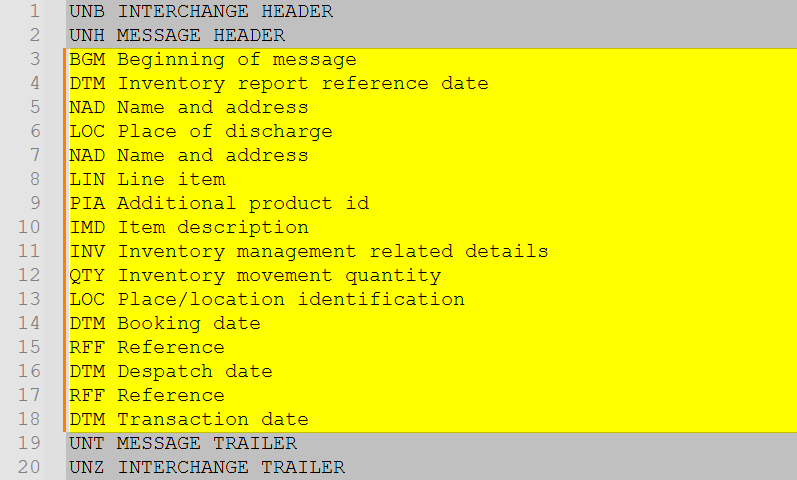
Unlike traditional EDI messages, where ‘segments’ are assembled and together carry transactional order, delivery, and shipping information, VDA messages are built based on fixed-position data fields grouped into logical record sections. Functionally speaking,
VDA messages contain recurring ‘data groups’ that play the same role as ‘segments’ or ‘elements’ do in other standards. ‘Data groups’ function like ‘segments’ and appear consistently across transactions (even though field positions differ).
| Data Group (Functional “Segment”) | What It Contains | Purpose |
|---|---|---|
| Message Header | Message type (e.g., 4925, 4915), sender ID, receiver ID, creation date/time, message reference number | Identifies and controls the message |
| Document Header | Document number (PO, schedule, ASN, invoice), document date, transaction purpose (original/change/cancel) | Identifies the business document |
| Party Identification | Buyer, supplier, ship-to, delivery plant, unloading point | Defines who is involved in the transaction |
| Reference Information | Purchase order number, schedule number, delivery note, ASN number, contract number | Links the message to related documents |
| Item / Material Data | Part number, description, drawing revision, material code | Identifies the product being ordered or shipped |
| Quantity Information | Ordered quantity, scheduled quantity, shipped quantity, cumulative quantity | Communicates volume commitments |
| Date / Time Information | Order date, delivery date, call-off date, production date | Controls timing and sequencing |
| Packaging Information | Package type, packaging unit, container ID, pallet count | Supports automotive packaging and handling |
| Transport / Delivery Data | Transport mode, carrier, route, unloading point | Supports physical logistics execution |
| Call-off / Schedule Data | JIT sequence number, call-off number, delivery window | Supports just-in-time and sequence-based supply |
| Price / Financial Data (if applicable) | Unit price, total price, tax, allowances | Used in invoice and credit note messages |
| Control Totals | Number of line items, total quantities, total amounts | Used for validation and reconciliation |
| Message Trailer | End-of-message indicator, record count | Confirms message completeness |
‘Data groups’ appear consistently across various transactions, thus are considered ‘common.’
- VDA 4925 (Purchase Order)
- VDA 4913 (Delivery Forecast)
- VDA 4915 / 4985 (JIT Call-off / DELJIT)
- VDA 4905 / 4987 (Despatch Advice / ASN)
- VDA 4906 / 4932 (Invoice)
What Status Codes are included in VDA messages?
VDA messages, while very similar to messages defined within other standards, does not leverage a single ‘global status code list.’ While status codes are used to represent transaction status (accepted, rejected, pending) unlike X12 or EDIFACT, each message type defines its own status code values, their meanings and where they appear in the layout of the transaction. VDA messages use profile-specific status codes to indicate the business state of orders, delivery schedules, shipments, and invoices.
Document / Transaction Status Codes
Document / Transaction Status Codes are used to describe the overall purpose or state of the document and are used in the VDA 4925 (PO), VDA 4913 (Forecast), VDA 4915/4985 (JIT), VDA 4905 (Despatch Advice), VDA 4906/4932 (Invoice), for example:
| Category | Meaning |
|---|---|
| Original | First issuance of a document (order, call-off, ASN, invoice) |
| Change / Update | Revision to a previously sent document |
| Cancellation | Cancels a prior order or schedule |
| Replacement | Supersedes a previous version |
Order & Schedule Status Codes
Order & Schedule Status Codes are used to describe the commercial state of an order or delivery call-off and Used in the VDA 4926 (Order Response), VDA 4913 (Delivery Forecast), VDA 4915 (JIT).
| Category | Meaning |
|---|---|
| Accepted | Supplier confirms the order or call-off |
| Rejected | Supplier cannot fulfill the order |
| Partially Accepted | Some lines accepted, others rejected |
| Confirmed Quantity | Quantity agreed by supplier |
| Changed Quantity | Quantity modified from original request |
| Firm / Frozen | Delivery is fixed and cannot be changed |
| Forecast | Planning information only (non-binding) |
Delivery & Shipment Status Codes
Delivery & Shipment Status Codes are used to describe the logistics execution state and can be found in the VDA 4905 (Despatch Advice) and VDA 4987 (ASN).
| Category | Meaning |
|---|---|
| Ready for Dispatch | Goods prepared for shipment |
| Dispatched | Shipment has left the supplier |
| In Transit | Shipment is moving to destination |
| Delivered | Shipment has arrived |
| Partially Delivered | Only part of the shipment delivered |
| Delayed | Delivery will not meet planned date/time |
Call-off / JIT Sequencing Status Codes
| Category | Meaning |
|---|---|
| Call-off Valid | Active delivery instruction |
| Call-off Changed | Revised delivery instruction |
| Call-off Cancelled | Instruction no longer valid |
| Sequence Confirmed | Production/shipping sequence acknowledged |
| Sequence Rejected | Sequence cannot be met |
Call-off / JIT Sequencing Status Codes are used in just-in-time and sequence-based supply chains and it is used in the VDA 4915 and VDA 4985 (DELJIT subset).
Invoice & Financial Status Codes
Invoice & Financial Status Codes are used to describe billing and settlement state and can be found in the VDA 4906, VDA 4932 (Invoice), and VDA 4908 / 4938 (Credit/Debit)
| Category | Meaning |
|---|---|
| Invoice Issued | Billing document created |
| Credit Issued | Credit note generated |
| Debit Issued | Debit adjustment |
| Disputed | Invoice under review |
| Corrected | Replacement or correction invoice |
| Paid / Settled | Financially closed (if supported) |
Technical / Processing Status Codes
Technical / Processing Status Codes are used to indicate message handling results and these are most often embedded in response messages or handled via transport acknowledgments (e.g., OFTP/OFTP2)
| Category | Meaning |
|---|---|
| Message Accepted | Syntax and business rules passed |
| Message Rejected | Validation failed |
| Duplicate | Message already processed |
| Error in Content | Business rule violation |
What Reason Codes are included in VDA messages?
Here again, VDA reason codes are profile-specific business explanation codes that explain why an order, call-off, shipment, or invoice was rejected, changed, or adjusted. Used to qualify rejections, changes, and most importantly, deviations in automotive order, scheduling, shipping, and invoicing processes explanations for rejections and/or changes include qualification include quantity unavailable, capacity constraints, material shortages, scheduling conflicts, packaging rather than using a single universal reason code list. They communicate why a transaction could not be processed as requested. Where X12 message might indicate simply ‘Rejected’ a VDA response indicates ‘Rejected — due to material shortage’, or ‘Changed — due to capacity constraint’ or ‘Delayed — due to transport issue’ a structure that enables automated exception handling and coordinated supply-chain response – perhaps the first steps in the direction of fully autonomous supply chain.
Common Reason Code Categories in VDA Messages
| Category | Typical Meaning | Business Use |
|---|---|---|
| Quantity Not Available | Supplier cannot meet requested quantity | Explains partial or full rejection of an order or call-off |
| Capacity Constraint | Production capacity is insufficient | Explains delivery delay or reduced quantity |
| Material Shortage | Raw materials or components unavailable | Explains inability to fulfill request |
| Schedule Conflict | Requested date/time cannot be met | Explains delivery date changes |
| Packaging Not Available | Required packaging type not available | Explains logistics or ASN deviations |
| Transport Problem | Carrier or routing issue | Explains shipment delay or change |
| Technical Error | Data incorrect or incomplete | Explains rejection due to invalid message content |
| Pricing Error | Price does not match contract | Explains invoice dispute or rejection |
| Incorrect Part Number | Material number invalid or unknown | Explains line-item rejection |
| Contract Not Valid | No valid agreement exists | Explains commercial rejection |
| Order Superseded | Replaced by a newer message | Explains cancellation or replacement |
| Duplicate Message | Message already processed | Explains technical rejection |
| Regulatory / Compliance Issue | Legal or compliance rule violated | Explains blocked delivery or billing |
Where Reason Codes Are Used
| VDA Message | Reason Codes Explain… |
|---|---|
| VDA 4926 (Order Response) | Why an order line is rejected or changed |
| VDA 4913 (Delivery Forecast) | Why forecast quantities are adjusted |
| VDA 4915 / 4985 (JIT Call-off / DELJIT) | Why a call-off or sequence is rejected or changed |
| VDA 4905 / 4987 (Despatch Advice / ASN) | Why shipment differs from plan |
| VDA 4906 / 4932 (Invoice) | Why amounts differ or are disputed |
| VDA 4908 / 4938 (Credit/Debit) | Why a credit or adjustment was issued |
What Use Cases do VDA messages support?
VDA messages support high-volume end-to-end automotive supply-chain use cases including purchase order management, delivery forecasting, just-in-time scheduling, shipment notification, invoicing, exception handling, and compliance.
Together, these use cases enable tightly synchronized, high-volume, and automated collaboration between OEMs and suppliers. 
| Business Function | VDA Message ID | Use Case |
|---|---|---|
| Order Management | 4925, 4926 | Electronic transmission of purchase orders; create and confirm supply commitments |
| Planning and Demand Forecasting | 4913 | Communicate planned demand |
| Just-in-time Manufacturing | 4915, 4985 | Issue sequenced delivery instructions |
| Shipping | 4905, 4987 | Notify of outbound shipments |
| Billing | 4906, 4908, 4932, 4938 | Invoice and adjust charges |
| Exception Handling | 4926, revised call-offs | Manage rejections and changes |
| Compliance | All | Maintain auditable records |
- Delivery scheduling between OEMs and suppliers
- Packaging Instructions
- Forwarding Instructions
- Delivery Notes / Dispatch Advice (ASN - Advance Shipping Notice)
- Receipt Acknowledgment
- Automated invoicing, remittance, and reconciliation
What are the Benefits of VDA messages?
• Improves supply chain synchronization
• Reduces manual reconciliation
• Enhances automotive compliance (VDA & AIAG alignment)
How Efficient are VDA messages?
VDA messages are optimized for high-volume, repetitive automotive transactions such as call-offs, delivery schedules, ASNs, and invoices. They are the backbone that enables the most demanding and efficient manufacturing practices in the world, the automotive sector. Their design prioritizes speed, predictability, and low processing cost over flexibility, in fact, VDA messages are extremely efficient VDA messages are used almost exclusively for Just-in-Time (JIT) and Just-in-Sequence (JIS) in the automobile sector when compared with other manufacturing sectors.
- Parsing is simple (fixed field positions, no variable-length loops)
- Validation is predictable (rules are embedded in the profile)
- File sizes are small compared to X12 or EDIFACT
- CPU and memory usage is low during processing
- Batch processing is fast, even at very high volumes
Key Efficiency Characteristics
| Efficiency Dimension | How VDA Achieves It | Resulting Benefit |
|---|---|---|
| Compact Format | Fixed-length, positional fields instead of verbose tagged segments | Smaller message size and faster parsing |
| Profile-Driven Structure | Mandatory fields and strict layouts defined by VDA recommendations | Minimal ambiguity and fewer validation rules |
| Single-Purpose Messages | Each message supports a specific business process (e.g., call-off, JIT, invoice) | No extra or unused data elements |
| Automotive Semantics Embedded | Built-in concepts such as cumulative quantities, call-offs, and sequencing | Eliminates need for external business logic |
| Low Optionality | Limited optional fields compared to X12 or EDIFACT | Reduces conditional branching and mapping complexity |
| Deterministic Processing | Same structure every time for a given message type | Enables straight-through processing (STP) |
| Transport Optimized | Historically paired with OFTP/OFTP2 | Reliable, high-throughput transmission |
How Compliant are VDA messages?
VDA messages are highly compliant by design. Primarily governed by industry rather than government (e.g., regulation) they leverage strict, profile-driven rules that define field usage, code values, and business semantics for specific automotive processes. Compliance is industry-mandated rather than legally mandated, and operationally compulsory for participation in many automotive supply networks and enforced through industry standards and trading partner agreements. The result is deterministic validation, reduced ambiguity, and reliable automation across OEM and supplier networks.
- Messages follow the exact structure defined in the VDA recommendation
- Mandatory data elements are always populated
- Codes and qualifiers match allowed values
- Business rules (e.g., cumulative quantity logic) are applied consistently
- Rejected or changed transactions include valid reason codes
- Superseded messages properly reference prior versions
What is the Format of a VDA message?
VDA messages are structured variable-length text files (Delimited). VDA messages use predefined field lengths. While many data elements have fixed lengths and formats, they can be harmonized with EDI and IDoc mappings in some of the more advanced solutions in the market like the PartnerLinQ platform which consolidates, normalizes and harmonizes data from various sources making critical information accessible for optimizing supply chain operations.
How Accurate are VDA messages?
VDA messages are designed to ensure precision with minimal human intervention. Delivered through standardized data exchanges like Just-in-Time (JIT) and Just-in-Sequence (JIS), just two examples just how accurate VDA messages can be. The automobile sector shines with their approach to coordinated supply-chain response, perhaps leading the first steps in a fully autonomous supply chain now that AI is taking hold.
What are the Limitations of a VDA message?
VDA’s fixed-length formats in support of the automobile sector requires strict adherence and lack flexibility compared to X12 or EDIFACT, messages that are non-compliant typically result in:
- Message rejection
- Delivery or payment delays
- Manual intervention
- Potential commercial penalties (e.g., chargebacks)
Are Guidelines & Sample Files for VDA messages available?
Yes. PartnerLinQ provides sample VDA Transactions and Implementation guides are available through its Support and Guideline Management Team.
Sample implementation guides illustrate both inbound and outbound flows, segment layouts, and valid data examples and support testing and partner onboarding. Customized specification documents for use in on boarding and technical development are available upon request.
PartnerLinQ provides:
- Transaction implementation guide
- Sample payloads
- Qualification and testing maps
- Error handling and best-practice notes
What are the Basic Questions for Integration of the VDA message workflow?
- Which VDA versions are used or required?
- What is the general direction of the transaction?
- Are orders inbound or outbound?
- Are there Samples and Specs available?
- Are functional acknowledgments needed?
- Is EDIFACT, X12, or AIAG alignment required?
- Are PO Changes accommodated?
- How are changes to orders managed today?
- Is there automation? (an internal systems triggers) or are PO changes triggered manually
- How will cancellations and changes be managed?
- Are there other parties interested in this same transaction?
- What transactions might these interested parties also be a party to?
- What type of connection will be used for exchanging the EDI Files? (OFTP/OFTP2, AS2, VAN…)
- Is the customer only sending EDI or are there other ways to get the order into the system?
- Is there customization to accommodate Order to Cash flows?
- How are Payment Terms, FOB, INCO Terms, and/or Method of Payment terms applied?
- Are Line Items identified by SKU or UPC?
- How does pricing work?
- Is a contract or a Price/Sales Catalog transaction in use?
- Are we expecting Service, Promotion, Allowance, or Charge Information (SAC) within the PO?
What is the basic VDA Business Level Workflow model?
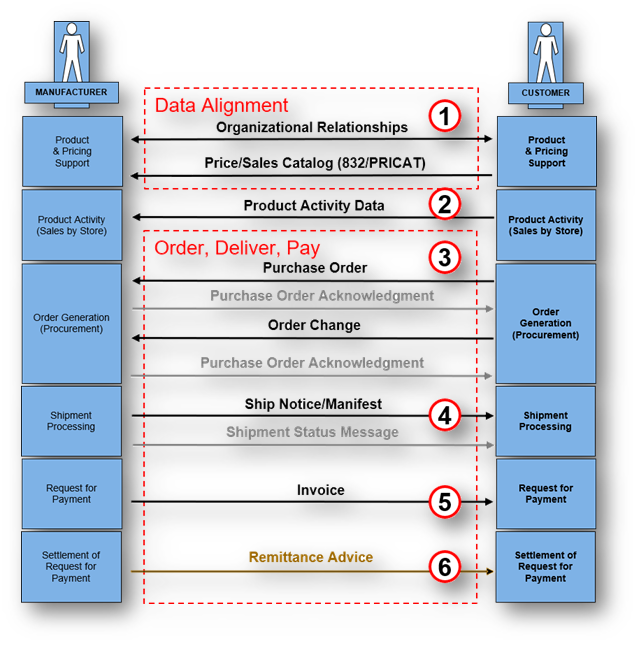
The VDA workflow model reflects how German and European automotive OEMs and suppliers coordinate planning, shipping, invoicing, and payment using fixed-format VDA messages. It’s built to support Just-in-Time (JIT) and Just-in-Sequence (JIS) manufacturing.
- OEM issues planning schedule (VDA 4905)
- Supplier sends delivery note (VDA 4913)
- Supplier issues invoice (VDA 4920)
- OEM confirms payment (VDA 4939)
Planning & Forecasting
VDA 4905 – Delivery Forecast / Scheduling Agreement
- Communicates medium- to long-term production requirements.
- Defines expected quantities and delivery dates.
- Drives supplier production planning and material procurement.
Shipping Instruction & Execution
VDA 4908 – Shipping Schedule (call-off / JIT instruction)
- Converts forecast into near-term shipping requirements.
- Often used for JIT or sequence-based delivery.
- Supplier prepares goods and ships.
Delivery Notification
VDA 4913 – Delivery Note / Despatch Data
- Sent when goods are shipped.
- Contains packaging, handling unit, and transport details.
- Enables dock planning and automated receiving.
Invoicing
VDA 4920 – Invoice
- Requests payment for delivered goods.
- References shipment and order data for matching.
Payment & Remittance
VDA 4939 – Payment Advice / Remittance
- Confirms payment and identifies which invoices were paid.
Quality & Test Reporting
VDA 4987 – Quality Data / Test Results
- Provides inspection or quality assurance results.
What are the Best Practices of the VDA message workflow?
- Validate message formats before transmission
- Map each VDA file to the corresponding X12/EDIFACT/SAP equivalent
- Use automated acknowledgment and reconciliation
- Maintain strict version control across partners
Appendix: Mapping Table – VDA ↔ X12 ↔ EDIFACT ↔ SAP IDoc
| VDA | ANSI X12 | EDIFACT | SAP IDoc |
|---|---|---|---|
| VDA 4905 – Delivery Forecast | 830 – Planning Schedule | DELFOR | DELFOR |
| VDA 4908 – Shipping Schedule | 862 – Shipping Schedule | DELJIT | DELJIT |
| VDA 4913 – Delivery Note | 856 – Advance Ship Notice | DESADV | DESADV |
| VDA 4920 – Invoice | 810 – Invoice | INVOIC | INVOIC |
| VDA 4939 – Payment Advice | 820 – Payment Order/Remittance | REMADV | REMADV |
| VDA 4987 – Quality Data | 863 – Report of Test Results | QALITY | QALITY |



Explore Our Integration Solutions

PartnerLinQ Integration Solutions
Connect Everything. Integrate Intelligently.
Future-Proof Your Business with Composable, AI Powered Connectivity.