PARTNERLINQ PLATFORM
Composable Digital Backbone for the Enterprise
PartnerLinQ is an enterprise-grade, multi-cloud, composable platform that unifies ecosystem integration, data management, and intelligent decisioning—enabling faster transformation and AI-driven, business-centric automation.
PartnerLinQ’s platform architecture
is designed around five unified layers:

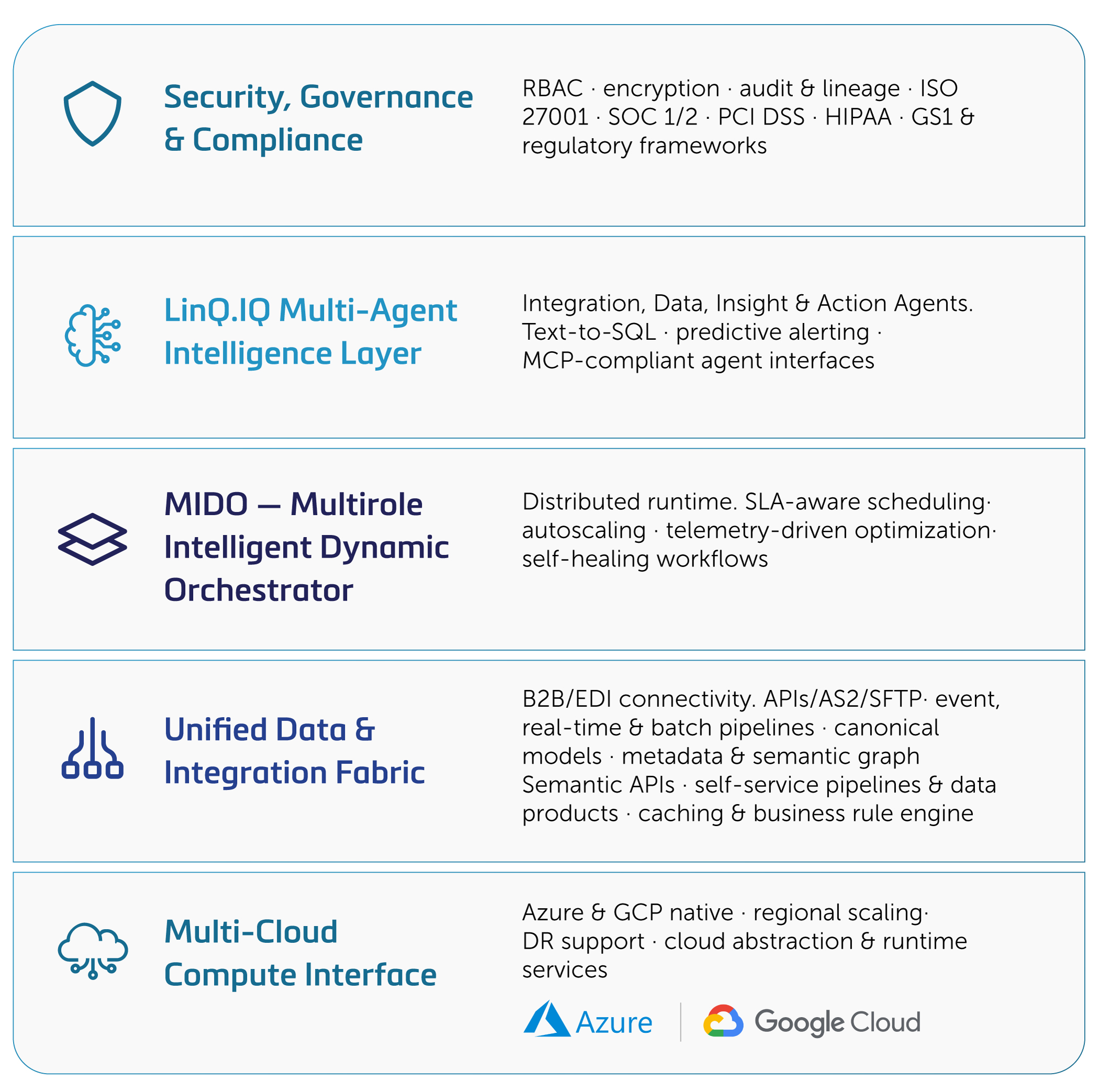
Multi-Cloud Compute Interface

MIDO — Multirole Intelligent Dynamic Orchestrator

Security, Governance & Compliance

Unified Data & Integration Fabric

LinQ.IQ – Multi-Agent Intelligence Layer
Built for connected,
intelligent supply chains

Abstracts infrastructure complexity while preserving expert control.
Merges EDI, APIs, events, and semantic data products into a single platform fabric.
Prepares enterprises for Agentic AI with LinQ.IQ multi-agent intelligence.
Delivers real-time visibility, predictive automation, and governed operations.
ARCHITECTURE
Platform Architecture Overview
PartnerLinQ’s five-layer architecture unifies integration, semantic data, orchestration, and AI agents
into a composable platform that runs natively across Azure and GCP.
Five Layers, One Composable Platform
The platform is structured into five tightly integrated layers that can be adopted incrementally or as a full-stack deployment. Each layer exposes clear interfaces for integration, observability, and extension.
Security, Governance & Compliance provides end-to-end control and assurance.
LinQ.IQ Multi-Agent Layer powers automation, analytics, and decision support.
MIDO — Multirole Intelligent Dynamic Orchestrator intelligently adapts, coordinates, and automates multi-party workflows across complex digital ecosystems.
Unified Data & Integration Fabric merges pipelines, connectivity, and semantics.
Multi-Cloud Compute Interface abstracts underlying cloud infrastructure.
FABRIC
Unified Data & Integration Fabric
The Unified Data & Integration Fabric is the foundation of PartnerLinQ’s composable architecture,
bridging application connectivity with semantic data management.
Integration Pipelines, Canonical Models & Semantic Data
PartnerLinQ combines integration pipelines, canonical data models, metadata-driven semantics, and AI-assisted orchestration into one cohesive framework.
B2B/EDI lifecycle management with partner communication and onboarding.
Integrated connectivity suite with built-in AS2, managed SFTP, and APIs.
High-performance pipelines for event-driven, real-time, and batch data flows.
Low-code mapping and transformation engine with enrichment and validation.
Active metadata catalog, canonical data framework, and semantic knowledge graph.
Semantic API layer that exposes graph and canonical models as self-service APIs.
DATA PRODUCTS & SELF-SERVICE
Data Products, Studios & AI-Assisted Setup
The fabric is designed to be self-service for both business and technical users, with AI assistance to simplify complex configuration.
Pre-built industry and process data products for rapid analytics.
No-code pipeline and API builder for ingestion and exposure.
Partner Onboarding Studio for template-driven setup of trading partners.
AI Integration Agent that bootstraps mappings, routes, and monitoring policies.
Distributed caching and cross-reference engine for high-frequency lookups.
ORCHESTRATION
MIDO — Multirole Intelligent Dynamic Orchestrator
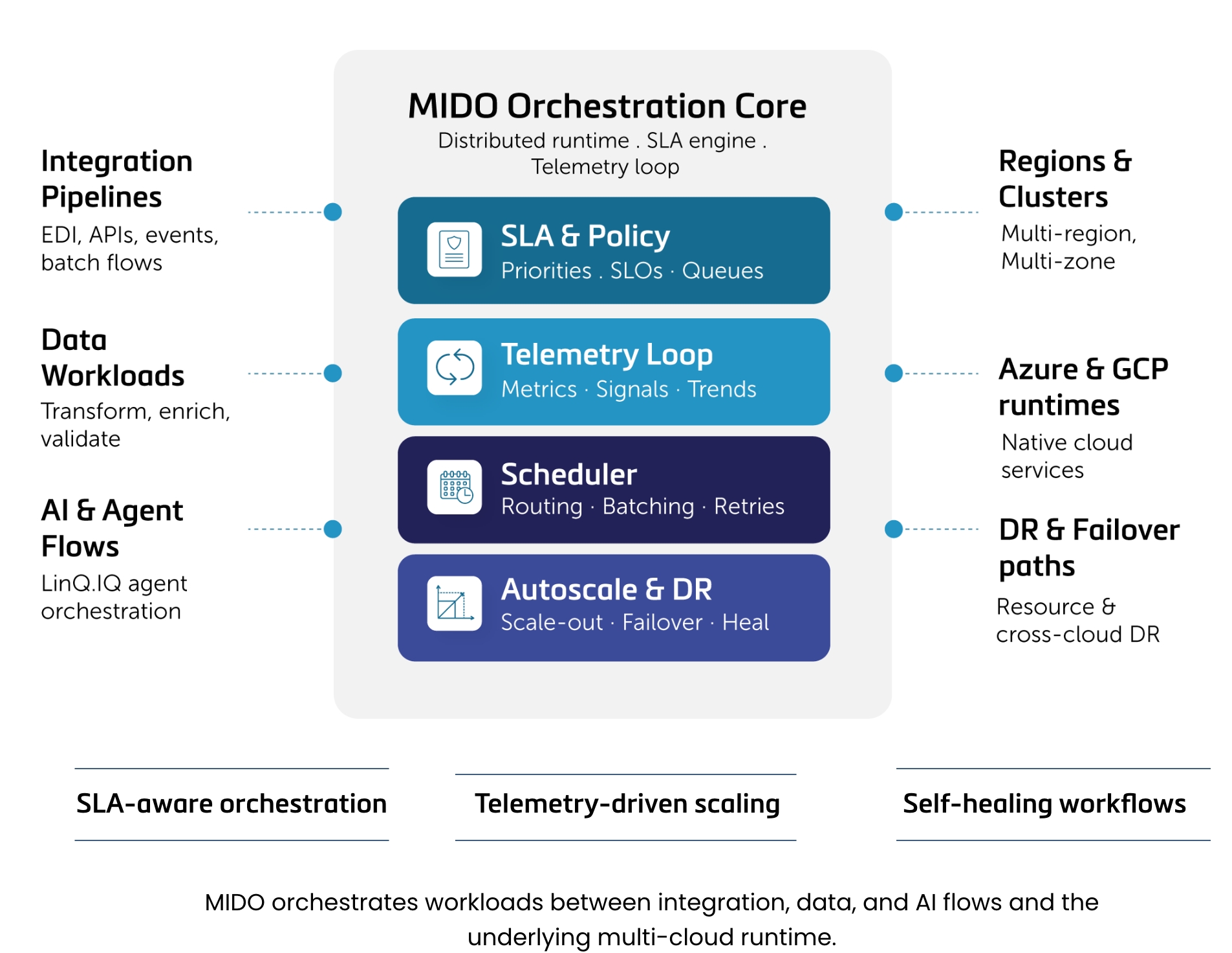
MIDO is the orchestration backbone that manages distributed workloads, SLA-based scheduling,
and self-healing pipelines across multi-region, multi-cloud deployments.
Telemetry-Driven, SLA-Aware Orchestration
MIDO coordinates PartnerLinQ’s integration, data, and AI workloads via distributed scheduling, autoscaling, and recovery workflows, ensuring business SLAs are met.
Distributed execution engine for pipelines, APIs, and agents.
SLA-aware scheduling with priorities, backpressure, and queue control.
Telemetry loop that observes metrics, learns patterns, and tunes resources.
Autoscaling policies that respond to volume, latency, or error thresholds.
Resource-level, regional, and cross-cloud DR orchestration.
INTELLIGENCE
LinQ.IQ – Multi-Agent Intelligence Framework
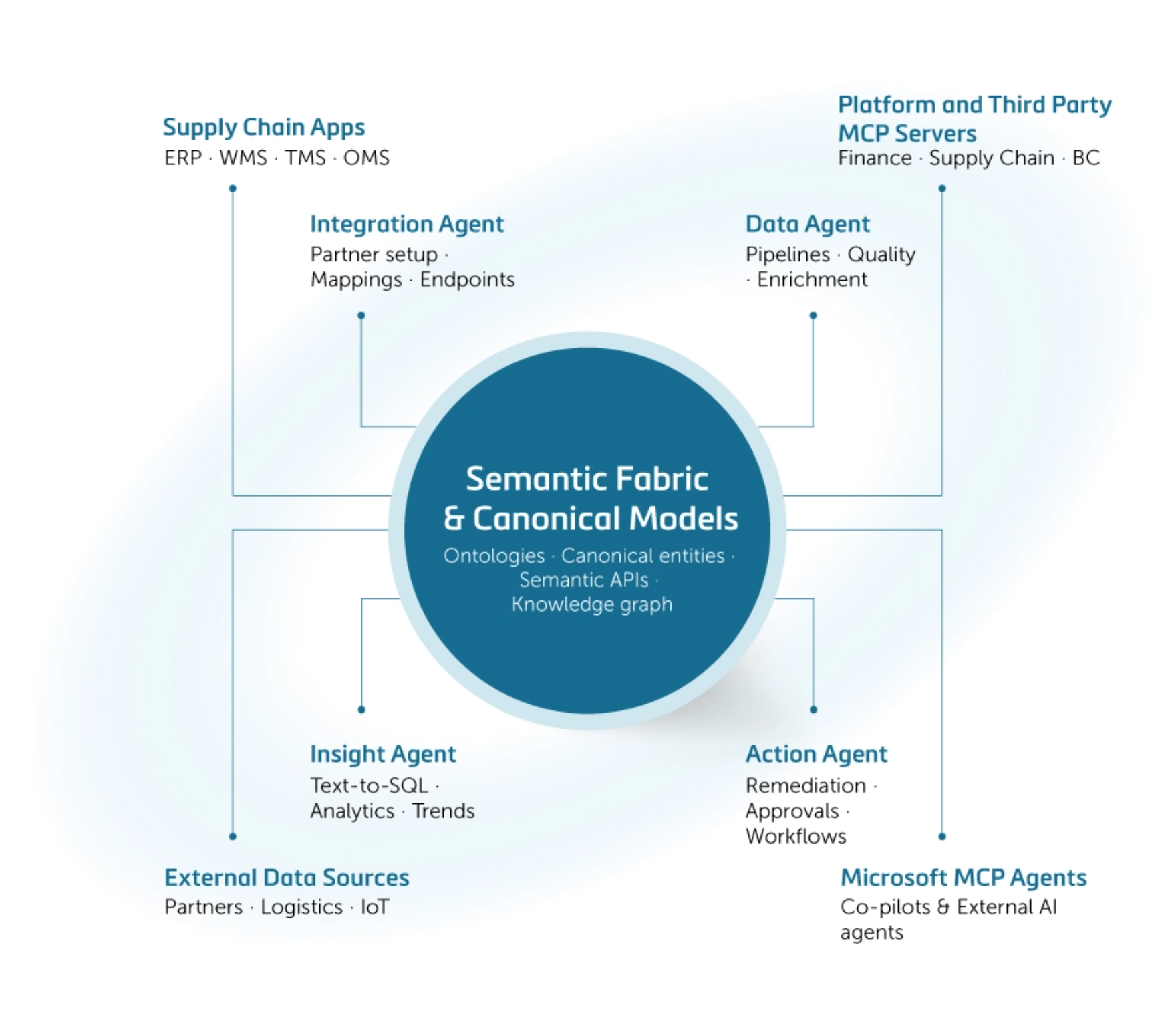
LinQ.IQ introduces autonomous agents that understand enterprise semantics, optimize integrations, and orchestrate
bi-directional data flows between PartnerLinQ and external systems, including MCP-compatible Microsoft agents.
Integration, Data, Insight & Action Agents
LinQ.IQ enables cognitive automation across the platform, with agents that collaborate over canonical models and semantic APIs to deliver context-aware recommendations and autonomous actions.
Integration Agent automates partner onboarding, mappings, and endpoint setup.
Data Agent manages pipeline health, quality, and enrichment policies.
Insight Agent powers Text-to-SQL, analytics, and trend detection over semantic data.
Action Agent executes remediation steps, orchestrates workflows, and can loop in humans for approvals.
MCP-compliant interfaces allow Microsoft agents to traverse PartnerLinQ’s Data Fabric.
SECURITY, GOVERNANCE & COMPLIANCE
Security, Trust & Regulatory Alignment
PartnerLinQ’s Security, Governance & Compliance layer provides the guardrails for every integration, data flow,
and AI workload running on the platform. It is designed to support enterprise-grade security controls and align with leading industry
and regulatory frameworks, including ISO 27001, SOC 1/SOC 2, PCI DSS, HIPAA, and GS1-driven supply chain standards.
Cross-Layer Controls for Data, Users & Workloads
Security in PartnerLinQ is enforced consistently across connectivity, data pipelines, semantic fabric, orchestration, and agents. Access, usage, and change are all governed by a single policy model.
Fine-grained RBAC: Role-based access control down to object, field, and transaction level across integrations, data products, and monitoring views.
Encryption by Default: TLS for data in transit and strong encryption for data at rest, including configuration, credentials, and telemetry artifacts.
Auditability & Lineage: Every change and every transformation step is captured with lineage, timestamps, and user or automation context for forensic analysis and compliance reporting.
Policy-Driven Governance: Policy-Driven Governance: Central policy definitions applied consistently across tenants, business units, and workloads, including retention, masking, and segregation-of-duty policies.
Resilience & DR: Multiple layers of backup, failover, and multi-region deployment patterns help protect against data loss and availability incidents.
COMPLIANCE FRAMEWORKS
Designed for Regulated & Global Supply Chains
PartnerLinQ’s controls and operational practices are structured to support organizations operating under stringent security, privacy, and industry-specific requirements across regions and verticals.
ISO 27001: Alignment with information security management best practices for risk assessment, controls, and continuous improvement.
SOC 1 & SOC 2: Support for control environments focused on financial reporting integrity (SOC 1) and security, availability, and confidentiality of services (SOC 2).
PCI DSS: Controls and patterns to support secure handling of payment-related data where applicable in supply chain and commerce flows.
HIPAA: Capabilities to help safeguard protected health information (PHI) and support HIPAA-aligned use cases across healthcare, life sciences, and logistics involving medical products.
GS1 & Supply Chain Standards: Support for GS1-based identification, barcoding, and data structures used across retail, food, logistics, and transportation networks.
Regional Privacy & Residency: Configurations to support data residency, isolation, and privacy requirements (e.g., regional data zones, separation of duties, and tenant-level isolation).
CAPABILITIES
Platform Core Components
A unified framework spanning connectivity, data movement, semantic intelligence,
orchestration, and governance within a single platform.
Layer
Multi-Cloud Interface
Unified Data & Integration Fabric
MIDO Orchestrator
LinQ.IQ Intelligence
Governance & Security
Core Components
Azure & GCP abstraction, runtime services
Connectivity, pipelines, canonical models, semantic graph
Orchestration runtime & telemetry engine
Multi-agent framework with MCP support
RBAC, audit, compliance controls, lineage
Technical Capabilities
Azure & GCP abstraction, runtime services
Connectivity, pipelines, canonical models, semantic graph
Distributed scheduling, optimization, self-healing
Predictive alerting, Text-to-SQL, autonomous actions
Encryption, policy management, ISO 27001, SOC 1/2, PCI DSS, HIPAA, GS1-aligned data structures, metadata governance
Business Impact
Elastic performance, compliance, resilience
Unified ecosystem, reduced integration complexity
Operational efficiency, reliability, SLA adherence
Decision intelligence, faster response & automation
Trust, control, regulatory and industry compliance
End-to-End Platform Capabilities
Partner Connectivity
B2B/EDI lifecycle management, partner communications, AS2/SFTP/API endpoints, and template-driven onboarding with self-service experiences.
Data Movement
Event-driven, real-time, and batch pipelines with self-service orchestration for ingestion, routing, and delivery across the supply chain.
Transformation & Rules
Low-code mappings, canonical models, enrichment, validation, and policy-driven routing with distributed caching and cross-reference services.
Metadata & Semantics
Active catalog, lineage, semantic knowledge graph, and semantic APIs enabling self-service data products and domain-aware integrations.
Self-Service Studios
Partner Onboarding Studio, Pipeline Builder, and Data Product & API Designer for business and technical teams.
AI & Decision Intelligence
LinQ.IQ agents for integration setup, monitoring, Text-to-SQL, anomaly detection, and automated remediation actions.
Distributed Orchestration
MIDO-driven scheduling, autoscaling, and telemetry-based optimization across regions and clouds.
Security & Compliance
Cross-layer RBAC, encryption in transit and at rest, auditability, lineage, regional residency support, and alignment with ISO 27001, SOC 1/SOC 2, PCI DSS, HIPAA, and GS1 supply chain standards.
DEVELOPERS & EXTENSIBILITY
Developer Experience & Extension Model
PartnerLinQ exposes a consistent, cloud-native developer surface for building, extending, and integrating with the platform.
APIs & SDKs
REST APIs and event interfaces expose key platform capabilities, including integration management, partner configuration, and data products. SDKs and templates help teams adopt common patterns quickly.
Composable Components
Pipelines, mappings, transformations, and agents are all represented as composable components with versioning and reuse across tenants, business units, and projects.
Marketplace & Ecosystem
Pre-built connectors, templates, and solution accelerators can be published and consumed as part of an ecosystem of industry-specific capabilities, aligning with hyperscaler marketplaces.
OUTCOMES
Why Enterprises Choose PartnerLinQ
PartnerLinQ replaces fragmented B2B gateways, ETL tools, API platforms, and MDM
solutions with a single, composable, AI-ready platform. The result is a connected,
intelligent supply chain powered by semantic data and autonomous orchestration.
85% faster
Partner onboarding
Template-driven onboarding and agent-assisted configuration accelerate time to value.
Multi-cloud
Azure & GCP Native
Run where your ecosystem lives, with cross-cloud DR and regional resilience built-in.
AI-native
Semantic & Agentic
LinQ.IQ agents leverage canonical models and semantic APIs for domain-aware decisions.
End-to-end
Governed Visibility
Unified monitoring, lineage, and governance across integrations, data products, and decision flows.