
What Is the EDI 277?
The EDI 277 Health Care Claim Status Response is an ANSI ASC X12 transaction set used by payers, insurers, and government agencies to communicate the processing status of a previously submitted healthcare claim. It provides structured electronic feedback regarding whether a claim has been received, is pending, denied, finalized, or requires corrective action. The EDI 277 is transmitted in direct response to an EDI 276 Health Care Claim Status Request and supports both healthcare and workers’ compensation environments.
What Does the EDI 277 Do?
The EDI 277 delivers claim-level and service-line-level adjudication status in response to an EDI 276 inquiry. It replaces manual status calls and email follow-ups with a standardized electronic communication that integrates directly into revenue cycle and claim management systems.
Who Uses the EDI 277?
The  EDI 277 is a terminal informational response to the EDI 276 inquiry, is used by payers, insurers, and government agencies and within defined regulatory and payer ecosystems. A transaction pair that aligns the EDI 276 & 277 they are part of the HIPAA-adopted electronic transaction standards, with an important distinction.
While HIPAA does not require providers to submit claim status inquiries (276) electronically nor does HIPAA require an ‘in kind’ electronic response (277). HIPAA does require when claim status inquiry is conducted electronically, the standardized X12 276 format MUST be used, a distinction critical in establishing an understanding of voluntary standards. Here is a breakdown…
- HIPAA does not require providers to submit claim status inquiries electronically, nor does HIPAA require an electronic response
- HIPAA ONLY requires that when a claim status inquiry is electronically submitted, the submission MUST leverage the X12 276.
- This ensure voluntary standard alignment among regulatory and payer ecosystem participants

The EDI 277 Health Care Claim Status Response is used by payers, insurers, and government agencies, more specifically
- Government healthcare programs
- Workers’ compensation boards
- Commercial insurance payers
- Healthcare providers
- Clearinghouses and billing services
When Is the EDI 277 Required?
The EDI 277 is issued when a payer responds to an EDI 276 Health Care Claim Status Request. In regulated healthcare environments, it is required to support HIPAA-mandated electronic claim status workflows.
Is the EDI 277 Mandated Under Regulation?
The EDI 276/277 transaction pair for electronic claim status inquiry and response while not mandated under HIPAA, operates within HIPAA covered entities, defined, regulatory, and payer ecosystems.
How Does the EDI 277 Work in the Business Workflow?
Positioning the EDI 276 at the center of lifecycle, upstream transactions become those transactions that occur before the EDI 276 is issued and downstream transactions occur after the EDI 276 is sent.
Upstream Transactions
| ID | Name | Category Purpose | Relationship to 277 |
|---|---|---|---|
| 148 | Report of Injury, Illness or Incident | Workers’ Compensation Reporting - Submit first notice of injury (FROI) | May precede claim creation; later monitored via 276 |
| 837 | Health Care Claim | Submit medical claim for adjudication | Creates the claim record for 276 inquiry |
| 270 | Eligibility Inquiry | Verify patient coverage | Prevents denials that require 276 |
| 271 | Eligibility Response | Returns coverage details | Reduces need for 276 |
| 276 | Claim Status Request | Request claim status | Main monitoring transaction |
| 997 | Functional Acknowledgment | Confirms receipt | Confirms 276 received |
| 999 | Implementation Acknowledgment | Validates format | Confirms 276 compliance |
Downstream Transactions
| ID | Name | Category/Purpose | Relationship to 277 |
|---|---|---|---|
| 275 | Additional Information to Support a Claim | Claim Attachment - Transmits supporting documentation | Triggered after 277 requests additional information |
| 824 | Application Advice | Reports business-level transaction errors | May report errors related to 276 |
| 835 | Health Care Claim Payment / Remittance Advice | Communicates payment, denial, adjustments | Final financial outcome after 276 monitoring |
| 997 | Functional Acknowledgment | Confirms receipt of transaction | Confirms 276 received |
| 999 | Implementation Acknowledgment | Validates structural compliance | Confirms 276 format compliance |
End-to-End Workflow Example
- Provider submits 837 claim.
The provider transmits an X12 837 Health Care Claim to request reimbursement, sending patient, diagnosis, procedure, and charge data to the payer for adjudication. - Provider or clearinghouse sends 276 status inquiry.
If processing appears delayed or unclear, a X12 276 Health Care Claim Status Request is sent to ask the payer for the current status of the submitted claim. - Payer responds with 277 status response.
The payer returns an X12 277 Health Care Claim Status Response that reports where the claim stands in the adjudication process and whether action is required. - Provider reviews STC codes.
The provider examines the STC status codes within the 277 to determine if the claim is accepted, rejected, pending, or needs correction. - Claim is corrected or proceeds to payment via 835.
If corrections are needed, the claim is resubmitted; if approved, payment and remittance details are issued through the X12 835 Health Care Claim Payment/Advice to complete the reimbursement cycle.
Where Is the EDI 277 Used?
- Healthcare provider networks
- Payer adjudication systems
- Managed care organizations
- Government programs
- Workers’ compensation programs
Are There Industry-Specific Responses to the EDI 277?
Yes. Companion guides and jurisdiction-specific implementations such as those available through the Ohio Bureau of Workers' Compensation (BWC) define code usage, timing expectations, and additional reporting requirements depending on payer type or regulatory authority.
Typical Workflow
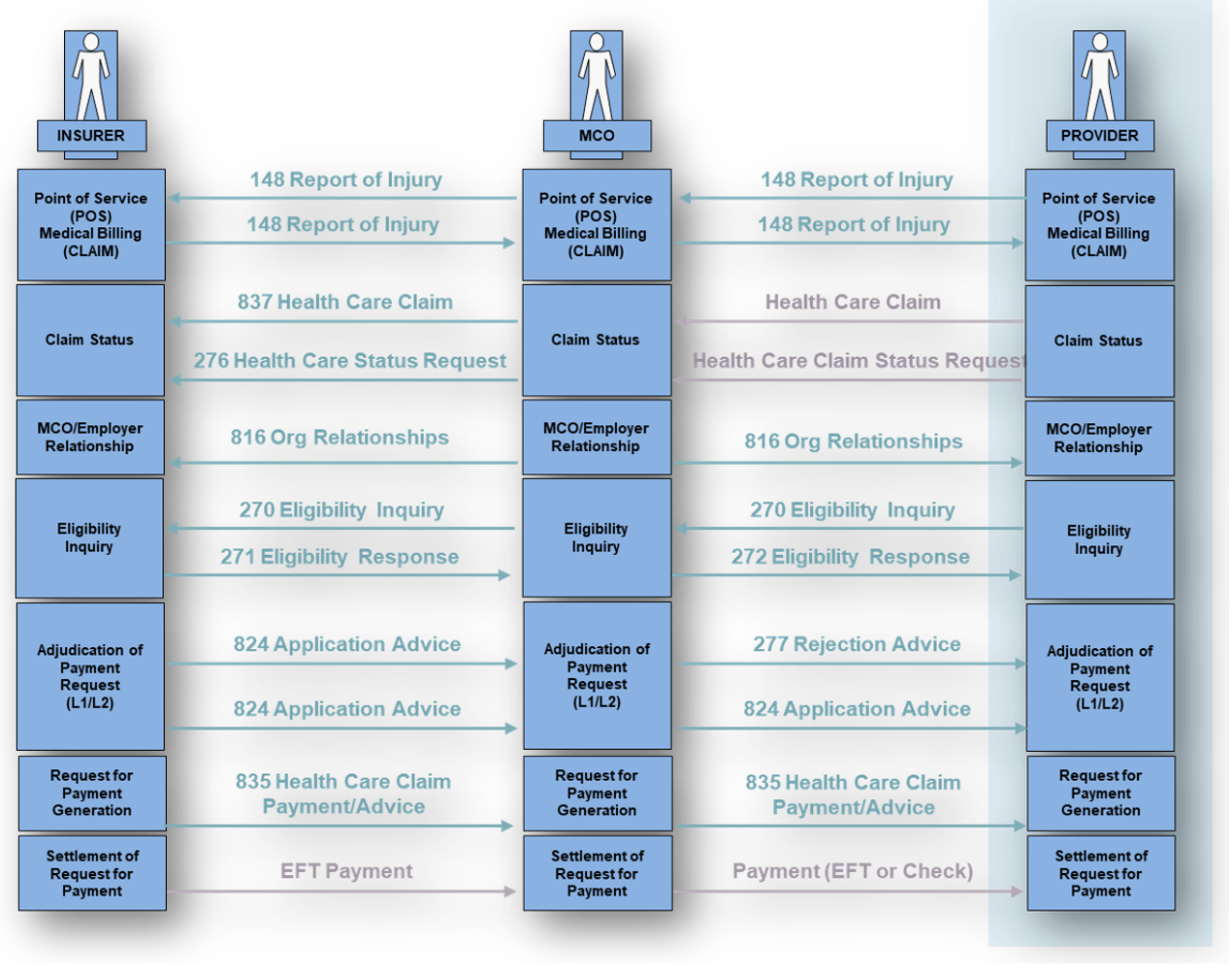
Industry-Specific Workflow Variations
While  the EDI 277 Health Care Claim Status Response is standardized under ANSI ASC X12 and governed by HIPAA rules, and the data structure of the 277 remains standardized across all segments, its workflow behavior varies significantly by healthcare segment, payer model, and processing environment. How EDI 277 Health Care Claim Status Response is used differs operationally by industry.
- Timing varies
- Automation depth varies
- Service-level reporting varies
- Authorization dependency varies
- Companion guide requirements vary
Below are the most common industry-specific workflow variations
Commercial / Medicare Example Flow
Private payers often automate aging triggers for 276 inquiries, and some issue unsolicited 277 responses. STC codes feed denial management systems and revenue cycle dashboards in near real time.
270 → 271 → 837 → 999 → 276 → 277 → 835
Clearinghouse-Centric Environments
Clearinghouses may normalize, aggregate, or even proactively generate status reporting. Providers may receive standardized 277 responses even when payer implementations differ internally.
270 → 271 → 837 → 999 → 276 → 277 → 835
Government Programs (Medicare / Medicaid)
276 → 277CA → 277 (detailed status may follow)
Medicare
Medicare emphasizes strict validation and regulatory turnaround timelines. The 277 often follows structured acknowledgment (277CA), and compliance accuracy is tightly monitored under CMS rules
270 → 271 → 837 → 999 → 277CA → 276 → 277 → 835
Medicaid (State-Based Programs)
State Medicaid agencies publish companion guides that may alter timing, required loops, or code interpretations. Some states issue proactive 277 updates, while others rely strictly on inquiry-driven workflows.
270 → 271 → 837 → 999 → 276 → 277 → 835
Workers’ Compensation Example Flow
Workers’ compensation workflows often include injury reporting (148) and longer investigation periods. The 277 may reflect authorization or investigative status rather than standard adjudication timing.
148 → 837 → 276 → 277 → 275 (if required) → 835
Hospital & Institutional Billing
Institutional claims often involve high-dollar and multi-service complexity. The 277 may include detailed service-level STC, AMT, and QTY reporting, supporting financial forecasting and partial approval tracking
270 → 271 → 837I → 999 → 276 → 277 (claim + service-level) → 835
Dental
Dental claims generally adjudicate quickly. The 277 is used primarily for rapid rejection resolution or confirmation rather than extended pending cycles, with less hierarchical complexity than medical claims.
270 → 271 → 837D → 999 → 276 → 277 → 835
Behavioral Health
Behavioral health frequently depends on prior authorization and unit limits. The 277 often communicates pending review and quantity approvals, closely tied to authorization workflows.
270 → 271 → 278 (authorization) → 837 → 276 → 277 → 835
How does PartnerLinQ use the EDI 277?
PartnerLinQ enables automated, system-to-system claim status communication between payers and providers. The platform standardizes interpretation of STC codes, integrates responses into billing systems, and reduces administrative follow-up through governed automation and exception workflows.
What Is the Purpose, Key Features, and Business Use Cases of the EDI 277?
The EDI 277 – Health Care Claim Status Notification transaction set enables trading partners to communicate the status of previously submitted health care claims. It is most commonly used in healthcare payer–provider ecosystems to report acceptance, rejection, pending review, or adjudication outcomes at the claim or service-line level.
Key features include hierarchical reporting of claim and service status, standardized status and reason code structures, traceability to the originating inquiry, and alignment with HIPAA-mandated claim status workflows. The transaction supports both professional and institutional claim environments and accommodates jurisdiction-specific implementations.
Although most often associated with revenue cycle management, the 277 does play a broader role in operational visibility, compliance alignment, and exception control across healthcare networks.
Operational Purpose
Provides standardized claim status visibility after submission.
Key Features
- Hierarchical claim and service reporting
- Standardized STC status codes
- Inquiry-response traceability via TRN
- HIPAA-aligned structure
Business Use Cases
The EDI 277 supports a range of post-submission claim management and visibility use cases by providing a standardized method for responding to claim status requests with timely information after a claim has been filed. These use cases are especially critical in high-volume healthcare and Workers’ Compensation environments where timely insight into claim processing directly impacts patients, services, cash, and operational efficiency.
| Use Case | Description | Primary Stakeholders |
|---|---|---|
| Claim Tracking | Monitors adjudication progress electronically | Providers, Payers |
| Denial Management Follow-Up | Identifies reasons for claim delays, rejections, or denials | Billing Services, Providers |
| Claim Receipt Verification | Confirms that a claim was received and accepted for processing | Providers, Clearinghouses |
| Claim Processing Tracking | Determines whether a claim is pending, in review, or finalized | Providers, Payers |
| Workers’ Compensation Claim Monitoring | Tracks the status of injury-related medical claims | Providers, Ohio BWC |
Primary Industry: Healthcare
The EDI 277 is  most commonly used in:
- Health insurance payers
- Government healthcare programs
- Revenue cycle management (RCM) providers
- Clearinghouses
- Hospitals
- Physician practices
Operational Visibility
The 277 provides structured insight into where a claim sits in the adjudication lifecycle by transforming claim status inquiries from manual inquiry (e.g., email, telephone calls) into a structured automated transaction that improves visibility.
- Reduces call-center dependency
- Enables real-time dashboards
- Improves days in accounts receivable (AR)
| Scenario | Operational Value |
|---|---|
| Claims pending review | Enables proactive follow-up |
| Rejected claims | Immediate correction workflow |
| Accepted claims | Forecasts revenue inflow |
| Pended for additional info | Prevents AR aging drift |
Compliance Reporting
Under HIPAA Administrative Simplification, electronic healthcare claim status transactions must follow X12 standards aligning EDI 276/277 as a transaction pair and part of the HIPAA-adopted electronic transaction standards, which is not the same as mandated. In other words manual healthcare claim status inquiries may be manual.
Financial Reconciliation
Although the 277 is not considered as a payment transaction, the 277 influences financial forecasting and reconciliation working upstream of the X12 835.
What is the Purpose of the EDI 277?
The purpose of the EDI 277 is to provide a reliable, standardized, and auditable mechanism for communicating the processing state of a submitted health care claim. The transaction removes uncertainty from post-submission workflows by clearly identifying whether a claim has been accepted, is under review, has been denied, or requires correction prior to further processing.
Downstream Transactions
| ID | Name | Category/Purpose | Relationship to 277 |
|---|---|---|---|
| 275 | Additional Information to Support a Claim | Claim Attachment - Transmits supporting documentation (e.g., medical records) | Often triggered after a 277 indicates additional information required |
| 824 | Application Advice | Application-Level Error Reporting - Reports business-level transaction errors | May report content errors related to 276 submissions |
| 835 | Health Care Claim Payment / Remittance Advice | Payment - Communicates payment, denial, and adjustments | Financial conclusion of lifecycle monitored by 276 |
| 997 | Functional Acknowledgment | Technical Acknowledgments - Confirm receipt of transaction set | Confirms 276 receipt at functional level |
| 999 | Implementation Acknowledgment | Technical Acknowledgment - Validates structural compliance with implementation guide | Confirms 276 format compliance before status processing |
Supply Chain Coordination
While the 277 is not considered a traditional supply-chain document, the 277 coordinates information flow across providers, clearing houses, payers and billing services. In a healthcare revenue supply chain, claims function as financial transactions moving through a processing network.
Exception Management
The EDI 277 is an excellent foundational exception-management document.
Common 277 Status Categories with STC01 Composite Examples
| STC01 Category | STC01 Status Code | Typical Meaning | Operational Action |
|---|---|---|---|
| A0 | 19 | Claim accepted for processing | Monitor |
| A1 | 20 | Claim rejected for structural or data error | Correct and resubmit |
| A2 | 21 | Missing or invalid information | Review documentation |
| A3 | 562 | Missing documentation - additional information required | Submit supporting documents |
| A4 | 29 | Claim pending review - may require manual review | Monitor |
| F0 | 65 | Claim finalized | Await 835 |
| F2 | 88 | Claim denied | Initiate appeal |
| P0 | 23 | Claim not found | Verify identifiers |
| P1 | 35 | Eligibility issue - mismatch | Validate coverage |
What Information Is Required in the EDI [Transaction ID]?
Required Segments
| Segment | Purpose |
|---|---|
| ST | Transaction Header |
| BHT | Hierarchical Transaction Control |
| HL | Hierarchical Structure |
| NM1 | Party Identification |
| TRN | Trace Correlation |
| STC | Status Information |
| DTP | Date Reference |
| SE | Transaction Trailer |
Optional Segments
| Segment | Purpose |
|---|---|
| AMT | Monetary context |
| REF | Additional identifiers |
Required Identifiers
- Payer ID
- Provider ID
- Claim Control Number
- TRN reference
Required Dates
- Processing Date
- Status Effective Date
Required Financial Data (if applicable)
- Claim monetary amounts via AMT segment
Required Reference Numbers
- Claim numbers
- Inquiry reference numbers
Claim-Level vs Line-Level Detail
The 277 supports both claim-level and service-line-level reporting using hierarchical loops and STC status indicators.
Summary Table of Key Segments
| Segment | Primary Use |
|---|---|
| ST | Transaction identification |
| BHT | Response purpose |
| HL | Structural hierarchy |
| TRN | Inquiry-response correlation |
| STC | Status communication |
| DTP | Processing dates |
What Status and Reason Codes Are Used with the EDI 277?
The X12 277 uses standardized status codes to communicate claim processing outcomes in a structured, machine-readable format.
How Codes Work Together in the STC Segment
The STC segment combines codes with meaning to enable automation and exception routing.
Example: STC*A3:29*20260220*WQ~
Meaning:
- A3 → Claim rejected as un-processable
- 29 → Subscriber/patient mismatch
- Date → Status effective date
- WQ → Work queue status
Code Elements
| Code Element | Meaning |
|---|---|
| STC01 | Health Care Claim Status |
| STC02 | Date |
| STC03 | Action Code (Accept/Reject Indication) |
| STC04 | Monetary Amount |
| STC05 | Monetary Amount |
| STC10 | Health Care Claim Status |
| STC12 | Denial or suspension reason – Unformatted Text |
Status Codes (Code Source 507)
| Category Code | Meaning | Business Interpretation |
|---|---|---|
| A0–A9 | Acknowledgement categories | Claim accepted or rejected at intake |
| DR01–DR08 | (Data) Received/Acknowledged | Received/Acknowledged + feedback |
| F0–F3 | Finalized categories | Claim fully processed |
| P0–P6 | Pending categories | Claim under review |
| R0–R3 | Requests for additional info | Documentation required |
| E0–E4 | Error Responses | Structural/data issues |
| D0 | Data Search Unsuccessful | Not payable |
*Only used with the EDI 277 CA
**A complete list of Claim Status Category Codes is available through X12 https://x12.org/codes/claim-status-category-codes
Reason Codes
| Code | Description | Typical Root Cause |
|---|---|---|
| 19 | Entity not found | Invalid subscriber/member ID |
| 20 | Entity not eligible | Coverage inactive |
| 21 | Missing or invalid information | Data incomplete |
| 23 | Invalid value | Format error |
| 26 | Duplicate claim/service | Previously submitted |
| 27 | Information requested | Documentation missing |
| 29 | Subscriber and patient mismatch | Demographic error |
| 41 | Authorization issue | No pre-certification |
| 65 | Claim/service adjusted | Reprocessing occurred |
| 85 | Entity not covered | Benefit exclusion |
Industry-Specific Code Sets
Companion guides define allowable status and action codes by payer or regulatory authority.
What are the Benefits of the [Transaction ID]? 
Operational Benefits
- Eliminates manual status follow-up
- Improves claim lifecycle visibility
Financial Benefits
- Accelerates denial resolution
- Improves cash flow predictability
Compliance Benefits
- Supports HIPAA reporting requirements
- Maintains standardized audit trails
What are the Benefits of Automating the EDI [Transaction ID]?
- Automated STC interpretation
- Exception workflow routing
- Trend analysis on denial patterns
- Reduced administrative workload
How to Check Claim Status Electronically Using EDI 276/277 pair?
Electronic claim status monitoring follows a structured lifecycle. The process begins with claim submission and continues through automated inquiry, response interpretation, and resolution management. Each transaction plays a distinct role within the revenue cycle. Operational walkthrough:
- The lifecycle begins with the EDI 837 Health Care Claim transaction.
- The EDI 276 is triggered after a defined monitoring interval
- Typically, 10–14 days after claim submission or beyond expected cycle
- The payer returns the EDI 277 Claim Status Response.
- The EDI 277 provides status codes describing claim position within the adjudication workflow.
- Analyze and act upon returned status indicators
- Monitor and Interpret EDI 277 Status Codes
- STC01-1 = Claim Status Category Code
- STC01-2 = Claim Status Code
Common 277 Status Categories with STC01 Composite Examples
| STC01 Category | STC01 Status Code | Typical Meaning | Operational Action |
|---|---|---|---|
| A0 | 19 | Claim accepted for processing | Monitor |
| A1 | 20 | Claim rejected | Correct and resubmit |
| A2 | 21 | Missing or invalid information | Review documentation |
| A3 | 562 | Additional information required | Submit supporting documents |
| A4 | 29 | Claim pending review | Monitor |
| F0 | 65 | Claim finalized | Await 835 |
| F2 | 88 | Claim denied | Initiate appeal |
| P0 | 23 | Claim not found | Verify identifiers |
| P1 | 35 | Eligibility issue | Validate coverage |
Are there Regulatory and Compliance Requirements for the EDI [Transaction ID]
The EDI 277 complies with ANSI ASC X12 standards and supports HIPAA Administrative Simplification mandates governing electronic healthcare transactions.
EDI [Transaction ID] Technical Structure, Format, and Versions
Hierarchical Loop Structure 
The transaction uses HL segments to define information hierarchy across information source, information receiver, subscriber, dependent, claim, and service levels.
File Format and Delimiters
The EDI 277 follows standard X12 delimiter conventions and is transmitted within Functional Group HR. Typical Production Delimiters include:
- Segment Separator - hex 15 (NAK) or hex 7E (~)
- Element separator - hex 7C (|) or hex 2A (*)
- Sub-element Separator - hex 3E (>)
Version Differences
Implementation specifics vary by payer companion guide, common versions include v3051, v4010 and v5010.
What are the Limitations of the [Transaction ID]?
Version or Companion Guide Constraints
Companion guides may restrict code sets or segment usage.
Jurisdiction-Specific Requirements
Workers’ compensation programs may impose additional validation rules.
Timing and Frequency Limitations
Status availability depends on payer adjudication processing cycles.
Are Implementation Guidelines and Sample Files Available for the EDI [Transaction ID]?
Guidelines and sample files are available through trading partners and operators like PartnerLinQ to support onboarding and technical development.
EDI [Transaction ID] Example File (X12 Sample)
What Are the More Common EDI Errors and Rejection Scenarios for the EDI 277?
Structural Errors (997 / 999) 
- Invalid hierarchical loops
- Segment count mismatch
Data Validation Errors
- Missing claim identifiers
- Invalid payer codes
Identifier Mismatch Errors
- TRN reference mismatch
- Subscriber ID inconsistency
Version Compliance Errors
- Incorrect version indicator
- Non-compliant segment usage
Industry-Specific Rejections
- Jurisdiction-specific rule failures
- Companion guide violations
What Are the Basic Questions for EDI Integration with the EDI 277?
- What is the general direction of the EDI 277 transaction?
- Is the transaction inbound or outbound?
- Are companion guides available?
- Are there samples and specs of the response transaction available?
- Are AS2, VAN, or SFTP connections used?
- Are more than one trading partner exchanging the EDI 277?
- Are there other interested parties?
- What trading partner requirements apply?
- What version is supported?
- What version is required (v3051, v4010 v5010)?
- What other transactions might these interested parties be a party to?
- What systems generate or receive the transaction?
- What validation rules apply?
- What response to the EDI 277 is expected or sent?
- Is a response to EDI 277 a timed event? Are notifications involved/needed?
- Is there automation?
- Are responses automatically triggered? or do transactions require human intervention?
- How are STC codes interpreted?
- What testing process is required?
What transactions form the lifecycle (276, 837, 835)?
Summary Table of Associated Transactions
| ID | Name | Category / Purpose | Relationship to 276 |
|---|---|---|---|
| 148 | Report of Injury, Illness or Incident | Workers’ Compensation Reporting - Submit first notice of injury (FROI) to state or insurer | May precede claim creation; establishes claim context later monitored via 276 |
| 837 | Health Care Claim | Claim Submission - Submit medical claim for adjudication | Creates the claim record that the 276 inquires about |
| 270 | Eligibility Inquiry | Eligibility Verification - Verify patient coverage before services | Helps prevent claim denial that would require 276 monitoring |
| 271 | Eligibility Response | Returns coverage and benefit information | Reduces downstream claim status inquiries |
| 275 | Additional Information to Support a Claim | Claim Attachment - Sends supporting documentation | Triggered when 277 indicates additional information required |
| 276 | Health Care Claim Status Request | Status Inquiry - Request claim processing status | Core monitoring transaction |
| 277 | Health Care Claim Status Response | Status Response - Communicates claim status | Direct response to 276 |
| 816 | Organizational Relationships | Information maintenance - trading partner / payer relationships | Supports routing and configuration for 276 |
| 824 | Application Advice | Business-level error reporting | Reports issues related to 276 processing |
| 835 | Health Care Claim Payment / Remittance Advice | Payment, denial, adjustments | Financial completion of lifecycle monitored by 276 |
| 997 | Functional Acknowledgment | Confirms receipt of transaction set | Confirms 276 received (functional level) |
| 999 | Implementation Acknowledgment | Validates structural compliance | Confirms 276 format compliance before processing |
What are the Best Practices for using the [Transaction ID]?
| Best Practice | Description | Benefit |
|---|---|---|
| Store claim control identifiers | Match claim control numbers | Accurate responses |
| Validate claim control identifiers | Confirm billing provider NPI, member ID, claim control number, date of service, and billed amount match the original 837 exactly | Improves successful claim matching and lowers rejection rates |
| Align with payer companion guides | Configure transaction structure, REF qualifiers, loop requirements, and frequency limits according to payer-specific rules | Prevents structural and business-level rejections |
| Respond in a timely manner | Trigger 277 responses after reasonable claim processing window (typically 10–14 days post-837) | Reduces excess submissions and avoids rework |
| Automate inquiry cadence | Use aging thresholds and SLA triggers to generate inquiries instead of manual follow-up | Reduces AR days and standardizes monitoring |
| Automate follow-ups | Trigger responses systematically | Reduced workload |
| Suppress duplicate submissions | Prevent repeated 276 inquiries within short intervals or after adjudication; alert sender via 824 | Avoids transaction costs and trading partner friction |
| Respond to service-level inquiry strategically | Respond only to line-level 276 when partial adjudication occurs | Speeds targeted resolution |
| Log TRN for traceability | Capture TRN segment values to correlate 276 and 277 | Improves audit trail and reconciliation |
| Interpret 277 STC codes correctly | Automate interpretation of STC01 status categories | Faster denial resolution and actioning |
| Integrate 276 monitoring into KPIs | Track aging, denial detection interval, and pending duration | Improves forecasting and visibility |
| Monitor responses | Track EDI 277 outcomes | Faster resolution |
| Implement exception-based monitoring | Prioritize high-dollar or aged claims for early inquiry | Focuses resources on financial risk |
| Coordinate with 275 for documentation | Submit EDI 275 attachments when additional info is required | Accelerates adjudication |
| Tailor approach for workers’ compensation | Include employer loop, injury date, and state claim number; allow longer validation cycles | Improves match success and reduces premature inquiries |
| Stop inquiry after finalization | Suppress 276 after final 277 or 835 receipt | Eliminates unnecessary transactions |
What Transactions are associated with the EDI 276?
The EDI 276/277 Health Care Claim Status Request/Response transactions does not function independently, rather they are paired, follow a structured lifecycle and operate within a broader healthcare EDI ecosystem interacting with claim submissions, acknowledgments, response, and remittance workflows.
Summary Table of Associated Transactions
| ID | Name | Category / Purpose | Relationship to 276 |
|---|---|---|---|
| 148 | Report of Injury, Illness or Incident | Workers’ Compensation Reporting - Submit first notice of injury (FROI) to state or insurer | May precede claim creation; establishes claim context later monitored via 276 |
| 837 | Health Care Claim | Claim Submission - Submit medical claim for adjudication | Creates the claim record that the 276 inquires about |
| 270 | Eligibility Inquiry | Eligibility Verification - Verify patient coverage before services | Helps prevent claim denial that would require 276 monitoring |
| 271 | Eligibility Response | Returns coverage and benefit information | Reduces downstream claim status inquiries |
| 275 | Additional Information to Support a Claim | Claim Attachment - Sends supporting medical documentation | Triggered when 277 indicates additional information required |
| 276 | Health Care Claim Status Request | Status Inquiry - Requests claim processing status | Core monitoring transaction |
| 277 | Health Care Claim Status Response | Status Response - Communicates claim status | Direct response to 276 |
| 816 | Organizational Relationships | Trading partner / payer master data maintenance | Supports routing and configuration for 276 |
| 824 | Application Advice | Business-level error reporting | Reports issues related to 276 submissions |
| 835 | Health Care Claim Payment / Remittance Advice | Payment, denial, and adjustment communication | Financial completion of lifecycle monitored by 276 |
| 997 | Functional Acknowledgment | Confirms receipt of transaction set | Confirms 276 received (functional level) |
| 999 | Implementation Acknowledgment | Validates structural compliance with implementation guide | Confirms 276 format compliance before processing |



Explore Our Integration Solutions

PartnerLinQ Integration Solutions
Connect Everything. Integrate Intelligently.
Future-Proof Your Business with Composable, AI Powered Connectivity.