
What is the Message Delivery Notification (MDN)?
In today’s  interconnected supply chains, where trading partners exchange sensitive business documents across digital networks, certainty and security are paramount. One of the most critical mechanisms to ensure confidence in this process is the Message Delivery Notification (MDN). Often referred to as a Message Disposition Notification, the MDN plays a vital role in confirming that an electronic message, typically sent through protocols like AS2, has been successfully received, validated, and preserved without alteration.
This paper explores the definition, benefits, history, and business implications of Functional Acknowledgements, inspired by PartnerLinQ’s thought leadership.
How is the Message Delivery Notification (MDN) defined?
The Message Delivery Notification (MDN) is an electronic receipt generated in AS2 communications to confirm that a message has been successfully delivered and received without alteration. It verifies that the transmission was completed and that the data’s integrity is intact. Unlike a Functional Acknowledgment (997) or EDIFACT CONTRL, the MDN does not validate syntax or business rules—it only confirms delivery at the transport level. By providing proof of receipt, the MDN reduces disputes, ensures compliance, and builds trust between trading partners in secure electronic exchanges.
In the AS2 framework, the MDN confirms two key aspects:
- Successful completion of the AS2 transfer
- Integrity of the transmitted message, ensuring it was not altered in transit.
In practice, the MDN functions as proof of receipt—a digital ‘return receipt’ that enhances trust in electronic exchanges between trading partners.
What are the Benefits of the MDN?
The  adoption of MDNs in secure business-to-business data exchange provides a number of key benefits:
- Savings and Efficiency: Organizations save time and reduce errors by avoiding disputes around whether documents were successfully delivered.
- Proof of Delivery and Integrity: The inclusion of hash totals ensures messages cannot be tampered with without detection.
- Cooperation and Compliance: MDNs support multiple industry standards, helping enterprises meet regulatory and partner-driven requirements
- Enhanced Trust: By providing clear, auditable confirmation of message delivery, MDNs strengthen trading partner relationships.
What is the History and Evolution of acknowledgments in EDI? 
The need for reliable acknowledgments in electronic data interchange (EDI) dates back to the early days of digital business transactions in the 1970s and 1980s. Originally, companies relied on Value-Added Networks (VANs) and Functional Acknowledgements to provide delivery assurances. The emergence of EDIFACT in the 1980s added the CONTRL document to the list and with the advent of internet-based protocols, AS2 in particular emerging as a secure, low-cost, and flexible way to transmit documents. MDNs became a core element of AS2 message acknowledgment, offering assurance that messages had been successfully delivered with their integrity preserved, further fulfilling the need for increasingly reliable transaction acknowledgments in the age of electronic data interchange.
While some may conflate MDNs with Functional Acknowledgements (such as the 997 in X12 and the CONTRL document in EDIFACT), the two serve distinct purposes. An MDN confirms that the message was received without corruption, while Functional Acknowledgements (997, CONTRL) confirm syntactical accuracy and documents the formatting errors. MDNs and Functional Acknowledgements complement one another in a robust EDI framework, both part of a complete EDI solution framework.
What is the Functional Acknowledgment (997)?
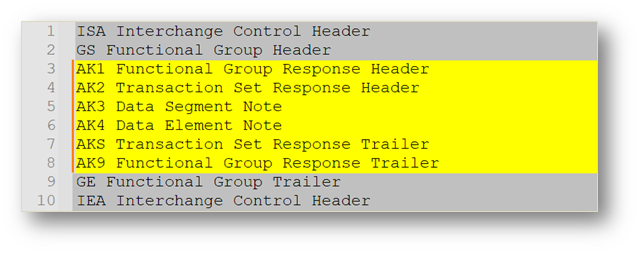
The Functional Acknowledgment (997) is an ANSI X12 EDI transaction set that represents industry best practice and is automatically generated by modern EDI software. It confirms delivery and receipt of information, validates syntax, and reports any formatting errors or data loss. Unlike a Message Delivery Notification (MDN), which only confirms transport-level delivery, the 997 provides feedback on the structural integrity of the message. Business documents may be accepted with errors or rejected outright, with rejected messages requiring correction and re-transmission by the sender. By providing this level of detail, the 997 ensures that corrected transactions are properly structured and ready for downstream processing.
What is the EDIFACT CONTRL?
The EDIFACT CONTRL message is a control document within the UN/EDIFACT standard used to acknowledge receipt of an electronic message and confirm its syntactical validity. It indicates whether a message complies with EDIFACT rules, highlighting any structural errors that must be addressed. Like the X12 997, CONTRL provides detailed feedback on syntax and formatting, but is designed for international exchanges across industries and regions. If a message is rejected, the sender is responsible for correcting and re-transmitting it. By delivering structured responses, the CONTRL ensures global interoperability and reliable downstream processing in complex, cross-border supply chains.
Are Guidelines & Sample Files for the MDN, 997, and CONTRL document available?
Yes. PartnerLinQ provides sample MDN, 997, and CONTRL message transaction and implementation guides through its Support and Guideline Management Team.
Sample MDN, 997, and CONTRL message implementation guides illustrate both inbound and outbound flows, segment layouts, and valid data examples, support testing and partner onboarding. Customized specification documents for use in on boarding and technical development are available upon request.
PartnerLinQ provides:
- MDN, 997, and CONTRL message transaction implementation guide
- Sample payloads
- Qualification and testing maps
- Error handling and best-practice notes
Is there a Side-by-Side Comparison of the MDN, 997, and CONTRL document?
This comparison highlights the distinctions and commonalities between the Message Delivery Notification (MDN), the Functional Acknowledgement (997 in ANSI X12), and the EDIFACT CONTRL message. Each plays a vital role in ensuring trust, validation, and efficiency in electronic data interchange (EDI) across global supply chains.
| Category | MDN (Message Delivery Notification) | 997 (Functional Acknowledgement) | EDIFACT CONTRL |
|---|---|---|---|
| Standard | AS2 / Transport-level acknowledgment | ANSI X12 Transaction Set 997 | UN/EDIFACT CONTRL message |
| Definition | Confirms message delivery and integrity at the transport layer (proof of receipt). | Confirms receipt and validates syntax of an X12 document. | Acknowledges EDIFACT documents and confirms syntax compliance. |
| Purpose | Ensures the message was received without corruption or alteration. | Provides feedback on structural correctness, acceptance, or rejection of EDI documents. | Reports whether EDIFACT documents conform to syntax standards. |
| Workflow Role | Generated automatically in AS2 flows after message receipt and validation. | Returned by the receiver after checking message syntax; may indicate acceptance or rejection. | Generated by EDIFACT systems to acknowledge or reject messages based on syntax validation. |
| Key Benefits |
|
|
|
| Supply Chain Example | A retailer sends a PO via AS2 to a supplier. The supplier’s AS2 system generates an MDN confirming receipt, ensuring the order was delivered intact. | A distributor sends a PO to a manufacturer. The manufacturer returns a 997 confirming syntax validity; if errors exist, the 997 indicates rejection. | An automotive OEM sends forecasts via EDIFACT. A supplier’s system generates a CONTRL message if forecasts contain errors, ensuring production planning is not disrupted. |
| PartnerLinQ Perspective | MDNs provide certainty at the transport layer, reducing disputes and enhancing compliance in AS2-based exchanges. | 997s embody best practice in EDI by ensuring onboarding transparency and error detection, as emphasized by PartnerLinQ blogs. | CONTRL supports global partner onboarding and reduces ambiguity in international supply chain communication, aligning with PartnerLinQ’s emphasis on clarity and reliability. |
References
This paper draws on industry insights and explanations from PartnerLinQ’s resources, including:



Explore Our Integration Solutions

PartnerLinQ Integration Solutions
Connect Everything. Integrate Intelligently.
Future-Proof Your Business with Composable, AI Powered Connectivity.