
Modern supply chain networks rely on  Electronic Data Interchange (EDI) to automate the exchange of business documents. Brands, retailers, suppliers, carriers, and third-party logistics providers all use EDI and as trading ecosystems grow more complex—and expectations around visibility, fulfillment speed, and accuracy continue to rise—organizations continue to evolve from basic EDI connectivity into ever more advanced footing. Operational orchestration models that extend beyond Order-to-Cash and into planning, forecasting, replenishment, logistics, compliance, and settlement, post-transactional settlement to be more precise.
While PartnerLinQ supports a client’s journey from start up to complete maturity, prospects, partners, clients, even client partners that we encounter often require a deeper foundational understanding of what might be considered core EDI transactions for Order-to-Cash, for transportation, for warehousing, even basic forecasting and automation.
What are EDI transaction types?
EDI transaction types are standardized electronic documents used to exchange business data between trading partners. Common examples include purchase orders (EDI 850), invoices (EDI 810), and shipment notices (EDI 856), which automate procurement, fulfillment, and financial workflows across supply chains.
What are the most common EDI transactions?
The most common EDI transactions include EDI 850 (Purchase Order), 855 (Purchase Order Acknowledgment), 856 (Advance Ship Notice), 810 (Invoice), and 997/999 (Functional Acknowledgment). These documents support ordering, confirmation, shipment tracking, invoicing, and validation across supply chain networks.
What is an EDI transaction set?
An EDI transaction set is a standardized electronic document format used to exchange business data between systems. Each transaction set, such as EDI 850 or 810, follows defined structures and segments that ensure consistent communication across trading partners and systems.
What is an EDI Roadmap?
The EDI journey for most clients from novice to maturity takes place over time and to help teams plan their EDI roadmaps we’ve organized a clean categorization of transaction model groups for EDI that can be used by teams for planning purposes. Planning that is fully aligned with industry norms and grounded in how PartnerLinQ positions EDI maturity, expansion, and extensibility across retail, CPG, distribution, logistics, manufacturing, healthcare, and a few specialty use cases.
What are EDI Transaction Model Groups?
In modern supply-chain programs, EDI transactions typically fall into three tiers based on business necessity, maturity level, and industry adoption. Organizing a relatively clean categorization of EDI transactions into EDI Transaction Model Groups meant grouping EDI transactions into these three tiers based on business value and typical industry adoption.
The resulting Transaction Model Groups: Core, Expanded, and Extended.
| Category | Definition | Adoption Level | Role in Digital Supply Chain |
|---|---|---|---|
| Core | Foundational messages required for commerce (orders, confirmations, shipment, invoice, acknowledgment documents). | Very High | Supports Order-to-Cash and Procure-to-Pay |
| Expanded | Expanded message add levels of operational coordination and execution in key business areas, warehousing and logistics, inventory, transportation, visibility. | High to Moderate | Supports Visibility, Warehouse, Logistics, and Replenishment Automation |
| Extended | Industry-specific operational coordination and execution that might include compliance, regulatory, service-based, or billing. Operations that extend digitization beyond procurement and fulfillment. | Varies by industry | Supports Specialization, Compliance, Automation, and Supplier Performance |
What is the difference between Core, Expanded, and Extended EDI Transaction Model Groups?
Core EDI transactions support essential commerce workflows like ordering and invoicing. Expanded transactions enhance operational coordination across logistics, warehousing, and inventory. Extended EDI transactions enable advanced capabilities such as forecasting, compliance, transportation tendering, and industry-specific processes.
Comparison Table
| Category | Scope | Key Transactions | Business Value |
|---|---|---|---|
| Core | Foundational | 850, 855, 856, 810 | Commercial execution |
| Expanded | Operational | 860, 846, 214, 820 | Visibility & coordination |
| Extended | Strategic | 830, 852, 204, 990 | Planning & optimization |
What Are Core EDI Transactions?
Core  EDI transactions are the foundational business documents used to automate purchasing, fulfillment, and billing workflows between trading partners. The most common include EDI 850 (Purchase Order), 855 (Acknowledgment), 856 (Advance Ship Notice), 810 (Invoice), and 997/999 (Acknowledgment), forming the backbone of Order-to-Cash and Procure-to-Pay processes.
Core EDI transactions represent the foundational set of transactions required to transact digitally with most trading partners in one’s supply chain network. Messages, another word for transactions, that support essential purchasing, fulfillment, billing, and compliance workflows. Messages that support most retailers, distributors, and manufacturers. Messages that support business needs, often reclassified as requirements for those partners considered to on the demand side of things, or part of onboarding process new suppliers, carriers, or logistics partners to cite a few examples.
There is a strategic value to identifying core EDI Transactions for an industry. Core EDI transactions reduce manual data entry, eliminate processing delays, and enable automation from procurement to invoice workflows by providing communication guidance enhanced by standards like X12 or EDIFACT, even when API based.
The core 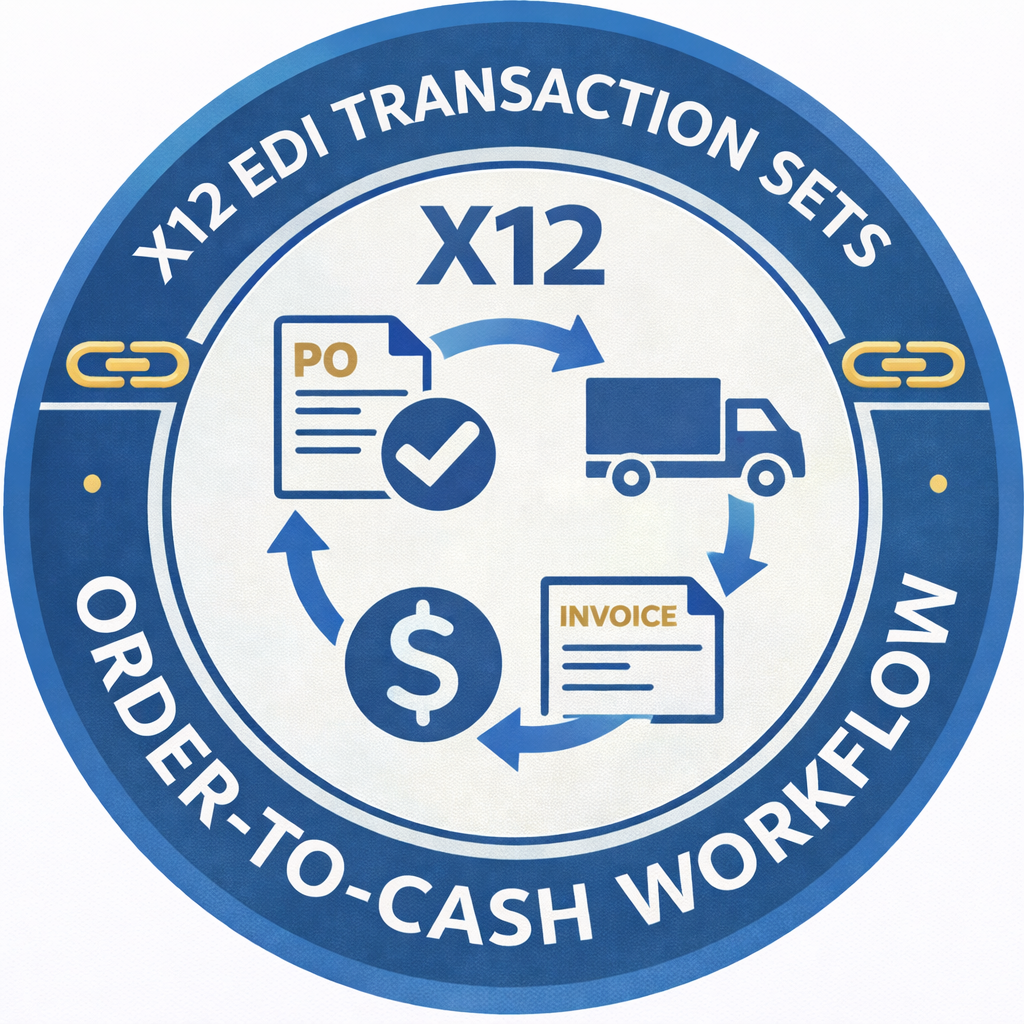 EDI transactions that fit these criteria form the backbone of the procurement to billing lifecycle. A lifecycle that includes Order-to-Cash and Procure to Pay workflows, one that ensures orders are received, confirmed, shipped, and invoiced accurately, and on a timely basis. While companies just getting started with EDI tend to begin with browser-based EDI products, they quickly and often find EDI solutions with automation, integration, and with system generated acknowledgments preferable to EDI solutions combined with human integration. Platform solutions that reduce or prevent errors by ensuring compliance with agreed to communication standards and protocols such as VAN and AS2 connections results in what ‘retail drivers’ call compliance.
How does EDI support Order to Cash?
EDI supports the Order-to-Cash process by automating the exchange of purchase orders (850), acknowledgments (855), shipment notices (856), and invoices (810). This reduces manual data entry, improves accuracy, accelerates fulfillment, and ensures timely billing and payment reconciliation across trading partners.
Core EDI Transactions
| Business Process Area | ANSI X12 Code | EDIFACT Equivalent | Primary Purpose |
|---|---|---|---|
| Purchase Order | 850 | ORDERS | Initiates the workflow, an order for goods or services placed electronically. |
| Purchase Order Acknowledgment | 855 | ORDRSP | Confirms acceptance and can also be used in some scenarios to communicate change between partners. |
| Advance Ship Notice | 856 | DESADV | Provides detailed shipment and packaging information for receiving and automation. |
| Invoice | 810 | INVOIC | This is a formal electronic request payment after fulfillment has taken place. |
| Functional Acknowledgment | 997 / 999 | CONTRL / APERAK | Confirms the successful receipt and validation of an EDI message. |
What is the EDI Order-to-Cash lifecycle?
The EDI Order-to-Cash lifecycle includes EDI 850 (Purchase Order), 855 (Acknowledgment), 856 (Advance Ship Notice), and 810 (Invoice). This sequence ensures orders are placed, confirmed, shipped, and billed accurately, enabling end-to-end automation across supply chain operations.
What EDI transactions are required for Retail?
Retail EDI programs typically require EDI 850 (Purchase Order), 855 (Acknowledgment), 856 (Advance Ship Notice), 810 (Invoice), and 997/999 (Acknowledgment). Many retailers also require EDI 860 (Order Change), 846 (Inventory), and 820 (Remittance) to support replenishment, visibility, and financial reconciliation.
Why do companies still use VANs instead of AS2 or APIs?
The value proposition proclaimed by the ‘BIG VAN’ operators is that VANs reduces partner-by-partner complexities, provides store-and-forward reliability, and simplifies compliance and onboarding—especially at scale.
Today’s EDI platform solutions deliver much more, better value than the ‘BIG VAN’ proposition and at historically lower costs. Today’s enterprises are experiencing a renewed interest in AS2, many opt to maintain hybrid models with the availability of multiple connection types and option including VAN, AS2 and API connections.
What Are Expanded EDI Transactions?
Expanded  EDI transactions extend beyond basic ordering and invoicing to support logistics, inventory management, warehousing, and financial coordination. Examples include EDI 860 (Order Change), 846 (Inventory Inquiry), 214 (Shipment Status), and 820 (Remittance Advice).
Expanded message add levels of operational coordination and execution in key business areas and may include communication standards and protocols, more advanced technologies such as API based.
Expanded transactions build on the core lifecycle by adding levels of operational coordination and execution in key business areas including finance, transportation, warehousing and logistics, inventory, and synchronization of key data elements. Execution that expands time to value enhancements that EDI transformation brings to the enterprise, value like financial clarity, inventory visibility, and precision.
While many of these document types are common among medium to large organizations, many more remain stretch goals for companies scaling their omnichannel operations or managing multi-facility inventory networks perhaps just beginning the integration of third-party logistics providers (3PLs) into process and product flows.
Delving deeply into slightly more advanced business automation becomes a critical path that helps companies continue to grow. Moving beyond purchase order and invoicing processing into expanded EDI messaging support visibility, collaboration, and automation across warehouse, logistics, and replenishment workflows—reducing lead times, and shrink.
The expanded EDI documents below help optimize inventory accuracy, transportation coordination, warehouse execution, and replenishment, setting the stage for deeper planning and traceability.
Expanded EDI Transactions
| Business Process Area | X12 | EDIFACT | Primary Purpose |
|---|---|---|---|
| Purchase Order Change | 860 | ORDCHG | Used to communicate purchase order changes like quantity, date, and term changes on previously issued purchase orders. |
| Organizational Relationships | 816 | CUSDEC *Not 1:1 | Used to support the electronic exchange (e.g., synchronization) of organizational relationships & location information between trading partners |
| Item Master/Product Catalog | 832 | PRICAT | Used to support the electronic exchange (e.g., synchronization) of product pricing and catalog content between trading partners |
| Inventory Availability | 846 | INVRPT | Used to facilitate the sharing of inventory details between sellers, buyers, or public warehouses, and between trading partners, such as warehouses, suppliers, distributors, or retailers by providing ‘stock status’ (item and location) to support replenishment, supply-demand alignment, and Available-to-Promise (ATP) workflows. |
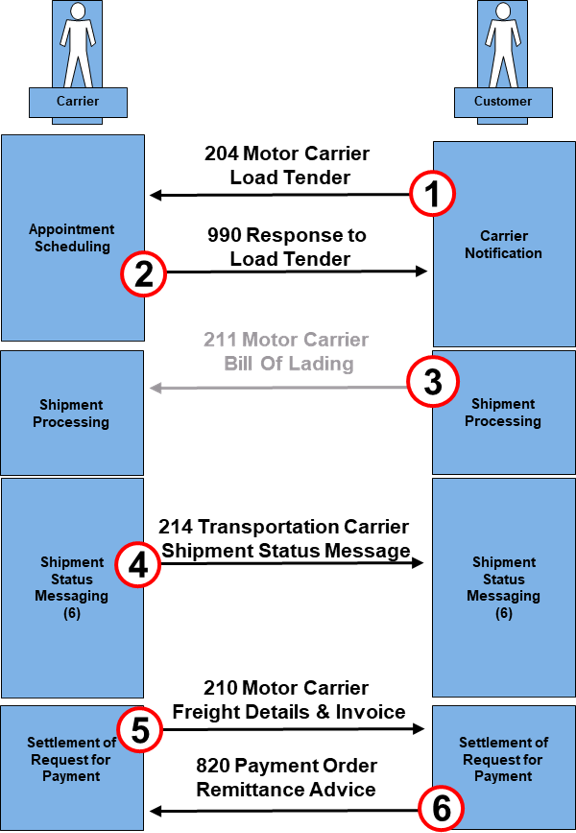
| Shipment Status | 214 | IFTSTA | Used to communicate precise updates regarding a shipment's progress, such as its location, condition, or event (e.g., picked up, in transit, delivered, or delayed), enables real-time transportation status and milestone update and coordination between trading partners in the supply chain. |
| Warehouse Shipping, and Handling Requests | 940/945 | HANMOV DESADV | Used to manage handling requests (pick, pack, ship, move, receive, stage, kit, label, etc.) and confirmation of completion of such requests including but not limited to outbound fulfillment from a warehouse to a trading partner or downstream location. |
| Warehouse Stock Transfer / Receipt | 943/944 947 | INVRPT HANMOV | Used to communicate inventory transfers and balances based on handling requests, movement, or receiving including returns. |
| Remittance Advice | 820 | REMADV / PAYORD | Used to clarify how payments align with invoices accounting for deductions, promotions, allowances, charges, or credits. |
| Debit/Credit Memo | 812 | CREADV / DEBADV | Used to correct, adjust, and generally assist in the reconciliation of amounts previously invoiced, in industries where pricing changes, promotions, deductions, chargebacks, returns, or disputes are common |
Is AS2 still relevant with APIs and modern integration?
Yes, AS2 remains highly relevant because it provides secure, encrypted, and non-repudiated message delivery with proof of receipt (MDN). While APIs enable real-time interactions, AS2 continues to meet compliance and audit requirements for document exchange in regulated and high-volume industries.
What is the difference between AS2 and API?
AS2 is a secure transport protocol designed for exchanging EDI documents between trading partners, while APIs enable real-time system-to-system interactions. AS2 focuses on reliable document delivery and compliance, whereas APIs focus on speed, flexibility, and event-driven integration.
What Are Extended EDI Transactions?
Extended EDI transactions support advanced and industry-specific processes such as forecasting (EDI 830), transportation tendering (EDI 204/990), point-of-sale reporting (EDI 852), and compliance workflows. These transactions enable predictive planning, automation, and supply chain optimization.
The extended EDI transactions support maturity beyond operational fulfillment. Document types that enable advanced demand planning, transportation tendering, regulatory compliance, claims processing, and service billing. Industry-specific operational coordination and execution that extend digitization beyond procurement and fulfillment, support automation, performance, compliance, and business specialization.
More common in mature supply chains and regulated environments extended EDI transactions are found in environments from Automotive & Industrial Manufacturing, to Retail & Consumer Packaged Goods (CPG), to Healthcare, Insurance, and Life Sciences, to Food, Beverage, and Alcohol Distribution, to Global Trade, Import/Export & Maritime Logistics, to Aerospace & Defense Industries, and to high-volume demand planning models that include the Electronics &
Extended EDI represents the moment when EDI evolves from a transactional, often a compliance related response into a strategic visibility and orchestration layer. Organizations using extended message sets typically move beyond connectivity and into:
This is the stage where PartnerLinQ’s platform demonstrates its highest value—connecting multiple ecosystems, synchronizing data, and enabling intelligent action across the network.
The strategic value extended EDI delivers incudes predictive planning, decision intelligence and optimization, compliance automation, and high-precision globally coordinated digital supply chain orchestration that spans multiple global increasingly regulated ecosystems.
Extended EDI Transactions by Focus Area
| Process Focus | ANSI X12 | EDIFACT | Primary Purpose |
|---|---|---|---|
| Transportation (Load Tenders) | 204 | IFTMBF | Used to automate load offers to carriers increasing competition by electronically extending offers to carriers for acceptance within time constraints |
| Carrier Acceptance (Tender Acceptance) | 990 | IFTMAN | Used to automate load tender acceptance and increase the velocity of carrier acceptance within time constraints. |
| Item Maintenance and Price Information | 879/888 | PRICAT | Used to support the electronic exchange (e.g., synchronization) of product pricing and catalog content between trading partners |
| Product Activity Reporting (POS Data) | 852 | INVRPT | Used to automatically or regularly provide consumption information updates (e.g., sales velocity) in vendor managed or consumption-based replenishment programs such as CPFR and VMI. |
| Forecasting and Planning | 830 | DELFOR | Used to automate communication of long-range forecasts for supply chain planning that includes manufacturing and fulfilment. |
| Just-in-Time Delivery Call-Off (JIT/JIS) | 862 | DELJIT | Used to automate communication of near-term delivery requirements for JIT/JIS programs. |
| Claims, Chargebacks & Reconciliation | 844 845 849 | SSDCLM/COMDIS ATHSTS SSDRSP CREMUL | Used to support contract and chargeback administration and increase velocity from claim to account settlement to improve cash flows in regulated industries. |
| Customs & Border Crossing | 309 350 322 315 404 | CUSCAR CUSDEC CUSRES COPRAR COARRI CODECO IFTSTA IFTMBF INVOIC IFTMIN / IFTMCS | Used in transportation by logistics professionals (e.g., carriers, terminal operators, port authorities, service centers) to automate communication with customs authorities about cargo and contents of a shipment to global trade enablement which includes duty, tariff, tax, transport documentation and reporting |
| Healthcare & Insurance Eligibility | 270/271, 276/277, 837/835, 275 | *No direct EDIFACT equivalents — healthcare messaging is typically regional and governed by HL7, NHS, GS1, or payer compliance frameworks, with formats sometimes modeled loosely on EDIFACT. | Used to assist healthcare providers, insurers, payers, and other authorized entities engaged in healthcare reimbursement lifecycles, to electronically submit, transmit and respond to information about a patient's eligibility, claim, benefits, or coverage; check the status, request information or supplemental documentation that provides support for a medical claim. |
Extended EDI Transactions by Industry
| Industry | ANSI X12 | EDIFACT | Primary Purpose |
|---|---|---|---|
| Automotive & Industrial Manufacturing | 830 862 204 - 990 852 | DELFOR DELJIT IFTMBF IFTMAN INVRPT | Used in support of forecast-driven manufacturing processes (e.g., production, assembly sequencing, inventory, availability, logistics, and capacity) in Just-In-Time (JIT) and Just-In-Sequence (JIS) manufacturing networks. |
| Retail & Consumer Packaged Goods (CPG) | 852 879/888 180/812 204 / 214 | INVRPT PRICAT RETANN / RETINS CREADV / DEBADV IFTMBF / IFTSTA | Used in support of sales and planning processes (e.g., data alignment, synchronization, inventory, availability, returns, logistics, and retail capacity) in vendor managed or consumption-based replenishment programs such as CPFR and VMI |
| Healthcare & Life Sciences / Medical Supply | 270/271 276/277 835/837 275 | No direct EDIFACT equivalent — healthcare messaging is typically regional and governed by HL7, NHS, GS1, or payer compliance frameworks, with formats sometimes modeled loosely on EDIFACT. | Used to assist healthcare providers, insurers, payers, and other authorized entities engaged in healthcare reimbursement lifecycles, to electronically submit, transmit and respond to information about a patient's eligibility, claim, benefits, or coverage; check the status, request information or supplemental documentation that provides support for a medical claim. |
| Food & Beverage / Grocery / Alcohol Distribution | 852 875/880 204 / 214 849 | INVRPT ORDERS / INVOIC IFTMBF / IFTSTA COMDIS / CREMUL | Used to support demand-driven replenishment, freshness tracking, and excise compliance, route-to-market logistics, and pricing and dispute workflows. |
| Global Trade, Import/Export, Maritime & Freight Forwarding | 309 /322 350/353/355 404/315 | CUSCAR/CUSDEC –IFTMBF/IFTMCS/IFTSTA COPARN / CODECO | Used to support intermodal/ international freight, customs and port logistics, container tracking, multimodal carrier coordination, border protection, tariffs, and regulatory processing. |
| Aerospace & Defense | 830 862 811 841 824 | DELFOR / DELJIT – INVOIC QUALITY or SPEC-DOCs (varies) | Used to support multi-year capacity and reservation, accommodate serialized asset tracking, engineering change notifications, and controlled bill-of-material workflows. |
| High-Tech Electronics & Semiconductor | 830 852 204/990/214 | DELFOR INVRPT INVRPT IFTMBF/IFTMAN/IFTSTA | Enables fab capacity planning, allocation control, VMI replenishment, lead-time assurance, and international logistics synchronization. |
Is there a framework for Supply Chain Digitalization (EDI)?
PartnerLinQ’s composable connectivity model allows organizations to adopt EDI in stages, supporting growth from foundational compliance to more advanced automation, predictive analytics and Artificial Intelligence (AI).
| Maturity Stage | Business Focus | EDI Categories Used | Business Outcome |
|---|---|---|---|
| Stage 1: Establish Connectivity | Replace manual processes with EDI automation | Core | Compliance, accuracy, efficiency |
| Stage 2: Expand Automation | Integrate warehouse, logistics, and financial workflows | Core + Expanded | Visibility, cost reduction, agility |
| Stage 3: Optimize & Innovate | Predictive planning, network optimization, compliance automation | Core + Expanded + Extended | Resilience, scalability, performance |
How can I build a flexible, adaptable, EDI Infrastructure?
A flexible, adaptable EDI infrastructure is built by combining scalable cloud integration, standardized EDI transactions, and hybrid connectivity (EDI, API, and AS2) to support evolving business needs. Platforms like PartnerLinQ’s EDI infrastructure guide emphasize automated onboarding, reusable implementation assets, and end-to-end visibility to enable growth from a few trading partners to thousands.
Are Implementation Guidelines and Sample Files Available for EDI transactions?
Yes. PartnerLinQ provides sample transactions and implementation guides which illustrate both inbound and outbound flows, segment layouts, and valid data examples for support, testing, and onboarding.
Companion Guides
Trading partners frequently publish implementation guidelines defining segment usage and validation rules.
Customized specification documents for use in on boarding and technical development are available through PartnerLinQ Support and Guideline Management.
People Also Ask
Do small businesses need EDI?
Yes, many small businesses use EDI to meet retailer and partner requirements. Cloud-based EDI platforms make it possible to start with a small number of transactions and scale over time, improving efficiency, reducing errors, and enabling participation in larger supply chain networks.
What EDI transactions are required to start?
To start using EDI, most organizations implement core transactions such as EDI 850 (Purchase Order), 855 (Acknowledgment), 856 (Advance Ship Notice), 810 (Invoice), and 997/999 (Functional Acknowledgment). These documents enable basic order processing, shipment visibility, invoicing, and validation across trading partners.
What is the most important EDI transaction?
The EDI 850 (Purchase Order) is often considered the most important transaction because it initiates the entire Order-to-Cash lifecycle. It communicates what goods or services are requested, triggering downstream processes such as order confirmation, shipment, invoicing, and payment across supply chain partners.
What is the difference between EDI 850 and 855?
EDI 850 is a purchase order sent by a buyer to request goods or services, while EDI 855 is the supplier’s acknowledgment confirming acceptance, rejection, or modification of that order. Together, they establish alignment between trading partners before fulfillment begins.
What industries use EDI transactions?
EDI transactions are used across industries including retail, manufacturing, logistics, healthcare, automotive, food and beverage, and finance. Any industry that requires standardized, high-volume document exchange between trading partners uses EDI to improve efficiency, accuracy, and compliance.
How many EDI transaction types are there?
There are hundreds of EDI transaction types defined by standards like ANSI X12 and EDIFACT. However, most organizations rely on a smaller subset of core, expanded, and extended transactions depending on their industry, maturity level, and operational complexity.
What are the core EDI transactions?
Core EDI transactions include EDI 850 (Purchase Order), 855 (Acknowledgment), 856 (Advance Ship Notice), 810 (Invoice), and 997/999 (Acknowledgment). These documents support essential procurement, fulfillment, and billing workflows and form the foundation of digital supply chain communication.
What is an EDI transaction set?
An EDI transaction set is a standardized electronic document format used to exchange structured business data between systems. Each transaction set, such as EDI 850 or 810, follows defined segment structures to ensure consistent, automated communication between trading partners.
How does EDI support the Order-to-Cash process?
EDI supports Order-to-Cash by automating the exchange of purchase orders, acknowledgments, shipment notices, and invoices. This reduces manual data entry, improves accuracy, accelerates fulfillment, and ensures timely billing and payment reconciliation across supply chain partners.
What is the difference between EDI and API?
EDI is designed for structured, document-based exchange between trading partners, often in batch or scheduled formats. APIs enable real-time, system-to-system interactions and event-driven communication. Modern integration strategies combine both to balance reliability, compliance, and agility.
What is an Advance Ship Notice (EDI 856)?
An EDI 856 Advance Ship Notice provides detailed information about a shipment before it arrives, including contents, packaging, and tracking details. It enables receiving automation, improves warehouse efficiency, and ensures accurate inventory updates upon delivery.
What is an EDI 810 invoice?
The EDI 810 is an electronic invoice sent by a supplier to request payment for goods or services delivered. It includes pricing, quantities, terms, and allowances, and supports automated accounts payable processing and financial reconciliation between trading partners.
What are expanded EDI transactions?
Expanded EDI transactions extend beyond basic ordering and invoicing to include logistics, inventory, warehouse, and financial coordination. Examples include EDI 860 (Order Change), 846 (Inventory Inquiry), 214 (Shipment Status), and 820 (Remittance Advice).
What are extended EDI transactions?
Extended EDI transactions support advanced and industry-specific processes such as forecasting (EDI 830), transportation tendering (EDI 204/990), and point-of-sale reporting (EDI 852). These transactions enable predictive planning, compliance, and supply chain optimization.
What is a functional acknowledgment (EDI 997/999)?
A functional acknowledgment confirms that an EDI transaction was received and validated according to agreed standards. It does not confirm business acceptance but ensures the message was structurally correct and successfully processed by the receiving system.
How do companies choose which EDI transactions to implement?
Companies select EDI transactions based on trading partner requirements, industry standards, and operational needs. Most begin with core transactions for compliance, then expand into logistics, inventory, and forecasting transactions as they scale and mature their supply chain capabilities.



Explore Our Integration Solutions

PartnerLinQ Integration Solutions
Connect Everything. Integrate Intelligently.
Future-Proof Your Business with Composable, AI Powered Connectivity.