
What is the EDI 309 Customs Manifest?
The EDI 309, o r Customs Manifest, is used to electronically transmit cargo and shipment information from carriers, terminal operators, port authorities, or service centers to customs authorities. It provides manifest data on cargo, detailed information about the contents of a shipment, arriving in or departing from oceangoing vessels, railroad trains, or other types of conveyances. Specific to international trade, the EDI 309 Customs Manifest presents detailed information to customs authorities about goods being transported across international borders, data essential for customs authorities to assess, monitor, and regulate the flow of goods into and out of a country.
Countries have customs authorities and borders for several important reasons including economic protection and revenue generation. Customs authorities collect tariffs, taxes, and duties on imported and exported goods, generating significant revenue for governments. Simultaneously, customs authorities protect domestic industries by imposing restrictions (tariffs) to protect their domestic industries from foreign competition, and in this way promote economic growth locally
Customs  authorities rely heavily on manifests as their primary tool for oversight— Customs manifest data supplies the critical data needed for risk assessment, duty collection, and enforcement actions. The EDI 309 Customs Manifest acts as an official declaration from the carrier or shipper, helping authorities track goods, calculate applicable duties and taxes, and identify any restricted or prohibited items before they enter the country.
How does PartnerLinQ use the EDI 309 Customs Manifest?
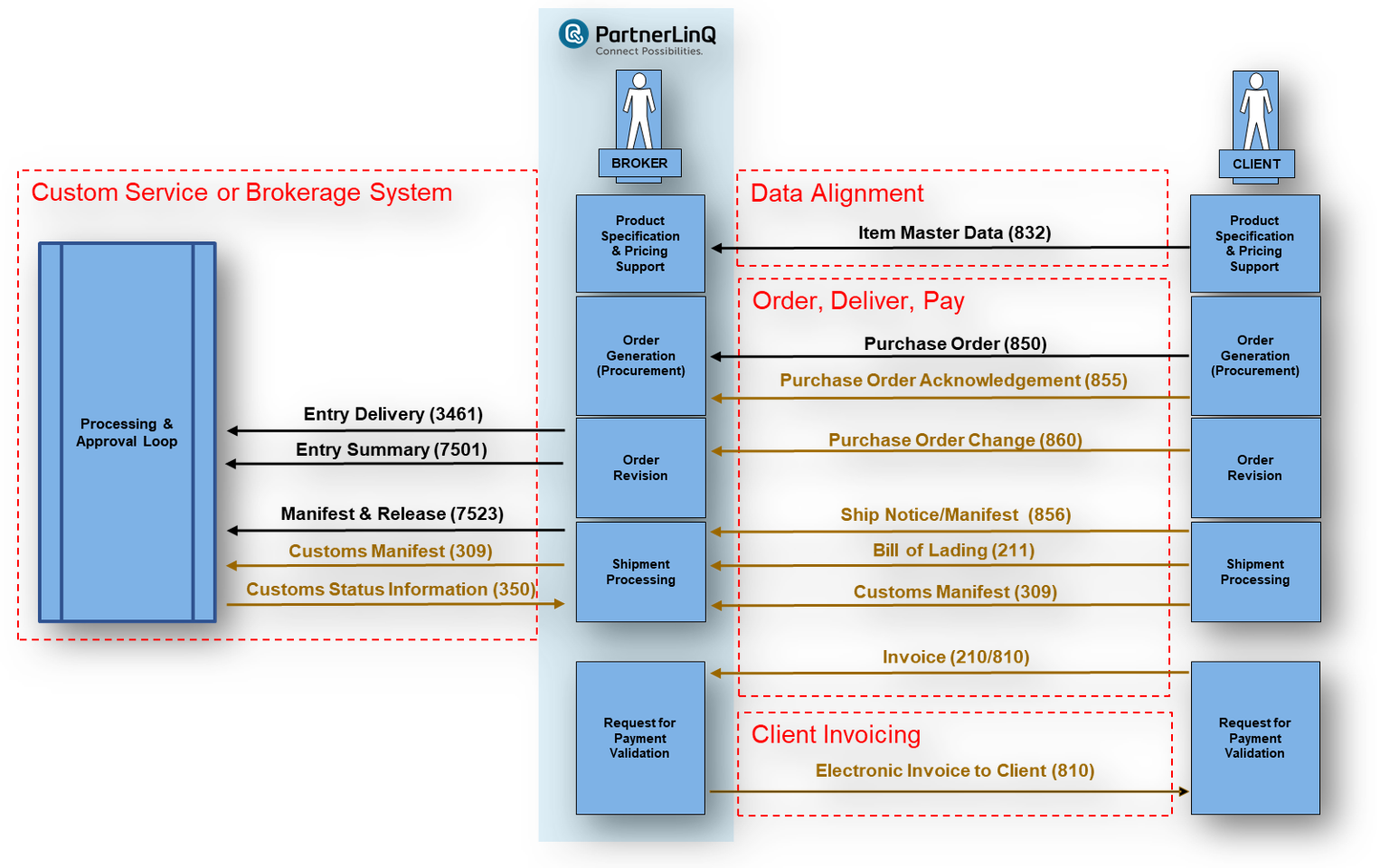
PartnerLinQ uses the EDI 309 Customs Manifest for international trade compliance. The EDI 309 Customs Manifest is exchanged between carriers, customs, and brokers before loading cargo onto a vessel. If filing errors occur, customs (CBP) may reject the manifest, requiring corrections before goods can move.
What responses to the EDI 309 Customs Manifest are expected/sent?
The EDI 309 is paired with responses from customs. Customs authorities may reply with the 350 (Customs Status Information) or 355 (Customs Acceptance/Rejection) transactions. The 353 Customs Events Advisory serves as the final notification, confirming the completion of the manifest cycle.
What does the EDI 309 Customs Manifest support? 
The EDI 309 supports customs clearance operations by ensuring customs authorities (CBP in the US) receive accurate and timely shipment data. It underpins security, compliance, and revenue generation processes for global trade. By digitizing the manifest process, the EDI 309 helps reduce delays, improve visibility, and protect domestic industries.
What are the Key Features of the EDI 309 Customs Manifest?
The US. Customs and Border Protection (CBP) requires key information that the the EDI 309 Customs Manifest provides, for example; the EDI 309 Customs Manifest…
- Provides complete cargo and shipment details
- Enables customs clearance before shipment arrival
- Includes vessel, vehicle, and hazardous material data
- Integrates with 350, 355, and 353 response sets.
- Supports compliance with CBP and international customs
What is the Purpose of the EDI 309 Customs Manifest?
The purpose of the EDI 309 is to transmit customs manifest information electronically to expedite clearance processes, reduce manual paperwork, and ensure compliance with customs regulations.
What Information is Included in the EDI 309 Customs Manifest?
The EDI 309 Customs Manifest 309 typically includes:
- Carrier and voyage details
- Vehicle and equipment identifiers
- Seal numbers
- Insurance information
- Party and location identifiers
- Port and bill of lading details
- Hazardous material descriptions
What are the Essential Components of the EDI 309 Customs Manifest?
Essential Components of the EDI 309 Customs Manifest include:
| Component | Description | Typical Segment(s) |
|---|---|---|
| Message Header & Control | Identifies the transaction and establishes the control number. | ST, M10 |
| Manifest Identification | Provides manifest number, voyage/flight details, carrier SCAC, and customs identifiers. | M10, M13 |
| Conveyance & Transportation Details | Captures vessel, aircraft, truck, or rail conveyance information, including departure and arrival details. | C11, M12 |
| Equipment Identification | Provides container or equipment numbers used in the movement. | VEH, VC, M7 |
| Cargo and Bill of Lading Details | Identifies shipment-level information, including HAWB/MAWB, BOL, weight, quantity, and type of goods. | M11, M12, NM1, N10 |
| Consignee / Shipper / Notify Party Identification | Identifies parties tied to the manifest. | NM1, N3, N4 |
| Commodity & Hazard Details | Describes goods, commodity codes, packaging, hazardous materials information. | M13, H1, H2 |
| Port / Location Information | Specifies relevant customs ports, origin, destination, and transit locations. | P4, NM1, N3, N4 |
| Transaction Trailer | Closes the transaction and provides segment count validation. | SE |
What are the Common Segments Included in the EDI 309 Customs Manifest?
| Segment | Segment Name | Purpose / Usage |
|---|---|---|
| ST | Transaction Set Header | Opens the 309 and assigns a control number. |
| M10 | Manifest Identifying Information | Establishes manifest number, SCAC, and basic customs identifiers. |
| VID | Conveyance Information | Provides vessel/flight/truck/rail data including carrier, voyage number, departure, and arrival information. |
| M10 | Vessel Information | Supplies conveyance characteristics including vessel name, flag, and registration where required. |
| NM1 / N3 / N4 | Name / Address Information | Identifies shipper, consignee, notify party, and customs agents. |
| VEH / VC | Equipment Details | Identifies container or equipment numbers, sizes, and types. |
| M12 | In-bond or Bill of Lading Information | Specifies bill of lading, weight, quantity, and shipment-level details. |
| P4 | Port of Discharge Information | Defines foreign and domestic discharge ports. |
| H1 / H2 | Commodity or Hazardous Description | Provides commodity description and hazardous materials details when applicable. |
| SE | Transaction Set Trailer | Ends the 309 and validates the segment count. |
What Status Codes are used with the EDI 309 Customs Manifest?
Status indicators for the EDI 309 Customs Manifest are reflected through related customs transactions, for example:
- The EDI 350: Status Information (acceptance pending, under review)
- The EDI 355: Acceptance/Rejection (approval or rejection details)
- The EDI 353: End of Manifest notification (completion confirmation)
What Reason Codes are used with the EDI 309 Customs Manifest? 
Reason codes appear in customs responses (e.g., the EDI 355: Acceptance/Rejection message) and may include rationale for rejection, reasons such as:
- Missing or invalid SCAC
- Invalid voyage/flight number
- Incorrect manifest type code
- Mismatched bill of lading number
What Use Cases does the EDI 309 Customs Manifest support?
- Brokers coordinating customs clearance
- Trucking companies handling cross-border freight
- Rail operators reporting on international shipments
- Ocean carriers filing manifests to CBP
What are the Benefits of the EDI 309 Customs Manifest?
- Ensures compliance with customs requirements
- Improves shipment visibility and tracking
- Reduces clearance delays
- Protects domestic industries and revenue generation
How efficient is the EDI 309 Customs Manifest?
The EDI 309 Customs Manifest speeds up customs clearance by digitizing manifest data and automating customs filing, together they speed up tracking and decision-making for carriers shippers, brokers, and CBP making the EDI 309 Customs Manifest a very efficient communication vehicle.
How Compliant is the EDI 309 Customs Manifest?
The PartnerLinQ 309 is modeled after the US. Customs and Border Protection (CBP) EDI 309 Customs Manifest so it meets or exceeds CBP and international customs standards. for partners (e.g., shippers, carriers, and brokers) using rail, ocean, truck, intermodal and/or terminal-based logistics.
What is the Format of the EDI 309 Customs Manifest?
The EDI 309 Customs Manifest follows ASC X12 v4060 standards and uses US. Customs and Border Protection (CBP) messaging constraints, thereby meeting or exceeding most international customs standards for CBP, shippers, carriers, and brokers.
How Accurate is the EDI 309 Customs Manifest?
The EDI 309 as a data carrier is very accurate and its construct ensures standardized manifest reporting, reducing filing errors. It standardizes the data exchange for consistent reporting.
What are the Limitations of the EDI 309 Customs Manifest?
Limitations include strict CBP file size limits, one transaction set per interchange, and uppercase-only alphabetic data. NOTE: Incorrect filings delay shipments until corrected.
Are Guidelines & Sample Files for the EDI 309 Customs Manifest message available?
Sample files and implementation guides are available from PartnerLinQ.
What are the Basic Questions for EDI Integration with the EDI 309 Customs Manifest?
- Are there Samples and Specs available?
- What is the general direction of the transaction?
- Are they Inbound to the client or outbound from the client to another party?
- What response sets (350, 355, 353) are expected or sent?
- Are there Samples and Specs of the response transaction available?
- Are there other interested parties?
- What transactions might these interested parties be a party to?
- How do you handle changes to the Customs Manifest today?
- How are errors corrected in the filing process?
- Is there automation? (an internal systems trigger) or are Customs Manifest changes triggered manually?
What Business Level Workflow does the EDI 309 Customs Manifest?
- Carrier compiles shipment data in TMS/ERP.
- EDI 309 is generated with manifest details (SCAC, voyage, bill of lading).
- File transmitted to customs authority.
- Customs validates and may return 350/355.
- If accepted, shipment clears; otherwise corrections required.
- Process ends with EDI 353 'End of Manifest'.
What are the Best Practices for using the EDI 309 Customs Manifest?
- Validate SCAC, voyage, and manifest codes before submission
- Ensure vehicle and seal numbers are accurate
- Use correct insurance and hazardous material identifiers
- Automate filings where possible to reduce errors
What Transactions are associated with the EDI 309 Customs Manifest?
| Transaction | Name | Relationship to the EDI 309 |
|---|---|---|
| EDI 310 | Freight Receipt and Invoice (Ocean) | Often follows ocean manifest filings; invoicing is triggered after manifest submission. |
| EDI 312 | Arrival Notice (Ocean) | Used to notify importers/agents of cargo arrival based on manifest information found in the 309. |
| EDI 322 | Terminal Operations & Intermodal Ramp Activity | Reflects equipment movements tied to containers on the submitted manifest. |
| EDI 309 → U.S. Customs (ACE/AMS) | Customs Manifest | The regulatory filing itself, submitted pre-arrival. |
| EDI 344 | Customs Shipment Information | Provides detailed customs entry information linked to the data filed in the 309. |
| EDI 350 | Customs Status Information | Used by customs (e.g., US CBP) to communicate shipment status updates to carriers. |
| EDI 353 | Customs Events Advisory | Communicates customs status or acceptance/rejection of manifest data from CBP. |
| EDI 355 | Customs Acceptance/Rejection | Used by customs (e.g., US CBP) to communicate Customs Manifest Acceptance/Rejection. |
| EDI 358 | Customs Consist Message | Used to communicate updates to customs regarding rail/ocean shipments associated with the manifest. |
| EDI 859 | Freight Invoice (Rail) | Rail carriers may pair it with manifest filings for billing against rail shipments. |
| EDI 997 / 999 | Functional / Implementation Acknowledgment | Returned by customs or the carrier's internal gateway to confirm receipt and syntactic acceptance of the 309. |