
What is the EDIFACT HANMOV Message?
The EDIFACT HANMOV (Cargo/Goods Handling and Movement Message) is a standardized EDI message used to communicate instructions, status updates, and reporting, and information for the physical handling and movement of goods within a warehouse or distribution center. Commonly used in ports, terminals, warehouses, container yards, freight stations, and multimodal transport hubs; the EDIFACT HANMOV message directs recipients on how items are identified. The EDIFACT HANMOV then goes on to direct recipients on how items must be prepared, handled, assembled, packed, or moved, to execute operations safely and consistently.
The EDIFACT HANMOV (Cargo/Goods Handling and Movement Message) enables stakeholders to communicate operational actions such as:
- Moving goods between storage locations
- Issuing gate-in or gate-out notifications
- Reporting handling completion or exceptions
- Assigning equipment or transport units (cranes, trucks, forklifts, containers)
- Loading or unloading containers/pallets
How is the EDIFACT HANMOV Message Used?
Trading partners use EDIFACT HANMOV to request or confirm handling activities such as loading, unloading, consolidation, kitting, relabeling, special storage, or hazard‑aware handling instructions. Schedules and events in the sender's WMS/ERP trigger the generation of the EDIFACT HANMOV messages; recipients then perform the action, reconcile the outcome, identify references and identities, and send a response to an activity request in the form of a response message. The EDIFACT HANMOV is one of several messages used to confirm handling activities.
EDIFACT HANMOV vs. X12 940 Warehouse Shipping Order
The EDIFACT HANMOV (Cargo/Goods Handling and Movement) and X12 940 (Warehouse Shipping Order) are both EDI standards used in supply chain and logistics to communicate instructions between trading partners, particularly those involving warehouses or distribution centers.
They do, however, differ in scope, functionality, and regional adoption. HANMOV is part of the UN/EDIFACT standard (widely used in Europe, Asia, and internationally), while the X12 940 is part of the ANSI X12 standard (primarily North American). HANMOV is bidirectional, making it a bit more versatile and capable of covering a broader range of internal warehouse operations beyond shipping; by contrast, the X12 940 is very focused on shipping authorization.
How does PartnerLinQ use the EDIFACT HANMOV Message?
PartnerLinQ uses the EDIFACT HANMOV message as part of its logistics coordination and terminal connectivity transaction layer, enabling real-time visibility and orchestration between shippers, carriers, 3PLs, warehouses, ports, customs, and rail systems.
PartnerLinQ Orchestration exchanges CONTRL acknowledgments to enforce syntactic integrity, then routes EDIFACT HANMOV message intake via AS2 or APIs, validates qualifiers, and enriches operations with dashboards and alerts for missing or late messages.
PartnerLinQ maps EDIFACT HANMOV message instructions to Logistics Service Provider (LSP) warehouse workflows while preserving sender-specific qualifiers and instructions as might be required by the sender.
Digital Handling Instructions: PartnerLinQ converts WMS/TMS/ERP instructions into HANMOV messages (e.g., move pallet to dock door #3, load container ABCU1234567).
Event Automation: PartnerLinQ enables triggered alerting, like when handling is delayed, cargo is misplaced, or exceptions occur (damaged, hazardous, missing units).
 API–EDI Transformation: PartnerLinQ easily transforms WMS, TMS, ERP, and EDI instructions from SAP, D365, Oracle, Blue Yonder, or Manhattan into consumable API-based warehouse instructions that mirror the EDIFACT HANMOV supporting modern Supply Chain technologies for shippers, carriers, 3PLs, warehouses, port, customs, terminals, and rail systems.
How do larger dairy and food products companies use the EDIFACT HANMOV Message?
Larger dairy and food products companies, companies such Lactalis, Danone, Nestle, Aria, Saputo, Schreiber Foods, Kraft Heinz, Müller, and Agropur, often rely on Logistics Service Provider (LSP) warehouses. These larger dairy and food products operations use the EDIFACT HANMOV message to instruct service providers (LSPs) of safe and compliant handling. Messaging may include local product status, notes, and grading codes. Instructions may be at the line or SSCC level, an approach that supports the regulated handling of dairy and food products through terminal and warehouse operations while promoting precise product movements and execution in global supply chain environments.
What responses to the EDIFACT HANMOV message are expected/sent?
EDIFACT messages used to respond to the EDIFACT HANMOV vary by sender requirement, below are some of the most common message variations used today to respond to an inbound EDIFACT HANMOV message:
| Document | Description |
|---|---|
| CONTRL (Functional Acknowledgment) | Confirms the delivery of information and documents any formatting errors or loss of data. |
| APERAK (Operational Acceptance / Confirmation) | Used to confirm acceptance or rejection of the handling instruction at the business level. May also report errors. |
| IFTMIN / IFTMCS (Transport / Movement Confirmation) | Used in response to the EDIFACT HANMOV message when the handling instruction triggers a transport movement. |
| IFTSTA (Status Update) | Used in multimodal operations as a status update message. |
| INVRPT (Inventory / Stock Level Feedback) | Confirms one or more inventory positions after handling instruction has been completed. |
| HANMOV (Response Message) | Used as a response, in some implementations with a different message function code. |
The EDIFACT CONTRL (Functional Acknowledgments) message which confirms the delivery of information and documents any formatting errors or loss of data.
The  EDIFACT APERAK (Operational Acceptance / Confirmation) message is used to confirm acceptance or rejection of the handling instruction at the business level. May also report errors.
The EDIFACT IFTMIN / IFTMCS (Transport / Movement Confirmation) message, used in response to the EDIFACT HANMOV message when the handling instruction triggers a transport movement.
The EDIFACT IFTSTA (Status Update) message is typically used in multimodal operations like port, customs, and rail systems as a status update message to describe a container/pallet's entry and exit from a terminal or port (e.g., gate-in’, ‘gate-out’) while loading or unloading, assigning equipment or transport units (cranes, trucks, forklifts, containers), confirming milestones (e.g., unloading complete, unloading, loading in progress, goods repacked, re-labeled, etc.).
The EDIFACT INVRPT (Inventory / Stock Level Feedback) message, which confirms one or more inventory positions after handling instruction has been completed (e.g., embargo, quarantine, blocked, repack, consolidation, after kitting).
The EDIFACT HANMOV (Response Message). Used in some implementations, the HANMOV is also used as a response, with a different message function code (e.g., BGM030 = 29 = “Accepted” or 27 = “Not Accepted,” etc.).
What does the EDIFACT HANMOV message support?
The EDIFACT HANMOV message supports the handling and movement of goods within Logistics Service Provider (LSP) warehouses or distribution centers. A scope limited to activities under the control of a single distribution center and applicable to both national and international trade. The EDIFACT HANMOV message purposefully excludes manufacturing processes and direct transport outside the center's jurisdiction (e.g., seller-to-buyer delivery), it requests or confirms handling activities like loading, unloading, consolidation, kitting, relabeling, special storage instructions, and reporting.
Instructions: The EDIFACT HANMOV message is sent from an ordering party (e.g., customer or supplier) to a warehouse or logistics provider, specifying required handling services and goods movements.
Responses (Status Report): The EDIFACT HANMOV message is sent from the warehouse or provider back to the ordering party, confirming execution, progress, exceptions, or completion of requested/required services.
What are the Key Features of the EDIFACT HANMOV message?
The message supports explicit handling instructions, qualified dates and periods, party and location context, item identification, package hierarchy, and identity numbers such as SSCC. Guidance includes service segments, qualifiers, and partner additions for operational precision.
What is the Purpose of the HANMOV?
The message standardizes communication of warehouse and terminal handling requirements so receivers can execute actions consistently and confirm compliance across partners, sites, and systems.
What Information is Included in the HANMOV?
Typical content includes message control numbers, document function, dates and times, parties and references, item and package details, identity numbers, locations, handling instructions, *(including free‑text clarifications where agreed), and a message trailer with control information.
What are the Essential Components of the HANMOV?
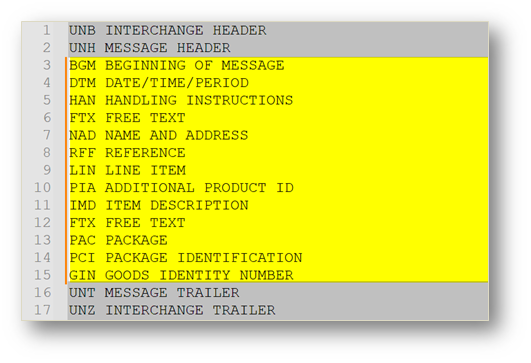
While not always mandatory, essential components cover service segments, headers, dates, handling instructions, party and reference groups, item and description, packaging hierarchy, identity numbers, locations, and trailer controls. Segment notes follow based on D.96A usage.
| Segment | Essential Notes |
|---|---|
| UNH – Message Header | Header that identifies the message and reference control type = HANMOV. |
| BGM – Beginning of Message | Indicates type, number, and function. |
| DTM – Date/Time/Period | Specifies document dates/times, ISO formats supported. |
| HAN – Handling Instructions | Specifies coded or textual instructions for how goods should be handled, moved, stored, or transported. |
| FTX – Free Text | Not recommended - provides agreed freeform notes, grading codes, or local statuses; controlled use. |
| NAD – Name and Address | Identifies relevant parties, including Logistics Service Provider (LSP) warehouse and delivery locations. |
| RFF – Reference | Carries handling or movement reference numbers; partner qualifiers may extend codes. |
| LIN – Line Item | Identifies the item being handled or the resulting item after assembly/disassembly. |
| IMD – Item Description | Describes product where codes are insufficient. |
| CPS – Consignment Packing Sequence | Defines hierarchical packing relationships. Used to model physical structure. |
| PAC – Package | Provides the count and type of packages under CPS. |
| PCI – Package Identification | Specifies marks and labels used on packages. |
| GIN – Goods Identity Number | Provides identifiers such as SSCC, serial, and batch for handled packages. |
| LOC – Place/Location Identification | Indicates site, warehouse, zone, or bin for handling activities. |
| UNT – Message Trailer | Ends the message and provides control totals and reference. |
What are the Common Segments Included in the HANMOV?
Common header segments include UNH, BGM, and DTM. Common operational segments include HAN for instructions, FTX for agreed notes, NAD and RFF for context, LIN and IMD for items, CPS/PAC/PCI/GIN for hierarchical packages and identities, LOC for locations, and UNT for control.
Common Segment use cases reflect typical warehouse and terminal handling processes documented in PartnerLinQ guidance, reflect D.96A usage and include larger dairy and food products use cases.
| Tag | Level | Purpose | Usage | Rep |
|---|---|---|---|---|
| UNH | Header | Identify message as HANMOV; set reference | Mandatory | Once |
| BGM | Header | Document number and function | Mandatory | Once |
| DTM | Header | Document date/time and periods | Must use | 1..9 |
| HAN | Detail | Coded handling instructions | Conditional (often required) | 0..9 |
| FTX | Detail | Agreed free text (grading/local status) | Conditional | 0..9 |
| NAD | Party | LSP and ship/deliver parties | Mandatory in SG3 | Per party |
| RFF | Party Ref | Handling/movement reference | Mandatory in SG4 | Per ref |
| LIN | Item | Item being handled | Mandatory in SG7 | Per item |
| IMD | Item | Item description | Conditional | 0..99 |
| CPS | Pack | Packing hierarchy link | Used | Per hierarchy |
| PAC | Pack | Package count/type | Mandatory in SG11 | Per hierarchy |
| PCI | Pack | Marks/labels | Mandatory in SG12 | Per package |
| GIN | Pack | SSCC/serial/batch IDs | Conditional | 0..9 |
| LOC | Loc | Handling location/bin | Conditional | As needed |
| UNT | Trailer | Segment count/control | Mandatory | Once |
What Status Codes are used with the HANMOV?
Status information travels primarily through handling qualifiers, local status notes, and condition codes carried by HAN, STS (where applicable), and FTX subject qualifiers. Examples include damaged, quarantine, customs refusal, or local warehouse statuses communicated for action.
What Reason Codes are used with the HANMOV?
Reason codes qualify handling actions or variances: why a rework occurred, why a package was relabeled, or why a move was refused. Trading partners define code lists in guidelines; Danone‑specific qualifiers appear in BGM, DTM, NAD, RFF, and FTX.
What Use Cases does the EDIFACT HANMOV Message support?
Use cases reflect typical warehouse and terminal handling processes documented in PartnerLinQ guidance.
| Use Case | Description |
|---|---|
| Loading/Unloading Operations | Carriers and terminals receive instructions for safe loading or unloading with location and time qualifiers. |
| Consolidation/Deconsolidation | Warehouse teams consolidate packages under CPS and PAC; SSCCs tracked with GIN. |
| Rework/Relabel | Handlers perform rework steps or apply new labels; marks and labels described with PCI and identities with GIN. |
| Kitting/Assembly/Disassembly | Operations convert or assemble items; resulting items identified under LIN with descriptions under IMD. |
| Hazard‑Aware Handling | Special handling and storage instructions transmitted under HAN and supported by FTX subject and free text. |
What are the Benefits of the HANMOV?
Benefits for Operations:  Operations gain standardized instructions, improved safety, faster execution, reduced mis‑handling, and traceable package identities across partners and sites.
Benefits for Senders: Senders gain operational efficiency through automation. Automation that can be used by WMS/ERP triggers in the generation of the EDIFACT HANMOV messages to send instructions to Logistics Service Provider (LSP) warehouse operators while preserving sender specific instructions as might be required.
Benefits for Receivers: The EDIFACT HANMOV message standardizes communication of warehouse and terminal handling requirements so receivers can execute actions consistently and confirm compliance across partners, sites, and systems in the form of a response message.
How Efficient is the EDIFACT HANMOV?
Efficiency comes with increased use, the EDIFACT HANMOV message improves operations for senders and receivers when event‑driven messages are aligned with WMS and operational tasking. CONTRL documents, acknowledgments, response transactions, and exception reporting (dashboards) ensure visibility and control.
How Compliant is the HANMOV?
Compliance strengthens when code lists and qualifiers drive actionable intelligence (handling), while service segments and MDN/CONTRL documents provide auditability for exchange integrity.
What is the Format of the EDIFACT HANMOV (Cargo/Goods Handling and Movement Message)?
The EDIFACT HANMOV (Cargo/Goods Handling and Movement Message) conforms to UN/EDIFACT D.96A with service segments UNB/UNZ and UNH/UNT; PartnerLinQ uses UNA:+.?' and generates CONTRL functional acknowledgments.
How Accurate is the EDIFACT HANMOV?
Accuracy depends on the sender’s ability to provide clear and concise instruction made possible by reliable identities such as SSCC in GIN, precise locations in LOC, correct party identifiers in NAD, and through handling qualifiers in HAN.
What are the Limitations of the EDIFACT HANMOV?
The EDIFACT HANMOV standard does not define business acceptance or confirmation; partners tend to use a mix of complementary messages or APIs to confirm receipt and activity. Local code lists and free‑text usage is widespread and requires internal governance to avoid ambiguity and compliance issues.
Are Guidelines & Sample Files for the EDIFACT HANMOV (Cargo/Goods Handling and Movement Message) available?
Yes. PartnerLinQ provides sample EDIFACT HANMOV Transaction and implementation guides are available through its Support and Guideline Management Team.
Sample implementation guides illustrate both inbound and outbound flows, segment layouts, and valid data examples and support testing and partner onboarding. Customized specification documents for use in on boarding and technical development are available upon request.
PartnerLinQ provides:
- Transaction implementation guide
- Sample payloads
- Qualification and testing maps
- Error handling and best-practice notes
What are the Basic Questions for EDI Integration with the EDIFACT HANMOV message?
Use cases reflect typical warehouse and terminal handling processes documented in PartnerLinQ guidance and executed with the EDIFACT HANMOV (Cargo/Goods Handling and Movement Message)
- Are there Samples and Specs available?
- What EDI version and standard will be used?
- What is the general direction of the transaction?
- Are they Inbound from or outbound to another party?
- Which acknowledgments (MDN/CONTRL) are required?
- What response is expected or sent in response to the transaction?
- Are there samples and specs of the response transaction available?
- Are there other parties interested in the EDIFACT HANMOV Message?
- What transactions might these interested parties be a party to?
- Are there distinct types of EDIFACT HANMOV messages that need to be tracked or handled differently?
- Are there any business rules that should be considered when processing an EDIFACT HANMOV message? (e.g., invalid/missing item or customer identification number)
- Do Batch or Lot numbers need to be tracked?
- Is there product serialization?
- Are products consolidated and presented as single line items, or are sublines involved?
- How are changes to the EDIFACT HANMOV business message managed today?
- Is there automation? (an internal systems trigger) Or are EDIFACT HANMOV messages triggered manually?
- Are responses and changes automatically triggered? (an internal systems trigger) Or do transactions require human intervention?
- Which handling instructions and code lists will be supported?
- Which parties and locations are required for execution?
- Which identity numbers (SSCC, serial, batch) must be included?
- Which references must be echoed to reconcile tasks?
- Which schedules or events will trigger messages?
What Business Level Workflow does the HANMOV support?
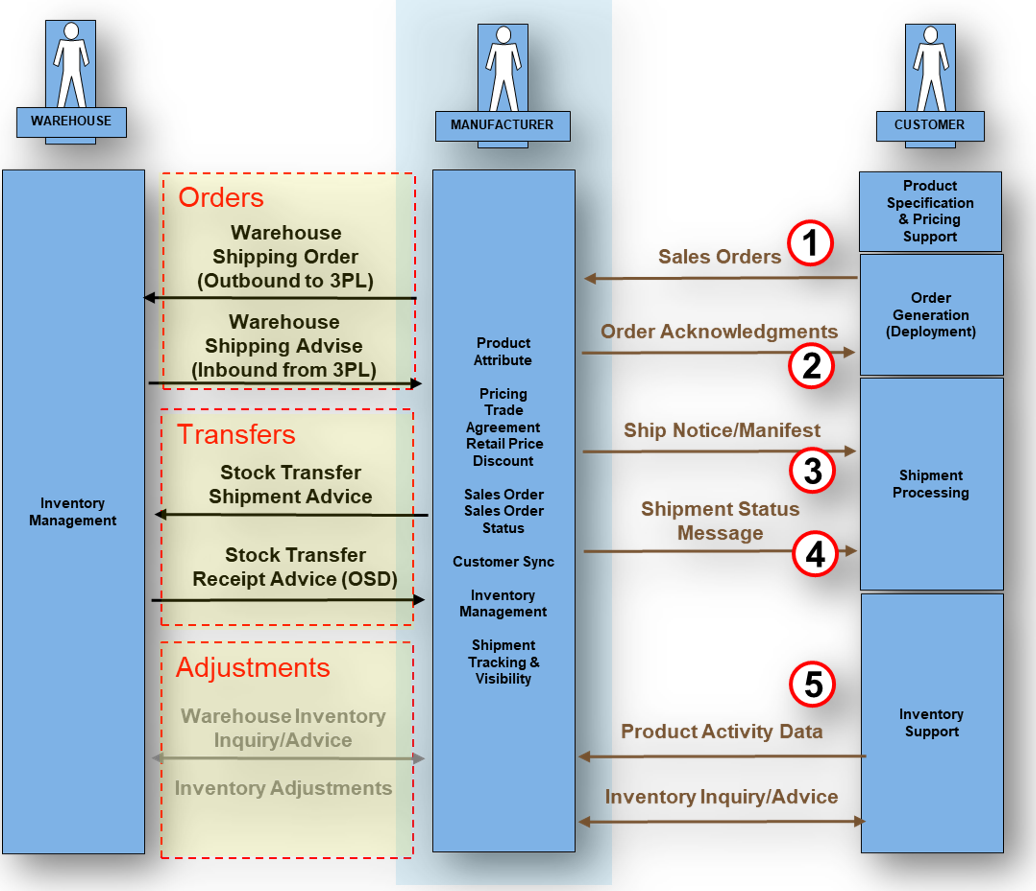
The typical workflow begins as a planned event or event‑driven trigger, proceeds through instruction preparation in a WMS/ERP, maps to D.96A segments, transmits via AS2 or API, generates CONTRL, and posts tasks and exceptions to dashboards for execution and reconciliation.
What are the Best Practices for using the HANMOV?
Best Practices reflect PartnerLinQ implementation guidance for handling operations.
| Practice | Recommendation |
|---|---|
| Use precise qualifiers | Align handling codes and subjects to partner code lists. |
| Minimize free‑text | Prefer coded instructions; use FTX only by agreement. |
| Model hierarchy | Represent package structures with CPS/PAC and label with PCI. |
| Track identities | Include SSCC and serials with GIN wherever applicable. |
| Governance (codes) | Publish local code lists and responsibilities. |
| Control exchanges | Enable MDN/CONTRL and monitor dashboards. |
What Transactions are associated with the HANMOV?
Associations vary by party and flow; CONTRL and MDN support exchange integrity.
| Transaction | Role |
|---|---|
| CONTRL | EDIFACT functional acknowledgment of syntax/receipt. |
| APERAK | Confirm acceptance or rejection at the business level. |
| IFTMIN / IFTMCS | Used when the HANMOV instruction triggers transport movement. |
| IFTSTA | A status update message used in multimodal operations. |
| INVRPT | Inventory visibility before/after handling operations where relevant. |
| DESADV | Despatch advice is used when movement results in shipment. |
| ORDERS/ORDRSP | Ordering and response context around work creation. |
| HANMOV (Response) | The HANMOV used as a response, with a different message function code. |



Explore Our Integration Solutions

PartnerLinQ Integration Solutions
Connect Everything. Integrate Intelligently.
Future-Proof Your Business with Composable, AI Powered Connectivity.